George Krause
The Good ShepherdGeorge Krause is a United States Navy commander whose authority extends beyond the destroyer Keeling: he is responsible for the convoy and the escort force protecting it. During the submarine campaign, his defining task is to make decisions with incomplete information while rationing ships, fuel, weapons, and human endurance. The narrative sets his professional effectiveness against a private life marked by estrangement and regret, and repeatedly makes victory inseparable from the deaths it entails.
Identity and Command
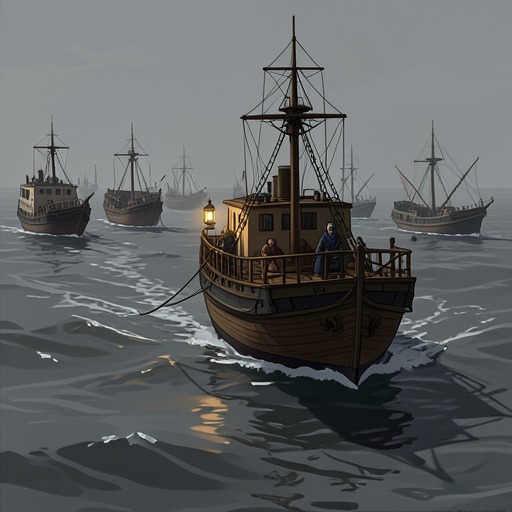
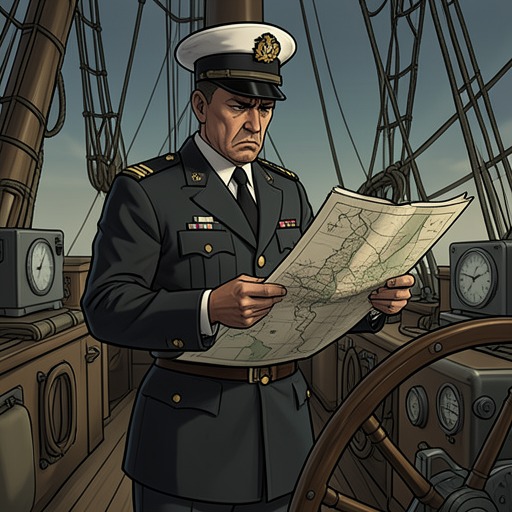
At forty-two, Krause is the captain of Keeling, a fifteen-hundred-ton Mahan-class destroyer commissioned in 1938, and the commander of the convoy’s escort. Nearly two thousand people are aboard the convoy, with more than eight hundred in its four destroyers and escort vessels. Those numbers make his responsibility concrete, but the narrative measures it in more than lives or the stated value of the cargo. The tanker Hendrikson carries oil whose arrival in England could provide an hour of steaming for the entire British Navy. Krause’s own physical condition matters for similarly practical reasons: his ability to reach the bridge quickly and remain there through exertion is part of the convoy’s protection.
His character is presented as operationally consequential rather than as background biography. Krause is the son of a Lutheran minister, was brought up devoutly, and is familiar with the Bible. He also regards himself impersonally, as someone whose body is to be employed in the performance of duty. That separation between the man and the function he serves helps explain both his discipline and the difficulty with which fatigue and private grief reach him.
Judgment Under Constraint
Krause’s decisions are shaped by the limits of the escort as a whole. When a contact may indicate a U-boat several miles from the convoy, he weighs the possibility of destroying it against the danger of detaching one of the few ships needed to screen the convoy. James would have to spend fuel accelerating toward the contact and then returning, while the convoy continued on without her. The escort has only a small fuel reserve, and a ship absent from station would leave gaps through which other submarines might pass. Krause nevertheless grants permission to attack: an undisturbed U-boat could report the convoy’s position, track it, or help bring a wolf-pack against it. He decides without pretending that the uncertain contact offers a guaranteed opportunity.
His restraint in sounding general quarters follows the same logic. Keeling is already at Condition Two, with much of the crew at battle stations and watertight integrity maintained. Calling the whole ship to general quarters would suspend routine work, deprive men of rest and meals, and consume a reserve of readiness better kept for a decisive emergency. Krause also knows that repeated alarms without clear necessity can make sailors slacken their response. When Carling waits for his decision, Krause declines the alarm in seconds, relying on professional habit and prior consideration rather than a spoken review of every factor.
The care behind that restraint extends to the ship’s daily operation. Krause inspects the seven lookouts, each responsible for a sector and required to keep searching despite spray and monotony. A U-boat may expose only a small part of its periscope briefly; regular attention can make the difference between an early warning and an unseen attack. He checks their work even while Carling is occupied with taking Keeling to her station, and then returns to the wheelhouse because he must remain available to direct the escort over the T.B.S. His attention moves from convoy formation to the lookouts, from the lookouts to the radio, and back to the larger tactical picture.
Battle, Rescue, and the Cost of Victory
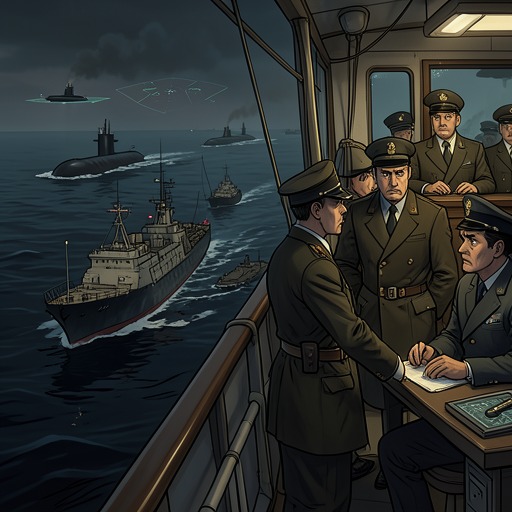
Krause’s command requires choices between dangers that cannot all be answered at once. During a night attack, he and Viktor are in contact with one submarine while another attacks the convoy. He recognizes that pursuing the contact may mean leaving sailors aboard damaged ships without immediate help; abandoning the hunt, however, offers no assurance that Keeling can find the other attacker. He judges that the second submarine has already done its damage for the moment and continues the existing pursuit. The decision is presented as a burden of command, not as indifference to the men under attack.
In another encounter, a sudden close-range contact turns into a direct attack. Krause orders Nourse to fire as the U-boat and Keeling converge. Later, the submarine surfaces almost alongside Keeling, too close for the depth-charge weapon and too low for the five-inch gun to bear; the 40 mm guns also cannot depress sufficiently. A machine gun comes into action only after the submarine has submerged again. Its repeated appearances in Keeling’s wake suggest that a bow-plane may be jammed, though the cause remains uncertain: it may be mechanical failure or damage from a depth charge. The scene shows how quickly an engagement can pass beyond the reach of the weapons on which a captain has relied.
When Keeling sinks a U-boat, Viktor reports the sound of its destruction. Krause has achieved an objective for which he has trained for more than twenty years, but the news brings no uncomplicated triumph: the submarine’s crew of fifty has died. He is briefly silent, conscious both of the professional success and of the human cost attached to it. Later, after Keeling has been struck in a separate engagement, he tells the crew that Dodge has picked up a survivor, that Keeling hit the enemy repeatedly with its five-inch guns, and that the ship has lost members of its own company. He frames those losses as occurring in the line of duty and insists that the ship must continue. His speech is difficult to give, and the effort reveals how little room battle leaves him to process grief before the next task begins.
Krause’s choices about rescue also test the relationship between humanitarian concern and the convoy’s survival. After a merchant ship is destroyed, Keeling encounters at least one survivor on wreckage or a raft, while Cadena is already a mile away. Turning Cadena back could bring the rescue vessel within a submarine’s reach and might still fail to locate the small object in the water. Krause weighs those risks against the value of the survivors, the safety of his own ship, and the effect that abandoning them could have on his crew and Allied solidarity. He orders Keeling around to return. The decision does not erase the danger; it commits the ship to a rescue attempt because the lives at stake and the consequences for the crew’s sense of duty matter too.
Endurance, Crew, and Private Loss
Krause’s concern for the crew is practical as well as moral. Keeling’s new weapons and instruments require more operators, crowding an already strained living space, while the ship lacks enough trained ratings to sustain three watches at Condition Two. He divides the company into four sections and arranges watch-and-watch duty. He also cancels routine general quarters for a watch, allowing the watch below four hours of rest unless an emergency occurs. The choice preserves what capacity the crew has; it does not remove the strain of prolonged readiness or make the ship’s shortages disappear.
That strain accumulates in Krause himself. After roughly thirty hours with very little sleep, he nearly falls from his stool when drowsiness overtakes him. He is shocked by the lapse and treats it as a warning, then stands rather than risk falling asleep again. His legs and feet hurt, but he rejects the idea of going to his cabin for slippers because he believes a captain should remain an example at his post. On another occasion, hunger and thirst return to his attention when Watson accidentally kicks Krause’s forgotten tray of sandwich and coffee. Such details do not interrupt the command narrative; they show the body that its commander tries to subordinate to duty, and the costs of maintaining that discipline.
The personal history that breaks through this routine concerns Evelyn. During a period of fatigue, Krause remembers their quarrels over the time he spent aboard ship and his inability to explain the force of his professional obligations. Their marriage lasted two years, with only a brief period of happiness. Evelyn was surprised that he prayed sincerely morning and night, and frustrated when he would not leave shipboard duties to his executive officer in order to attend a party. Krause believes she was justified in tiring of him, yet the memory of her and her young San Diego lawyer remains acutely painful. The adverse service evaluation, “Fitted and retained,” carries great weight for him but little meaning for Evelyn, marking how differently their lives registered the same demands on his career.
Changing Responsibilities and Narrative Significance
Krause’s command is not a sequence of isolated acts of bravery but an ongoing allocation of responsibility. He has to decide when to detach an escort, when to preserve a fuel reserve, when to summon the whole crew, when to spend scarce weapons, and when to leave one danger in order to address another. After Keeling has expended thirty-four depth charges in a pattern that brings the total to thirty-eight, Krause learns that only six remain; more than seven tons of explosives have been used in the preceding twenty-four hours. Because the area searched by a depth-charge pattern depends on the square of the number of charges, reducing a pattern sharply reduces the chance of a hit. Yet a single charge may still force a submarine to evade and interrupt its attack. Krause therefore orders single charges rather than spend the remaining supply in full patterns, preserving the chance to keep the submarine down and comparatively harmless while the convoy passes.
The same discipline governs his return to the wider escort mission. When he judges that there is little more to gain by remaining astern of the convoy, he orders Keeling to rejoin the struggle taking place ahead, directing Carling to take the ship around the convoy’s left flank at the best practicable speed. Later, when the Commodore reports that Viktor has been hit somewhere astern, Krause turns Keeling back to help and orders flank speed. The movement from convoy protection to pursuit, from pursuit to rescue, and then back toward an endangered escort ship makes his responsibility relational: he commands Keeling, but his decisions remain bound to the ships and people whose safety depends on one another.
The novel’s portrait of Krause rests on the tension between control and vulnerability. He does not possess certainty, inexhaustible resources, or freedom from grief. Instead, he repeatedly acts with incomplete information, attends to the endurance of his crew, and accepts that a decision may expose some people to danger in order to protect others. His victories are measured alongside enemy deaths, his rescue decisions alongside tactical risk, and his insistence on continuing alongside the bodily and emotional exhaustion that threatens his capacity to command.