James
The Good ShepherdJames, the corvette addressed over the T.B.S. as Harry, is a small but consequential part of the convoy’s four-ship escort screen. Her pursuit of a distant contact draws her away from station and into a prolonged night action; the resulting shortage of fuel and depth-charges turns her continued service into one of Krause’s most difficult resource decisions. By the end of the passage she is among the ships following Keeling, still needed as the convoy approaches the end of its escort passage.
Identity and Position in the Escort
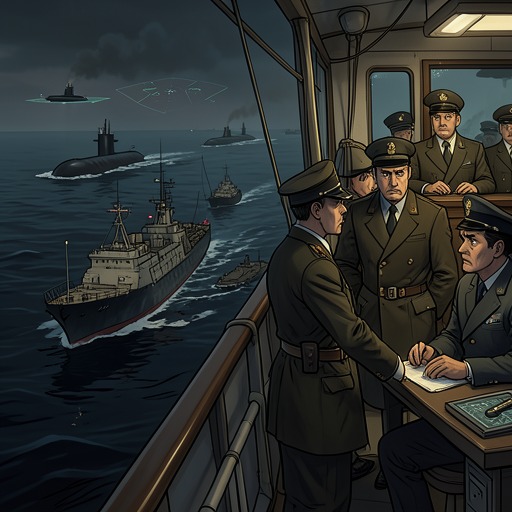
James is first placed three and a half miles beyond Viktor, which itself lies three and a half miles to port of Keeling. She is on Viktor’s quarter, considerably aft, and from Keeling’s pilot-house can be only just seen around the superstructure; when the ships drop into the trough between waves, she disappears altogether. Her callsign, Harry, identifies her in the brief, practical language of ship-to-ship communication. The distance that makes her hard to see also matters tactically: she is far enough from the convoy that an operation in pursuit of a contact may leave a widening gap in the screen.
James has already turned north away from the convoy when Krause learns that she is following a contact. The report gives a bearing of three-five-five and asks permission to attack, but it does not establish that the contact is a U-boat. Krause must therefore decide under uncertainty, rather than respond to a confirmed enemy. A course change due in fourteen minutes would turn the convoy away from the suspected submarine, supporting the cautious option of leaving it alone. Yet a submarine allowed to escape could report the convoy’s presence and movements by radio, or track it and summon other U-boats. James’s contact thus raises stakes beyond the possibility of a single engagement.
Detachment, Contact, and Communication
Krause’s hesitation is shaped by the thinness of the escort. Four fighting ships are just sufficient, when in station, to cover the convoy’s immense front with sonar searches. Detaching one or two risks leaving gaps through which other submarines might pass. James’s own fuel use compounds that danger: she must build speed to search away from the convoy, may remain out for hours, and will then need to overtake a convoy continuing on its course. In the heavy sea her maximum speed is estimated at no more than sixteen knots; even a prompt recall would require about half an hour at maximum fuel consumption to regain station. Each further delay makes the return longer still.
The demand for a decision is conveyed through clipped reports and calls on the T.B.S. Nine minutes after James has peeled off, Krause calculates that she must be more than three miles from station and asks how the contact is developing. The communication keeps a distant operation under the escort commander’s control, but cannot remove the uncertainty about what James has detected or how long she can remain away. Later, when the sonar report aboard Keeling gives no contact, Krause directs Harry to patrol the port half while Dicky takes the starboard half. James is therefore not simply pursuing independently: her movement forms part of a wider allocation of search areas among the escort ships.
At another critical point, James reports radar pips bearing zero-nine-one at a range of ten miles, two returns that appear to be submarines. The report widens the immediate picture from one uncertain contact to possible multiple threats. During the night pursuit, James is on the left flank, firing star-shells; lookouts report gunfire in that direction while Dodge fights off attackers on the right. The convoy continues eastward through the darkness as the escort’s separate actions unfold around it. James’s position on the flank makes her part of a coordinated struggle rather than a solitary chase.
The Cost of Prolonged Action
James’s endurance becomes explicit in a signal to Comescort beginning with the fact of prolonged action during the night. She is down to the danger point in fuel and has only nine depth-charges left. Krause recognizes the peril of keeping her: at economical speed she could reach Londonderry safely, whereas further service with the escort could leave her helpless and exposed. But she still has military value. Her guns could just out-fight a submarine on the surface; even single depth-charges, used at the right moments, could keep an enemy away from the convoy; and her sonar could guide Keeling or Viktor toward an attack. Its steady pinging might itself deter a listening submarine.
Krause’s reply orders James to carry on using the utmost economy in fuel and ammunition. He writes that the escort cannot spare her, then deliberately strikes those words out rather than transmit them: they could sound like a response to an appeal James has not made. The episode shows the distinction between an operational decision and the way it is communicated. Krause retains the ship because her contribution may protect the convoy, but takes care not to imply that her captain has asked to be released. His order preserves the escort’s strength while leaving James’s limited resources unmistakably in view.
The depletion continues. In a later report James has only three depth-charges and fuel for thirty-one hours. The assessment that reaching Londonderry will be a tight squeeze makes the cost of the earlier decision concrete: continued participation has brought the ship closer to the limit of her independent capacity. James answers that she might just make it, though the prospect remains uncertain. The figures are not abstract bookkeeping; they define how much further the ship can serve and how narrow the margin is between completing the passage and becoming a ship in need of help herself.
Handoff and Narrative Significance
As the convoy nears the point at which its escort duty can be handed over, Krause orders Dodge and James informed of the Admiralty message. He had been unable to raise them the previous night because they were too far away; both have apparently received the signal and decoded it, despite the mild breach of orders involved. Their responses carry an apologetic hesitation, and Krause’s exchange with them acknowledges that they have understood the same information. James is thus still operating at a distance, but remains connected to the command through the fragile chain of signals that has governed her detached actions throughout.
The final report of James’s condition—three depth-charges and thirty-one hours of fuel—makes clear that her place in the escort has been costly. Nevertheless, when Krause gives the order to form column astern of Keeling at thirteen knots on course zero-eight-seven, James is among the ships instructed to follow. The convoy’s transfer toward the relieving force closes her immediate passage with the escort, not with a return to comfortable reserve but with her remaining capacity already sharply reduced. In the narrative, James embodies the escort’s recurring trade-off: every ship kept in the screen adds protection, yet every hour of pursuit and every weapon expended narrows the options left for the next emergency.