Judgment under incomplete information
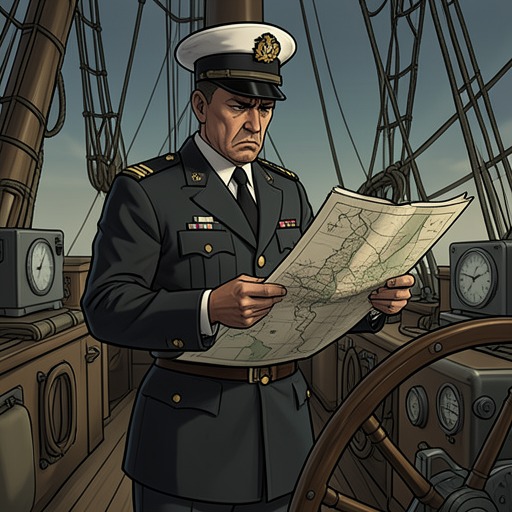
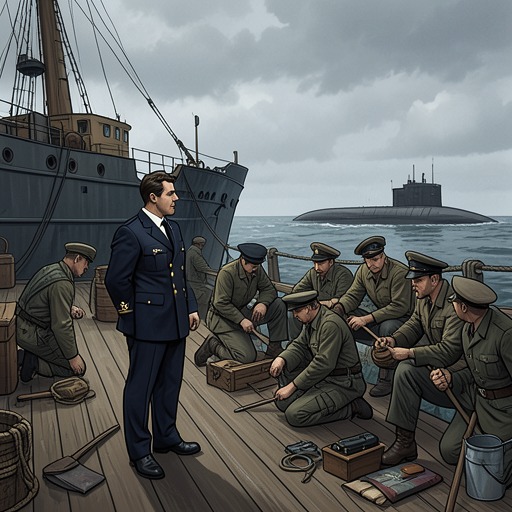
The Good ShepherdDecision-making under uncertainty shapes George Krause’s command of the convoy: he must choose before reports are complete, distinguish a credible threat from a misleading indication, and preserve enough strength to meet whatever comes next. His calculations are not abstract exercises. A decision to pursue can thin the escort screen, consume scarce fuel, and expose tired crews; a decision to hold back can leave a U-boat free to report the convoy’s position or summon others. As evidence arrives, Krause revises his judgments, but the narrative never lets incomplete information become perfect knowledge.
A Contact, and the Cost of Acting
When James reports a distant contact bearing three-five-five and asks permission to attack, Krause has seconds to weigh a cluster of connected risks. On the convoy’s current zigzag leg, the bearing places the possible U-boat forward of the port beam. James is already three miles to port; if it detaches to search, it may be absent for hours and then need to regain the convoy at high speed. That would consume part of the small fuel reserve that Krause wants available for a crisis. It would also weaken a screen whose four fighting ships are just sufficient to cover the convoy when properly stationed.
Yet the contact cannot simply be dismissed. If the submarine escapes, it may radio German U-boat Command with the convoy’s position, observe its course and speed, and help bring a wolf-pack against it. Even keeping the submarine submerged while the convoy moves away could make it harder for her to find the ships again. The decision therefore has competing costs: committing an escort may open gaps to other attackers, while refusing to act may preserve the screen but allow a potential attacker to guide further danger toward it. Krause’s prior thinking has prepared him to recognize the factors, but no preparation can make this precise combination of bearing, fuel, convoy position, and timing fully predictable.
The pressure is also institutional. Krause is an American officer commanding an Allied convoy and officers from other navies whose wartime experience exceeds his own. He understands that a reckless order or an overcautious refusal may invite criticism across national lines, with consequences for Allied goodwill. Those possibilities increase the weight of his responsibility, but do not decide the tactical question for him. The point is not that he can calculate every consequence; it is that he must separate considerations that bear on the decision from those that merely make it harder to carry.
Signals, Ambiguity, and Changing Assessments
Reports reach Krause through channels that differ in reliability and speed. Sonar is inconsistent: James’s contact may be a submarine, but it may instead be a school of fish or a layer of water at a different temperature. Viktor’s difficulty obtaining a cross-bearing leaves the contact less securely established. Later, a high-frequency direction-finding report gives a foreign transmission bearing zero-eight-seven at a range of fifteen to twenty miles. That indication is more positive than James’s possible sonar contact, and Krause orders the escort to run it down. The change in response follows a change in evidence, not a sudden disappearance of uncertainty.
A searchlight message from the Commodore illustrates another limit. The signal is transmitted too quickly for Krause to read comfortably, while the signallers record it without difficulty; their acknowledgment confirms receipt, but the exchange also makes visible the uneven distribution of information and expertise aboard ship. An Admiralty warning later reports an enemy concentration near Keeling’s position and recommends a radical course change southward. The message is already two hours old. Even if it reaches Krause, the convoy cannot turn instantly: orders must pass to the Commodore and then be conveyed and understood across the ships, while a large formation must maneuver without falling into disorder. Information can be accurate and still arrive too late to be used as intended.
Krause also resists treating a submarine’s disappearance as proof of any single explanation. The U-boat may have seen Keeling first because visibility differed by direction; she may have radar, have been warned of the convoy’s position, or have submerged as she crossed its path. A routine dive, crew exercise, or even the need to prepare a meal in rough surface conditions remain possible explanations. The account keeps these possibilities open rather than resolving them with hindsight. Krause’s immediate operational conclusion is narrower: a submarine is under the surface ahead, and the next decision cannot wait for certainty about why she dived.
Search, Delay, and the Limits of Prediction
The search problem turns uncertainty into geometry and time. Krause maintains flank speed to bring Keeling within sonar range. The submarine’s last known position is fixed, but her course and speed below the surface are not. In ten minutes she could travel a mile; the area in which she might be found expands rapidly, from a search zone of several square miles to one that could cover a hundred square miles in an hour. Krause assumes that she is most likely to continue the course she was following on the surface, since that course would bring her toward the convoy, but he recognizes that a different heading could make a one-ship search nearly hopeless.
He nevertheless judges an attempt to regain contact worthwhile. If both vessels maintain their courses, Keeling should cross the submarine’s path in a little over ten minutes and can search without remaining away from the screen for much longer. The alternative is to return to the escort position and wait for the U-boat to approach. This is not a choice between certainty and danger, but between two uncertain forms of defense: seeking the submarine now or preserving the possibility of intercepting her later.
The sonar operator adds a human limit to the technical one. Tom Ellis has listened to pings during months at sea, but his brief training at the Key West Sound School gave him little practice in detecting and interpreting an enemy submarine’s echo. The difference between a depth-charge landing ten yards from its target and one landing twenty yards away may decide success or failure, and a sonar report depends on rapid, delicate judgments from a single operator. Krause cannot know in advance whether Ellis will recognize the echo or how pressure will affect his work. The equipment’s information is therefore inseparable from the training and concentration of the person using it.
Once contact is made, the submarine’s maneuverability and the delay between a change underwater and a report reaching Keeling’s captain repeatedly complicate pursuit. A contact at the expected position supports Krause’s earlier deductions, but does not settle whether the U-boat has released bubbles, turned, or begun moving slowly across Keeling’s bows. Later, the submarine turns away while Keeling is still swinging after her; she regains distance before the destroyer can come around. The information available aboard Keeling is limited and slow, while the opposing captain can exploit that lag. Krause must act on bearings and ranges that describe where the submarine was, not necessarily where she is.
Readiness, Reserves, and the People Behind Decisions
Uncertainty also governs how much readiness Krause can demand from his crew. When Carling is poised to sound the general alarm, Krause refuses. General quarters would put everyone at battle stations, suspend ordinary shipboard work, and leave men without adequate sleep or food. The arrangement could not be sustained for long; it would spend the ship’s battle reserve before the crucial moment. Repeated alarms without an obvious reason could also make sailors slack in their response. Keeling is already at Condition Two, with most battle stations manned and watertight integrity maintained, a state that strains the crew and routine but can be endured for days rather than the hours possible at full battle stations.
The same concern informs Krause’s later decision to cancel the routine general-quarters call before dawn. After a day of contact with the enemy, he judges that an unnecessary alarm would cut into the watch below’s four hours of rest. Keeling’s new weapons and instruments have brought additional personnel into already crowded living spaces, and the ship lacks enough trained ratings to sustain three watches in Condition Two. Krause has divided the company into four sections and instituted a watch-and-watch routine; most officers work four hours on and eight off. Preserving rest is not separate from readiness but one of its conditions. The order makes explicit that if general quarters sounds, it will be for a real emergency.
Material reserves impose a harder limit as the fighting continues. Keeling has expended thirty-four depth-charges in the latest report and thirty-eight in the pattern being discussed; more than seven tons of high explosive have been dropped in the preceding twenty-four hours. Only six charges remain, including extras brought up from the crew’s living quarters. Krause therefore stops firing patterns. Smaller patterns would cover less area, and the chance of a hit falls sharply as the number of charges is reduced; even one explosion may still have a deterrent effect by forcing a submarine to evade. Future choices depend on conditions not yet settled, including the prospect of air cover the following morning and the recent reluctance of U-boats to attack in the eastern Atlantic. The dwindling stock changes not only what Keeling can do now but what it can afford to attempt later.
Judgment Without Closure
The narrative repeatedly distinguishes a quick decision from a simple one. Krause sometimes reaches a command choice in seconds because long habit and prior thought have made its relevant factors familiar. That speed does not mean the evidence is complete: it means he has learned to act before completeness is possible. At other moments, he explicitly considers competing explanations, estimates how long a search would take, or compares the immediate risk of one enemy with the greater but more distant danger of several.
His judgments remain revisable and bounded by what is known at the time. When he turns Keeling away from a submarine that has submerged, he gives priority to the three other escorts about to face heavy odds rather than spend time on a search with poor chances of recovering contact. He reasons that the submarine has been driven far astern and may be prevented from threatening the convoy for hours, while acknowledging that even a shell hit cannot be confirmed. The choice is presented as a responsible allocation of time and force, not as proof that every uncertain outcome has been foreseen.
Across sonar echoes, direction-finding reports, delayed signals, crew endurance, fuel, and ammunition, uncertainty is both informational and material. A commander does not merely lack facts: the act of seeking more information consumes time and resources, while waiting preserves some capacities and risks losing others. Krause’s command is therefore defined by disciplined judgment without closure—attention to weak or ambiguous signs, readiness to revise, and acceptance that even a reasoned decision leaves dangers unresolved.