K-guns
The Good ShepherdK-guns are launchers used aboard Keeling to throw depth charges out to either side of the ship during attacks on a submarine. Their importance lies in the problem they address: sonar could track a contact without fixing its position precisely, while the target might be turning beneath or beside the destroyer. By adding charges to the water on both sides, the launchers widened the attack beyond the ship’s wake—but could not remove the uncertainty that governed each pattern.
Function and Tactical Use
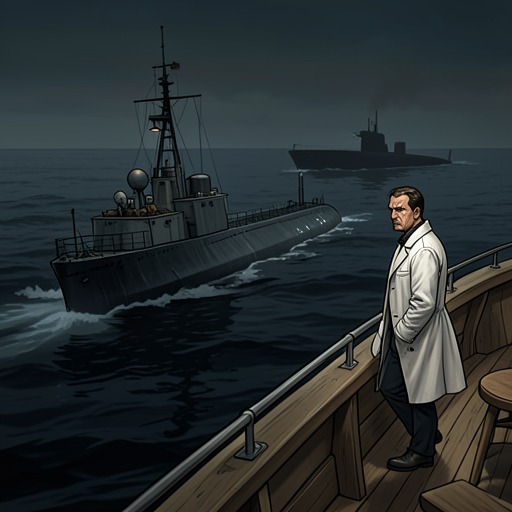
During one close attack, the contact’s sudden change of bearing suggested that the submarine might be turning toward Keeling to pass on an opposite course. At a range of about three hundred yards, sonar was at the limit of its usefulness, and the U-boat might already be passing beneath the destroyer, remain just ahead, or lie a hundred yards to either side. The double report of the K-guns marked charges being flung out on both sides in anticipation of that lateral uncertainty. The narrator compares the attempt to firing a sawed-off shotgun into a pitch-dark room at a moving target: the pattern could catch the submarine, but a hit was far from assured.
The launchers formed part of a sequence of timed attacks, not a self-sufficient means of locating the enemy. In a later exchange, after an interval calculated around the distance, combined speed, sinking time, and spread of the charges, K-guns fired on either side of Keeling as the first depth charge boomed. On another pass, Nourse ordered the K-guns to fire after the next charge was launched. The repeated orders show the launchers being used to extend patterns across successive moments in the attack, while the depth charges’ sinking time and depth settings shaped when those patterns could take effect.
Uncertainty and the Limits of the Attack
The weapons could cover water beyond the destroyer’s immediate track, but the account does not present them as ensuring a kill. The first pattern left no visible sign of a hit: no surfaced hull, large bubbles, or oil appeared in the disturbed water. Even after explosions raised successive towers of foam, the submarine remained unseen. The launchers therefore contributed to an attack whose outcome could not be read directly from the violence of the explosions.
The same uncertainty persisted when Keeling used deeper settings. Charges set to greater depth took longer to sink and fell in a more irregular spread; meanwhile, a submarine forced to surface might dive again and reach extreme depth before the next explosion. Krause wished for streamlined depth charges, which were already in production, rather than the clumsy cylinders then available. The passage distinguishes the launchers from the charges they fired: K-guns could put explosives into the water to broaden an attack, but the charges’ descent and spread still governed whether they reached the target.
Ammunition and the Cost of Repetition
Repeated firing consumed a limited supply. After a pattern brought the reported total expended to thirty-eight, Keeling had only six depth charges left; more than seven tons of high explosive had been thrown overboard in the preceding twenty-four hours. The six remaining charges included extra ones brought up from the crew’s living quarters during the previous watch. Krause consequently ordered that firing patterns stop. The constraint was not merely a matter of how many more attacks the launchers could deliver: the mathematics of pattern size meant that halving a pattern reduced its chance of a hit to a quarter, while reducing it to a third cut the chance to one-ninth. A single charge exploding within a submarine’s hearing could still have a deterrent effect, but deterrence was not the same as destroying the target.
K-guns thus belong to the book’s account of anti-submarine warfare as both a mechanical and an allocative problem. They gave Keeling a way to extend its attacks across uncertain water, yet each use drew on stores that could not be replenished during the action. Their force is visible in the repeated reports and towering explosions; their limitation is visible in the submarine that remains unseen and in the six charges left when the pattern firing has to end.