Keeling
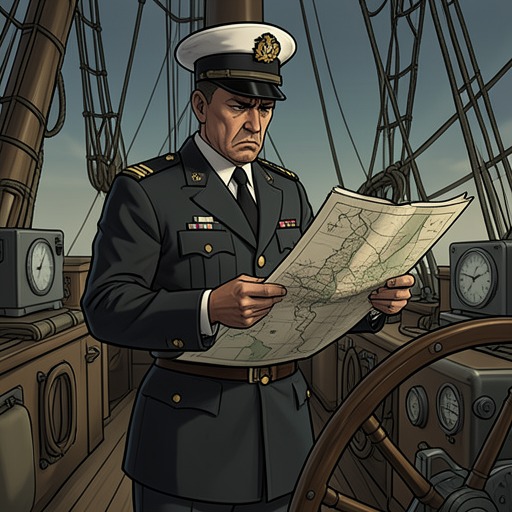
The Good ShepherdKeeling is a United States destroyer whose work in the convoy makes it both a fighting ship and a mobile system of protection: its weapons, sensors, watchkeepers, and captain must function together while fuel, ammunition, and human endurance run short. Commanded by George Krause, it helps defend the convoy against U-boats, remains at sea to protect the disabled Viktor and Cadena, and brings the closing burden of escort duty into view through its captain’s near-exhaustion.
Identity and Place in the Escort
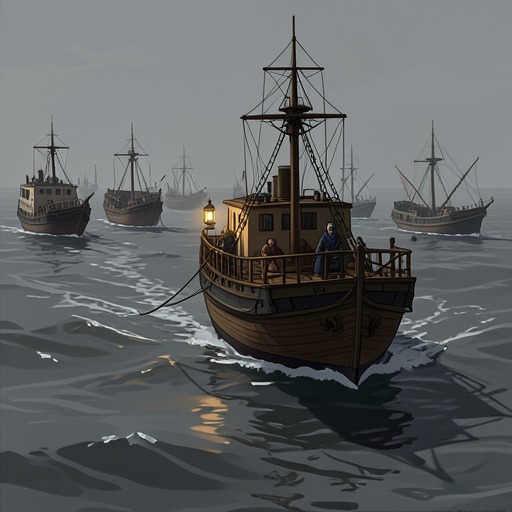
Keeling is a Mahan-class destroyer of fifteen hundred tons displacement, commissioned in 1938. Krause, aged forty-two, is both its captain and the convoy’s escort commander. The convoy contains nearly two thousand people, while more than eight hundred serve aboard the four destroyers and escort vessels guarding it. These figures give the ship’s work its scale: Keeling is one part of a thin screen responsible for protecting lives and cargo whose value cannot be measured by their accounting price alone.
The convoy’s cargo includes the tanker Hendrikson, whose oil could provide an hour’s steaming for the entire British Navy if it reached England. Keeling’s importance is therefore not simply that of a warship carrying guns. Its task is to preserve the movement of resources on which the wider war effort depends, while the convoy’s vulnerable ships keep moving through waters threatened by submarines.
The escort’s strength is limited. With only four fighting ships, detaching one or two to pursue a contact could leave openings in the screen through which other U-boats might approach. A pursuit would also consume scarce fuel: a destroyer might spend hours searching at high speed, then have to catch up with a convoy that had continued on without it. Keeling’s position within the escort is thus a continuing allocation problem, balancing the chance to attack a submarine against the need to keep the convoy covered and preserve reserves for later crises.
Readiness, Sensors, and the Human System
Keeling’s readiness is managed in degrees rather than by keeping every sailor at battle stations indefinitely. When James reports a contact and goes to investigate with Viktor, Krause does not sound general quarters. Keeling is already in Condition Two, with battle stations largely manned and watertight integrity maintained. A full alarm would bring everyone to duty, interrupt ordinary shipboard work, and leave the crew hungry and tired; the battle reserve must be conserved for a moment when the whole ship is needed. The narrative distinguishes Condition Two, which could be endured for days, from the much shorter period for which full battle stations could be maintained.
That policy also accounts for the fallibility of people under repetitive strain. Krause has seen sailors become slack when extraordinary demands are made without an apparent reason. The seven lookouts on deck must keep their assigned sectors under constant observation, pausing every few seconds to clear spray from their binocular lenses. A U-boat might show only a small part of its periscope for a brief interval, so a momentary lapse could matter to the whole convoy. The lookout’s report is one part of a chain in which vigilance has to be sustained even when the work is monotonous.
The same dependence on trained attention is present below deck, where Radioman First Class Tom Ellis operates sonar. He has been at sea listening to pings for months, but the passage emphasizes that he has not yet had practical experience detecting an enemy submarine. His training at the Key West Sound School included hurried exercises and examples of submarine echoes, but no real encounter in which he had to recognize and interpret one under pressure. The difference between a practiced and an unpracticed response could determine whether depth-charges fall close enough to hit. Keeling’s sonar is therefore not an automatic answer to the threat: its usefulness depends on Ellis’s ability to detect and interpret what the equipment returns.
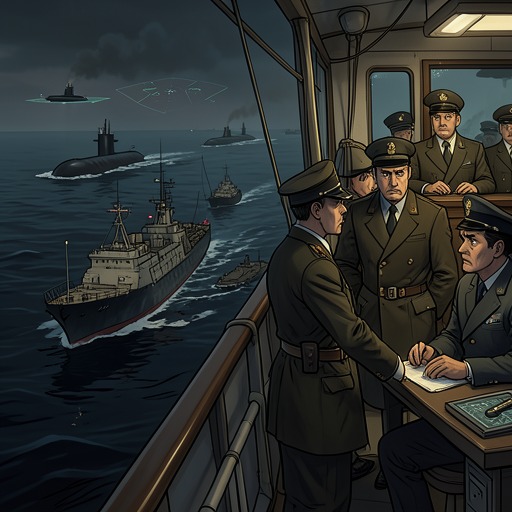
Krause’s own response is part of the ship’s readiness. When Carling summons him to the bridge, he abandons the sweater he was about to put on, grabs his uniform coat, and reaches the pilothouse seven seconds after the bell. The quick movement connects command decisions to bodily effort: Keeling’s defenses depend on a captain able to arrive, assess a report, and decide what the ship should do with very little time.
Combat and Escort Work
Keeling’s defensive role includes supporting the other escorts without abandoning its own responsibilities. When a contact is reported, James runs it down with Viktor while Keeling remains mindful of the gaps that detaching ships would create. Later, a lookout spots a U-boat on Keeling’s starboard beam, about a thousand yards away. Krause sees the submarine’s bow rise from the water, and Keeling’s guns fire. The encounter brings the unseen sonar search into a visible, immediate threat, but the ship’s task is not limited to striking at what appears before it: every movement must still be judged against the convoy’s position and exposure.
In a later engagement, the submarine is reported bearing zero-four-two at a range of three thousand two hundred yards. It is crossing Keeling’s bows toward the convoy. A star-shell illuminates the water, revealing the U-boat on Keeling’s starboard bow, less than two miles away, moving toward the ships. Keeling opens fire to intercept it. The illumination and gunfire make the danger visible, but they also underline the shortness of the decision window: the U-boat is already moving toward the convoy when Keeling acts.
The ship’s responsibilities expand when Viktor is disabled and under tow by Cadena. Keeling circles the two vessels, using sonar to search below the surface and radar to scan the water, while the towing hawser takes the strain and Viktor begins making way. The protection is calculated as well as continuous: a circle a mile in diameter takes Keeling about twenty minutes to complete, enough time for a submarine beyond sonar range to creep closer before the destroyer returns to the same point. Krause considers the danger to both vessels and the value of bringing Viktor back: a damaged destroyer could be made ready again far sooner than a new one could be built, and Cadena has already saved many lives and is itself a scarce, valuable tug.
This choice separates Keeling from the main convoy. As Cadena struggles onward at four knots, the convoy gains four or five miles for every hour that passes, and Keeling must maintain a sonar guard around the slow-moving tow. Krause anticipates that Keeling’s fuel will become urgent and that he may have to ask London for help by breaking radio silence. But a transmission could signal to German U-boat Command that the convoy is in severe difficulty and encourage submarines to concentrate against it. Keeling’s protection of Viktor and Cadena therefore creates a new risk for the ships continuing ahead: asking for help may reveal weakness, while silence leaves the destroyer’s future fuel supply uncertain.
Finite Stores and Crew Endurance
Keeling’s ability to fight is limited by its depth-charge supply. In one reported pattern, thirty-four have already been expended, bringing the total to thirty-eight. Over the preceding twenty-four hours, the ship has dropped more than seven tons of high explosive; only six charges remain, including extra charges brought up from the crew’s living quarters. Krause orders that firing patterns must stop. The figures turn ammunition into a measure of time: one day of fighting has consumed nearly the entire supply.
The remaining charges cannot simply be spread thinly without consequence. The area searched by a pattern varies with the square of the number of depth-charges, so halving a pattern reduces the chance of a hit to a quarter, while dividing it by three reduces that chance to one-ninth. A single explosion may still deter a U-boat or force it to evade, but Keeling can no longer spend ammunition as if each attack were independent of the next. Its choices are shaped by what has already been used and by the possibility of future engagements.
Crew strength imposes a parallel limit. Keeling has received new weapons and instruments, along with the additional personnel needed to operate them, but its living space is strained and it lacks enough trained ratings to maintain three watches in Condition Two. Krause divides the company into four sections and adopts a watch-and-watch routine. He cancels routine general quarters for a watch so that sailors below can have a full four hours of rest unless an emergency occurs. The decision is not a relaxation of readiness: it is an effort to preserve the people and attention that readiness requires. Even the officers’ four-on, eight-off routine can be spared an unnecessary interruption.
Losses, Fatigue, and Narrative Significance
By the closing sequence, Keeling draws away from the ships astern and enters a lane through the convoy. There were thirty-seven ships when Krause took over escort duty; thirty remain, meaning seven have been lost. He has brought thirty through, while the escort force has lost a destroyer. Keeling has also sunk two probable U-boats and a possible one. These results do not settle into a simple reckoning of success: the convoy has suffered heavy losses, and the ship’s achievements coexist with the loss of part of the force assigned to protect it.
The cost is registered in Krause’s exhaustion. While he has the conn and the convoy surrounds Keeling, he falls asleep on his feet. He wakes with a start, drinks coffee that has grown nearly cold, and hands the conn back to Carling. The moment places the ship’s continuing duty beside the bodily limit of its commander: Keeling is still in the convoy lane, still under his command, but even concentrated purpose cannot abolish fatigue.
Keeling’s radio callsign is George. The name makes the destroyer a recognizable voice within the escort’s communications, but the ship’s identity in the narrative is also carried by the repeated work behind that voice: maintaining formation, listening for weak signals, firing only with dwindling stores, protecting ships under tow, and preserving enough crew strength to answer the next emergency. Keeling is not portrayed as an inexhaustible instrument. Its effectiveness depends on disciplined choices about what to pursue, what to conserve, and whom it can still protect.