Keeling Escorts the Merchant Convoy
The Good ShepherdKeeling Escorts the Merchant Convoy is an extended test of escort duty under accumulating strain: George Krause must defend a large body of merchant ships without spending the fuel, ammunition, or human endurance needed to keep defending it. The escort’s success is real but incomplete. Thirty ships reach the handover point near England; seven are lost, and Keeling’s force loses a destroyer. The final transfer ends Krause’s charge over the convoy, not the larger war or the cost of bringing it through.
The convoy as a protected formation
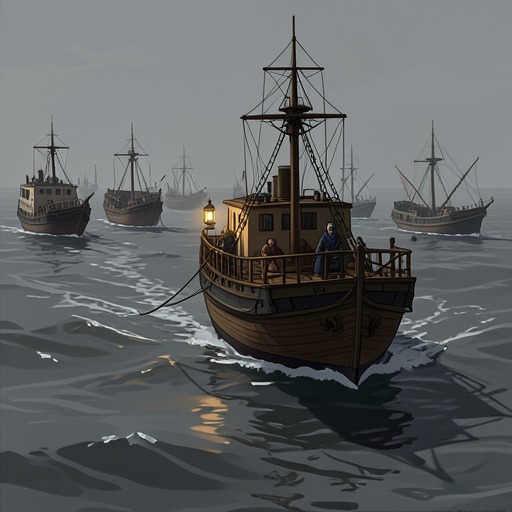
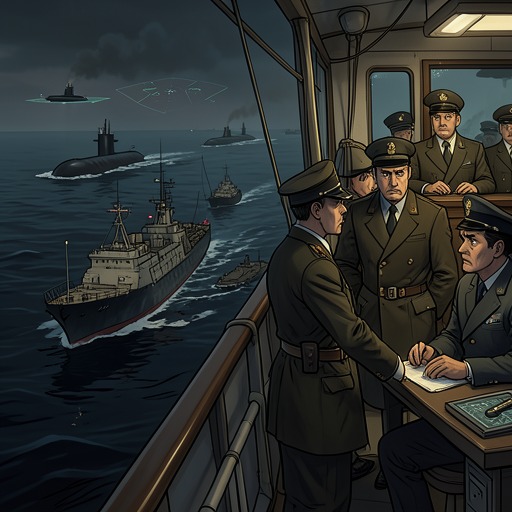
Krause’s responsibility begins with the convoy as a whole, not simply with the ship beneath him. The screen has only four fighting ships, and all are needed to cover its immense front with sonar. Detaching one or two to investigate a contact could open gaps through which other U-boats might pass. James is the wing ship, three miles to port, and a contact bearing lies ahead of the convoy’s port beam. The contact may indicate a U-boat, but that is not certain; a course change due in fourteen minutes will turn the convoy away from it. The decision is therefore not a simple choice between action and inaction. Any pursuit must be weighed against the possibility of leaving the rest of the formation less protected.
Fuel makes that calculation more exacting. James would have to build up to full speed, search at a distance from the convoy, and later spend more fuel rejoining it while the convoy continued on its course. Krause knows there is a reserve, but it is small, and his training has taught him to keep capacity in hand for the crisis of a battle. Against that caution stands the danger of allowing a U-boat to escape, report the convoy’s position, observe its speed and base course, or summon other submarines for a mass attack. The escort mission demands that Krause consider not only the immediate contact but also the consequences of what an enemy left free to act could do.
Readiness, observation, and human limits
Krause’s control of the screen depends on maintaining readiness without exhausting the crew prematurely. When Carling is poised to sound the alarm, Krause declines to call General Quarters. That decision keeps men from being held indefinitely at battle stations, where sleep and meals would be interrupted and routine maintenance deferred. The ship is already in Condition Two, with battle stations largely manned and watertight integrity maintained; this state strains the crew and interferes with the ship’s ordinary work, but can be endured for days rather than the hours associated with full battle stations. Krause also knows that repeated demands without an evident reason can make men slack in their duties. His refusal is an allocation of human endurance, not indifference to danger.
The same attention extends to the lookout watch. Seven lookouts sweep assigned sectors, repeatedly wiping spray from their binocular lenses. Krause checks their work while Carling is occupied with taking the ship to its new station. A periscope might appear only briefly and show little above the surface; constant, methodical observation is therefore essential. A reported glimpse of torpedo wakes might at least give Keeling a chance to evade. The scene makes the convoy’s security depend on small acts performed without interruption, as well as on orders from the bridge.
Sonar presents a different vulnerability: equipment and training cannot be separated from the person using them. Tom Ellis, a radioman who has served aboard Keeling since the outbreak of war, has heard repeated pings at sea but has never detected an enemy submarine. His brief training at Key West included listening to a friendly submarine’s echo and observing changes in pitch as it altered course underwater; he has had no refresher practice in an actual encounter. An echo must be recognized and interpreted quickly for a depth-charge attack to have a chance of success. Krause cannot yet know how Ellis will respond under that pressure. The account thus presents the escort’s technical search as dependent on fallible human judgment, not as an automatic guarantee of detection.
Fighting capacity and competing duties
As the engagements accumulate, ammunition becomes another hard limit. Keeling has expended thirty-four depth charges in the latest sequence, bringing that pattern’s total to thirty-eight. In the preceding twenty-four hours the ship has thrown more than seven tons of high explosive overboard, and only six charges remain, including extra charges brought up from the crew’s living quarters. Krause and his weapons officer agree that they must stop firing patterns. The decision is sharpened by the mathematics of search: halving a pattern reduces the searched area, and the chance of a hit, to a quarter; reducing it to a third leaves only a ninth of the previous chance. Yet even a charge that misses can have a deterrent effect, forcing a submarine to evade. The remaining ammunition therefore has both a diminishing tactical value and a possible psychological one.
The prospect of air cover the next morning and the expectation that U-boats have recently been less willing to attack in the eastern Atlantic inform Krause’s thinking about what may come next. They do not restore the charges already spent. His choices are constrained by the whole course of the escort: a ship’s ability to fight now must be balanced against what it may still need to do later. Similarly, the earlier reluctance to spend fuel and the refusal to keep the whole crew at full battle stations belong to the same practical discipline. Keeling cannot treat every contact as if resources were unlimited.
That discipline continues when Viktor is disabled and under tow by Cadena. At dusk, Keeling circles the two ships while its sonar searches below and its radar scans the surface. Krause works out that a one-mile-diameter circle takes about twenty minutes to complete. A U-boat two miles away, beyond sonar range, could cover that distance at six knots and approach within half a mile to launch before Keeling came round again. The calculation explains why the damaged ships require close protection: the pattern of Keeling’s patrol sets the time available to an approaching attacker.
Krause gives priority to covering Viktor and Cadena, leaving the remainder of the convoy to two corvettes. His reasons are material as well as immediate. Viktor could return to service in a fraction of the time required to build a new destroyer, with its valuable equipment intact; Cadena carries men it has rescued and is itself a scarce, valuable oceangoing tug. The decision is not framed as a choice made without consequences, but as a duty whose allocation is clear. Keeling’s protection shifts from the full convoy to the ships whose survival and recovery are now most at stake.
Handover and reckoning
Near the end of the escort, Krause takes the conn as Keeling enters a lane through the convoy. Thirty ships remain, compared with thirty-seven when he assumed escort duty. He measures the losses without letting the figures erase the accomplishment: seven ships have been lost, but convoys have suffered worse. His force has also lost a destroyer, a grave cost, while having sunk two probable submarines and one possible. In the midst of this reckoning, fatigue is so severe that Krause realizes he has fallen asleep on his feet while actually in charge of the ship. He drinks the nearly cold coffee that has been brought to him, then gives Carling back the conn.
Once the convoy is within touch of England, Krause hands it over to the relieving force. He sends James and Dodge to form astern of Keeling, sets the course and speed, and signals the convoy commander his thanks and good wishes. The reply acknowledges the escort’s work and offers gratitude from the ships that have come through. These messages mark a formal change of responsibility: Krause has completed the duty entrusted to him and is now moving away from the ships he has guarded for so long.
The transfer brings relief without uncomplicated triumph. Krause understands that the convoy has been delivered, yet feels a deep sadness as Keeling leaves it behind; he expects a long war and doubts that he will see those ships again. The distinction matters to the event’s ending. Escort duty concludes not with the disappearance of danger but with the disciplined passage of responsibility to another force. The convoy’s survival is measured in ships delivered, ships lost, resources consumed, and a commander’s exhaustion; the final exchange of signals gives the achievement recognition while leaving its cost visible.