Keeling and Viktor sink a U-boat
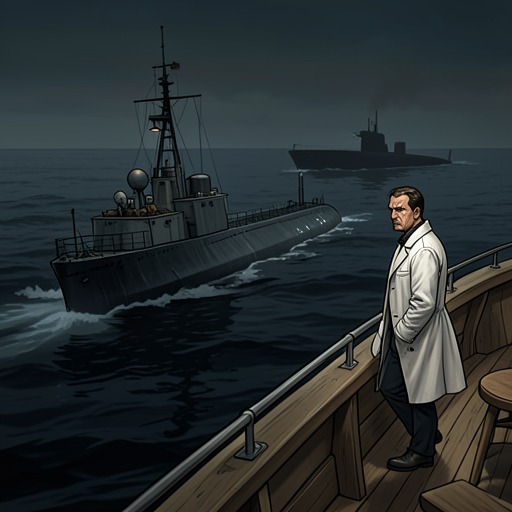
The Good ShepherdKeeling and Viktor sink a U-boat in a prolonged, uncertain engagement in which detection depends on disciplined watchkeeping, imperfect sonar information, and cooperation between the two destroyers. The submarine’s destruction is confirmed when Viktor reports hearing it break up, giving Krause and the crew their first clear assurance of victory; the moment is both a professional triumph and the death of fifty enemy sailors.
Operational Strain and Readiness
The engagement takes place against the accumulating strain of a ship kept ready for action over an extended period. Keeling is already in Condition Two, with battle stations largely manned and watertight integrity maintained. Krause does not treat a full general alarm as a costless precaution: battle stations would keep every man at duty, interrupt eating and sleeping, and leave the ordinary work needed to maintain the ship unfinished. The battle reserve must be conserved for a decisive moment, not spent indefinitely. He also knows that repeated demands without an evident reason can make men slack in their duties. His judgment therefore includes not only the enemy’s movements but the endurance and reliability of the crew.
That concern continues during the prolonged contact. Krause has spent much of the day dealing with the enemy without calling the whole ship to battle stations. Since the extra weapons and instruments have crowded Keeling and increased the demand for trained ratings, the ship cannot readily provide three rested watches in Condition Two. The available company has been divided into four sections, working watch-and-watch; the officers, for their part, are generally on four hours on and eight off. Krause cancels a routine general-quarters call for the watch, reserving it for a real emergency and allowing the watch below a full four hours’ rest unless circumstances change. The decision frames the hunt as a test of sustained readiness, not simply an isolated burst of combat.
Detection and Closing the Range
The search depends on several forms of attention, none of them certain by itself. Seven lookouts sweep separate sectors, repeatedly wiping spray from their binocular lenses. Krause checks their work while Carling is occupied with taking Keeling to a new station. A U-boat may expose only a small part of its periscope and do so briefly, so the search must remain continuous; a fleeting sighting or promptly reported torpedo wake could affect a ship’s chance of survival. The lookouts’ routine is therefore an active part of the attack, even before they see the submarine.
Below decks, sonar sends out its recurring pings, searching the dark water for an echo. Tom Ellis, the sonar operator, has been at sea since the outbreak of war, but his earlier training consisted of hurried exercises, and he has never heard an echo from an enemy submarine in service. The narrative stresses the gap between training and experience: recognizing an echo and drawing the necessary conclusions quickly may determine whether depth charges fall close enough to succeed. It does not establish that Ellis fails; rather, the possibility of human error is part of the danger Krause must manage while the contact remains uncertain.
Keeling’s maneuver improves the position. After the destroyer completes her turn and steadies, the talker reports a contact bearing port zero-two at a range of eight hundred yards. The account identifies the turn as successful because it anticipates the U-boat’s maneuver and brings the enemy almost dead ahead, closing the distance by two hundred yards. The numbers make the tactical gain precise, but they do not remove the uncertainty: a later report places the contact at close range, near the limit at which sonar can function, while the submarine may be turning to pass beneath the destroyer.
Attack and Cooperation
When the contact is reported dead ahead and close, the talker’s previously controlled delivery breaks into alarm. Krause orders fire, and Nourse relays the command through his mouthpiece. The narrative marks the order as an attempt to kill the submarine’s crew, not as an impersonal maneuver: at that instant, Krause and Nourse are directing an attack that may kill fifty men. The urgency comes from the submarine’s possible course beneath Keeling, which could leave the depth charges behind their target, or just ahead of the ship, where their explosions might surround it. The attack therefore turns on a narrow interval of position and timing rather than certainty about the enemy’s exact location.
The two destroyers continue the hunt together. As the depth-charge pattern ends, Keeling turns to starboard, and Krause watches Viktor as she turns as well. The ships circle one another in the hope that the U-boat lies within the area enclosed by their intersecting paths. This coordinated search makes the engagement more than a single ship’s attack: each vessel’s movement contributes to locating the submerged enemy, while Keeling must preserve its ability to turn toward any fresh contact.
A lookout on Keeling’s starboard side then spots the submarine. It rises about a thousand yards away, its bow and bridge briefly visible above the disturbed water. Keeling’s guns fire, but the sighting is fleeting and the submarine disappears from view. The visual contact confirms that the enemy has come to the surface, yet the disappearance itself does not prove that the attack has succeeded. The crew still needs evidence of destruction, not merely a target seen and lost.
Confirmation and Human Cost
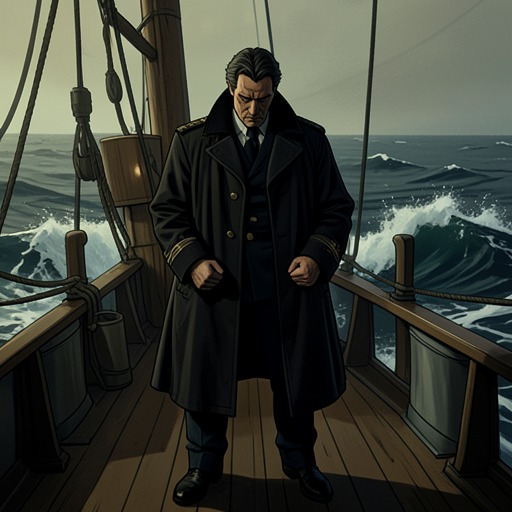
That confirmation comes over the T.B.S. from Viktor. Her officer first tells Krause that Keeling has got the submarine, then reports that the ship has heard it crunch. The sound is understood as the U-boat breaking up under pressure. Krause remains silent at the radio. He recognizes the achievement as the culmination of more than twenty years of training as a fighting man, but that recognition is inseparable from the knowledge that fifty men have died. The narrative compares the victory to a fencing thrust that should have met harmless resistance but instead passes through the opponent: the image captures the gap between the clean abstraction of a successful attack and its lethal result.
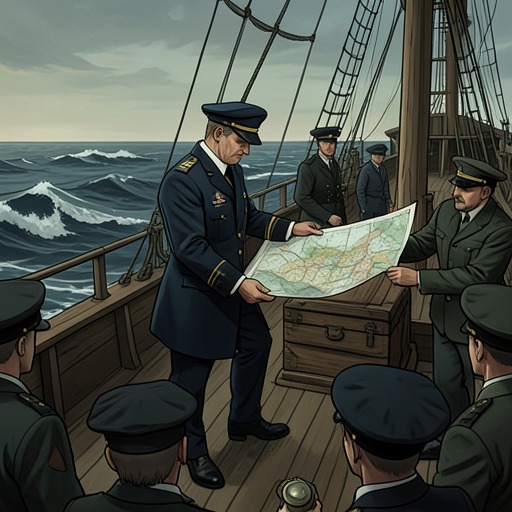
Krause subsequently tells the gathered men that they have destroyed the submarine and identifies Viktor’s report as confirmation. The shadowed faces under the helmets brighten; Nourse gives a partly suppressed cheer, and Krause himself relaxes into a grin. Their spontaneous response contrasts with the formal strain of an international working relationship and shows the two ships’ cooperation becoming a shared accomplishment. Krause immediately adds that this is only the first, placing the victory within an ongoing campaign rather than treating it as an end to the danger.
Significance
The sinking changes the crew’s uncertainty into confirmed success, but the event refuses to make that change emotionally simple. Sonar reports, lookout discipline, maneuver, and cooperation carry the ships toward victory; the same chain of decisions culminates in the deaths of the submarine’s crew. Krause’s silence holds these meanings together. He can understand the sinking as the achievement for which he has been trained and still measure its cost in human lives. The brief celebration aboard Keeling does not erase that cost; it reveals how professional accomplishment, relief, and the knowledge of what the attack has done coexist in the same moment.