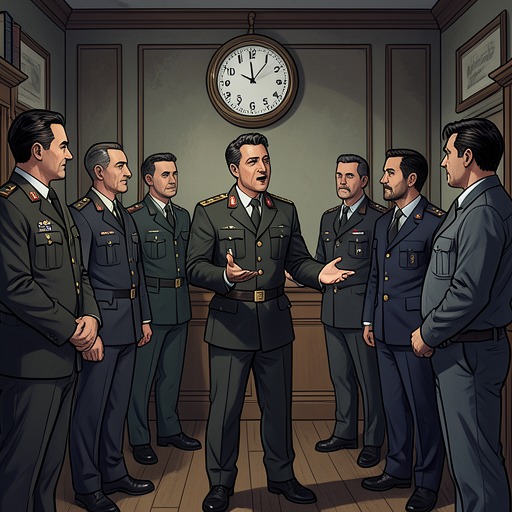
Keeling and Viktor’s destruction of a U-boat
The Good ShepherdKeeling and Viktor’s destruction of a U-boat is a convoy-defense action shaped by incomplete reports, constrained time, and the need to coordinate two destroyers without losing sight of the convoy. Krause’s decisions turn uncertain signals into an attack, but the resulting victory is not presented as uncomplicated: the U-boat is destroyed, and about fifty men die with it. The episode places the work of detection and command alongside the cost of success.
Warning and readiness
Krause receives a Huff-Duff report of a foreign transmission bearing 087, between fifteen and twenty miles away. In this setting, he understands the transmission to indicate a U-boat, and its bearing puts the contact nearly in the convoy’s path. It is a firmer warning than James’s possible contact, but it still requires a decision under uncertainty. Krause orders a signal to the convoy commander that Keeling will investigate, committing his ship to the search while leaving the convoy’s larger movement in view.
The ship is already at Condition Two, with much of the crew at battle stations and watertight integrity maintained. Calling General Quarters would bring everyone to duty, but it would also stop ordinary work, interrupt sleep and meals, and leave the ship’s many maintenance tasks undone. Krause regards the crew’s stamina and attention as a battle reserve: a resource to preserve for the moment when it is most needed. Repeated alarms without an evident reason could also make men slack in their duties. His restraint is therefore part of the action’s preparation, not a withdrawal from it.
As Keeling moves at nearly full power, the men called away from routine work do not know why they have been summoned or why the ship is making speed. Krause has the guns and depth-charge crews warned to be ready for immediate action. The seven lookouts, each responsible for a sector, must keep searching despite the monotony and the difficulty of maintaining attention. A U-boat might show only a small part of its periscope, and only briefly; a momentary sighting could determine whether the convoy is warned in time, or whether Keeling can save herself from an attack. The scene makes the ship’s readiness depend not on one dramatic act alone but on sustained, distributed attention.
Contact lost and regained
Radar appears likely to find the surfaced U-boat, but the target disappears before Keeling can establish it visually. Krause’s immediate response is to ask Charlie Cole what has happened. He then orders the ASDIC sonar brought into use. Its repeated pings search the dark water, but at first they produce no report. Below, Tom Ellis is operating the equipment. Ellis has received training at the Key West Sound School, including exercises in taking bearings and estimating range, but has never detected a submarine in service or practiced the encounter with an enemy that would demand rapid interpretation. The narrative emphasizes that accurate equipment alone cannot guarantee an accurate attack: the operator must recognize an echo and respond quickly enough for depth charges to be placed effectively.
When the talker reports sonar contact, Keeling has a basis for attack. At close range, Krause orders Nourse to release the depth charges. The contact’s sudden change of bearing suggests that the U-boat may be turning directly toward its attacker, raising the possibility that it will pass beneath Keeling before the charges can reach it. The engagement is therefore a contest of timing and position, not simply a matter of having detected the enemy. Sonar is later deafened by underwater explosions, and Keeling has to turn before it can search again, leaving Krause uncertain how far an uninjured U-boat might have escaped.
During this maneuver, a message from the Admiralty reports an enemy concentration at Keeling’s present latitude and longitude and recommends a radical course change southward. The warning is already two hours old, and Keeling is, within a mile or two, at the reported position: the destroyer and convoy are among a U-boat wolf-pack. Turning the convoy now would take time to relay and confirm orders across its ships, and would risk renewed disorder and straggling. The message clarifies the danger without providing a practicable way to remove the convoy from it. Keeling’s immediate task remains to act on the contact while the convoy continues forward.
Coordinating the attack
A later sonar report gives a distant contact on the port side, with its range indefinite. Krause adjusts course rather than treating that uncertain report as a settled target. Viktor, identified to him as Eagle over the T.B.S., reports a close contact converging on its port bow. Krause holds course long enough for Viktor to obtain a cross-bearing, then orders Keeling to turn, both to avoid collision and to position the ship for a possible attack. He has to anticipate what course the hunted U-boat might take and where it could be if Viktor’s attack failed.
Viktor reports that its depth charges are away. Their explosions obscure the sonar contact, so Krause directs a search on Keeling’s port bow rather than assuming the target has been destroyed. When sonar reports close contact bearing 182, he tells Viktor to keep clear and announces that Keeling will attack. The two destroyers circle in relation to one another, trying to place the U-boat within the area their movements enclose. This coordination requires a balance between cooperation and separation: Keeling needs Viktor’s reports and attack, but must keep room to maneuver and avoid the other ship.
A lookout then spots the U-boat on Keeling’s starboard beam, about a thousand yards away. It rises into view, and Keeling’s guns fire before it disappears again. The sighting is brief, but it gives the ship a visual confirmation to add to the uncertain sonar picture. Viktor subsequently tells Krause that Keeling has got the target and reports hearing it crunch after the last pattern. The confirmation comes from the cooperating ship’s report, not from a prolonged view of the U-boat. Krause waits until the sonar talker reports no contact before telling the bridge that the attack has succeeded, explaining that the Polish crew aboard Viktor heard the destruction after the final pattern.
Victory, cost, and command
The confirmation brings open relief on Keeling’s bridge. Nourse gives a restrained cheer, and the crew’s smiles mark a change from the concentrated uncertainty of the attack. Krause joins their reaction, while also recognizing that the victory has killed about fifty men. The account sets the two facts beside one another: this is the achievement for which he has trained as a fighting man for more than twenty years, and its success carries a human cost that cannot be absorbed into the crew’s celebration. The moment is described as a peak in his career, but not as a triumph free of moral weight.
Krause calls the destroyed U-boat only number one, turning the immediate success toward the continuing work of escort and combat. Elsewhere in the account of this sustained enemy contact, he arranges that General Quarters will not be called routinely during the next watch; unless there is an emergency, the men below can have a full four hours of rest. Keeling has been in contact with the enemy through the day, and the strain of Condition Two is already substantial. New weapons and instruments, together with the additional crew needed to operate them, have pressed the ship’s living space and personnel resources. With too few trained ratings to supply three Condition Two watches, Krause has divided the ship’s company into four sections and adopted watch-and-watch. His effort to spare the crew an unnecessary alarm shows that the same command responsibility continues after a successful attack: readiness must be maintained without exhausting the people on whom the next report and next decision will depend.