Krause and Carling’s mentoring relationship
The Good ShepherdGeorge Krause and Carling’s mentoring relationship takes shape amid an active submarine pursuit, where a junior officer’s composure and judgment can affect the safety of Keeling and the convoy. Krause does not treat Carling’s nervousness as proof that he is incapable. Instead, he adjusts how he delegates: first making sure Carling understands the tactical situation, then entrusting him with a straightforward manoeuvre and watching without taking control back. Carling’s later independent decision about the ship’s steering cables suggests that the approach is beginning to work, though the evidence presents progress rather than a completed transformation.
Authority Under Pressure
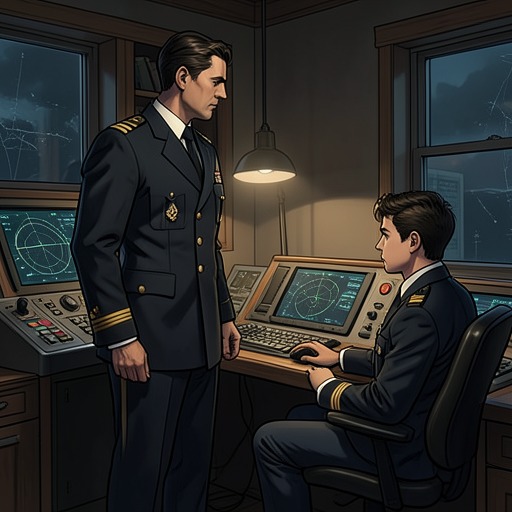
Krause’s attention to Carling is practical as well as developmental. He explains the presumed position and course of the U-boat and the plan to intercept it, because Carling may need to take the conn if Krause becomes unable to command. Krause considers the immediate hazards of the engagement, including the possibility that he might collapse or be hit by stray fire. The briefing therefore gives Carling a usable picture of events while preparing for a contingency, rather than leaving him dependent on orders he might no longer receive.
Carling answers that he understands, but Krause hears no confidence in his tone. Nor does Carling display eagerness for the fight. Krause allows for the possibility that his subordinate is regretting his choice of profession, without treating that impression as a verdict on his future ability. The contrast with Charlie Cole, who reports that the watch sections have been fed and that the others are getting their meal, helps establish the different kinds of attention Krause must give the officers and crew: operational continuity depends on both command readiness and the condition of the people carrying out their duties.
Recognizing Anxiety
When Krause says he intends to approach the U-boat from behind, Carling’s hesitant response exposes a gap between receiving orders and understanding the tactical picture. The situation should be clear to someone who has spent the preceding half-hour on the bridge, Krause judges, so he concludes that confusion alone does not explain Carling’s vagueness. He recognizes signs of nerves. That judgment is sharpened by his own recent experience of buck-fever: earlier, his hand had trembled and he had committed omissions under the pressure of command. He can therefore read Carling’s difficulty as a temporary impairment of judgment, not simply a lack of knowledge or courage.
Krause also recalls Carling’s earlier readiness to sound the general alarm. He considers that it may have reflected a wish to shed the responsibility of being officer of the deck, but the narration leaves this as a possibility, not a confirmed motive. In the present emergency, there is no time for an extended correction. Krause has been recording the reported ranges and bearings himself, so he can continue the pursuit while deciding how much responsibility Carling can safely carry.
Delegation as Training
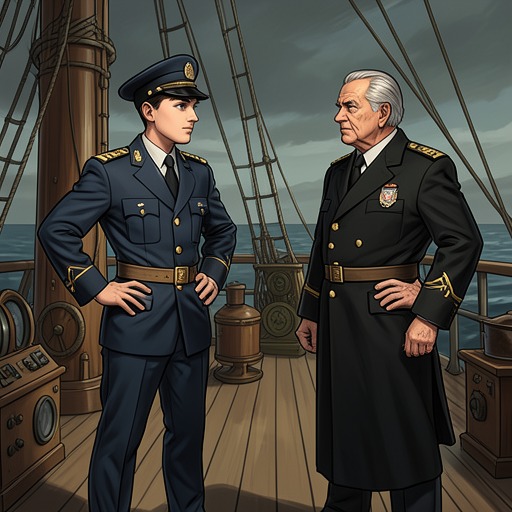
Once the immediate submarine threat has been suppressed sufficiently for Keeling to rejoin the wider struggle, Krause orders Carling to take the conn and bring the ship around the convoy’s left flank at the best practicable speed. Carling asks whether the ship should zigzag. At more than twenty knots in darkness, Krause considers the question mistaken, and his first impulse is to rebuke him. He restrains that response because a sharp reprimand could unsettle Carling further. Instead, he gives him a simple manoeuvre he can execute successfully, hoping that responsibility for a bounded task will help restore his self-command and contribute to his becoming a good officer.
The mentoring is deliberately quiet. Krause remains on the bridge rather than leaving Carling alone with the conn, but he positions himself so that he can listen both to the ship’s communications and to Carling’s actions without openly hovering over him. Carling consults the chartroom for the course, gives the helm order, and calls for twenty knots. He acts normally. Krause’s method combines a real transfer of responsibility with a safeguard: Carling must do the work, while Krause stays immediately available if the situation changes. It is neither an empty show of trust nor a humiliating public correction.
Independent Judgment and Evidence of Growth
The clearest later sign of change comes when Carling authorizes a shift of Keeling’s steering cables without first consulting Krause. Standing orders give that decision to the officer of the deck, so Carling is entitled to make it himself. The timing carries some risk: a submarine just beyond radar range would make the work less convenient. But there are no current contacts, and the change is due daily. Krause approves the decision as evidence that Carling has accepted responsibility within his authority, while acknowledging the limits of the test and the danger that always attends the ship’s work.
Krause then asks Carling to turn Keeling back across the front of the convoy. Carling gives the rudder order and course promptly and correctly, and the helmsman reports that the ship is steady on the new course. This is a modest test, not a battle-winning action, but its value lies precisely in the ordinary exercise of judgment and command. Krause imagines that, if the Navy continues to expand, Carling could be commanding a destroyer in battle within six months—if he survives. The forecast is conditional, not a promise: mentoring can develop an officer’s ability, but cannot remove the hazards of war.
Meaning of the Relationship
Krause’s approach joins discipline to an obligation to develop others. He does not excuse Carling’s lapses, but distinguishes between an error that needs immediate correction and anxiety that punishment could make worse. By assigning manageable work, remaining close enough to intervene, and allowing Carling to make a decision covered by standing orders, he treats competence as something exercised and built through responsibility. The relationship is therefore more than a senior officer’s evaluation of a subordinate: it is a practical apprenticeship conducted in the narrow space between trust and operational risk.
The evidence ends with signs of improvement rather than a declaration that Carling has mastered combat command. He has moved from hesitant understanding and visible uncertainty to an independent decision and a correctly executed course change. Krause recognizes both the progress and its limits. His forecast of Carling’s possible future command makes the stakes of this gradual development explicit, while the qualification that Carling must survive keeps the mentorship rooted in the precarious world where it occurs.