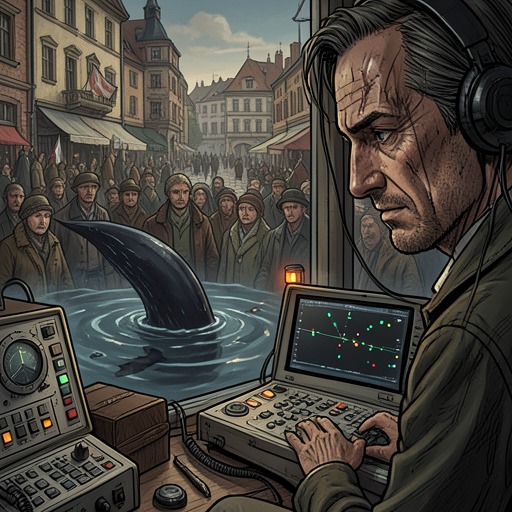
Nighttime U-Boat Torpedo Attack on the Convoy
The Good ShepherdNighttime U-Boat Torpedo Attack on the Convoy is a crisis of divided responsibility: as torpedoes strike ships in the dark, George Krause must decide whether to abandon Keeling’s active pursuit of one U-boat and turn toward the convoy’s victims. He continues the hunt, not because the losses behind him are unimportant, but because he judges that changing course may not allow him to reach the attacking submarine and could put his own ship at risk. The attack turns a tactical choice into a stark test of what an escort commander can protect when threats and resources cannot be brought to bear everywhere at once.
Background and Readiness
The attack unfolds while Keeling is already engaged in an extended effort to find and attack a submarine. Earlier, the possibility of sending James after a contact had raised a wider question: detaching escort ships could leave gaps in the convoy’s screen, while the extra high-speed steaming required to search and rejoin would consume a small fuel reserve. Yet leaving a submarine unchallenged could allow it to report the convoy’s position or help other boats organize an attack. That tension between preserving the escort’s capacity and acting against a possible threat forms the operational background to the later crisis.
The ship’s readiness is also being managed as a finite resource. George Krause has kept Keeling in Condition Two rather than calling the entire crew to General Quarters whenever a contact is reported. General Quarters would put every man at his post, but the crew could not sustain battle stations indefinitely without losing sleep, meals, and the time needed for routine maintenance. Continuous unnecessary alarms could also weaken attention and discipline. After a day of contact with the enemy, Keeling’s extra weapons and equipment have strained the ship’s accommodation, and the available trained ratings cannot provide three full watches in Condition Two. Krause has divided the company into four sections to maintain watch-and-watch and has arranged for the watch below to receive its full rest unless an emergency intervenes.
Readiness depends on people as well as orders. Seven lookouts sweep assigned sectors, pausing to clear spray from their binocular lenses. A submarine might expose only a small part of its periscope and do so briefly, so an interruption in the search could matter; a reported sighting of torpedo wakes might at least give Keeling warning. Below, Tom Ellis operates the sonar. His training has been brief, and he has not previously heard an enemy submarine’s echo in actual pursuit. The account emphasizes that recognizing a contact and interpreting it promptly require practice, leaving the ship’s detection system dependent on the judgment and performance of individual crew members under pressure.
The Attack and Krause’s Choice
The convoy attack becomes visible to Keeling through reports and flashes in the night. A lookout reports fire among the ships. Rockets rise above the flames, and a further torpedo explosion lights the upper works of nearby vessels. The interval between explosions tells Krause that the attack is not a single spread of torpedoes reaching several targets at once: a U-boat is selecting victims one after another. As this unfolds, sonar reports a contact on bearing zero-seven-seven. Keeling and Viktor are already in touch with one submarine, whose destruction may depend on the pursuers avoiding a false move.
Krause therefore faces two dangers at once. Behind him, men are dying aboard attacked ships; ahead, the submarine under pursuit remains a live threat. He considers breaking off to seek the second U-boat, but the prospect of saving survivors is uncertain. In the confusion and disorder of the convoy, locating the attacker is doubtful, and the submarine has already done its damage for the moment. Abandoning the current hunt would also mean losing a contact that may be difficult to regain and exposing Keeling to serious danger. Krause chooses to continue the pursuit, accepting that he cannot guarantee protection for the ships being attacked.
The decision is presented as painful rather than triumphant. The emotional force comes from the collision between the immediate sight of burning ships and the commander’s obligation to act on incomplete information. Krause cannot know that turning toward the convoy would save anyone; nor can he assume that maintaining the pursuit will succeed. His choice is constrained by uncertainty, distance, the possibility of losing contact, and the danger to Keeling. The scene makes command less a matter of selecting a good outcome than of deciding which risk must be borne when no available course can remove the peril.
Losses and the Continuing Pursuit
A later signal from Comconvoy to Comescord reports known losses during the night. Four names appear on the signal-pad, though the convoy is straggling badly and the list may be incomplete. The message adds that Cadena has saved some lives and that the scattered convoy needs its rear covered. It also notes the chance of picking up survivors. These facts confirm both the scale of the disruption and the limits of the available account: rescue has occurred, but the report does not establish that every missing person or ship has been located.
The signal reaches Krause while Keeling is temporarily in a supporting position. Viktor has taken over as the active pursuer, while Keeling is being maneuvered to attack again if Viktor is obstructed. Krause reads the losses and then receives word that the submarine is still circling and that Keeling will cross its bows. He orders another attack. The convoy’s casualties do not bring the pursuit to an end; instead, the ship must continue to balance the immediate search against the need to protect the damaged and straggling formation.
The capacity to continue is diminishing. By this stage Keeling has expended thirty-four depth-charges in the current accounting, and the next pattern brings the total to thirty-eight. More than seven tons of high explosive have been dropped over the preceding twenty-four hours, leaving only six charges, including extra weapons brought up from the crew’s living quarters. Krause ends the use of full patterns. The decision reflects a practical limit: the area searched by a depth-charge pattern varies with the square of the number of charges, so halving a pattern reduces the chance of a hit to a quarter, while reducing it to a third leaves only one-ninth of the previous chance. Even a single charge might still have a deterrent effect, but the remaining stock cannot support the earlier method indefinitely.
Significance
The attack’s consequences are therefore both human and operational. The convoy is scattered, four losses are known but the report may be incomplete, Cadena has rescued some survivors, and Keeling’s ammunition is nearly exhausted after a day of combat. At the same time, the U-boat hunt continues, with Viktor and Keeling shifting between active pursuit and support. No single action restores the convoy or guarantees the destruction of the submarines.
By setting the fires behind Keeling against the sonar contact and the changing pursuit ahead, the episode exposes the limits of escort command. George Krause’s choice is shaped by the same scarcity that governs crew rest, fuel, screen coverage, and depth-charges: every commitment protects one possibility by reducing another. The attack does not resolve that dilemma. It makes its cost visible, then leaves the ships still operating within it.