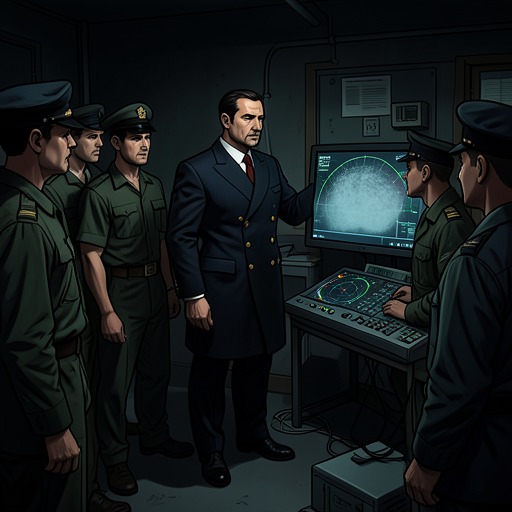
Pillenwerfer
The Good ShepherdPillenwerfer is a U-boat decoy that uses a stream of bubbles to create a sonar contact, diverting an attacking destroyer from the submarine itself. In Keeling’s pursuit, the device does more than conceal an escape: it makes the false target appear measurable, while leaving the enemy’s real course increasingly difficult to determine. Its eventual disappearance ends the false contact, not the uncertainty it has produced.
Function and Effect
The evidence identifies the Pillenwerfer through what sonar hears: a contact that sounds like a pill, or is reported as one, and then vanishes when its bubbles cease. The device’s deception depends on that acoustic appearance. Keeling’s crew can register a contact and report its range, but the contact is not the submarine they are trying to attack. The decoy therefore exploits the difference between a detectable signal and the enemy’s actual position.
That difference has immediate tactical consequences. While Keeling follows the bubbles, the U-boat can alter course and increase its distance. The decoy does not simply hide the submarine; it draws attention toward a misleading point in the water and complicates the interpretation of each new sonar report. Even when the crew recognizes the device, they cannot infer the submarine’s precise course from the false contact alone.
The First Misleading Contact
During one pursuit, sonar first reports a contact dead ahead at five hundred yards. Krause considers whether the submarine might be holding motionless on a cold stratum of water, but that possibility gives way to a more troubling explanation when sonar reports no contact. He concludes that the target they had been chasing was a Pillenwerfer: Keeling had followed bubbles while the U-boat escaped.
The sudden loss of contact matters because the false target had seemed close enough to invite continued action. Krause recognizes that Keeling was not simply too near for sonar to register the submarine; the last report had placed the ship outside that limit. The disappearance instead exposes a failure of interpretation. His suspicions had not become strong enough, while contact remained, to prevent him from treating the decoy as a real target.
Krause judges that the ship has been fortunate. If the bubbles had continued for another five minutes, he might have ordered depth charges against the phantom, then circled back and attacked the same false contact again. That would have consumed both ammunition and time without striking the escaping submarine. Once sonar reports no contact, he orders Keeling onto course zero-eight-zero and asks for the convoy’s position. The nearest ship is reported bearing zero-eight-nine, four miles away: a concrete reminder that the pursuit has also separated the destroyer from the formation it is meant to protect.
Repeated Deployment and Tactical Response
The decoy recurs in a later encounter. Sonar reports a pill dead ahead at one thousand yards; Tom Ellis detects the device, but its bubbling prevents him from establishing what new course the U-boat has taken. A subsequent possible contact is reported bearing zero-nine-two at eleven hundred yards, with the pill still dead ahead. Krause judges that the submarine has most likely turned to port, a move that would give it its best chance to escape, and that the decoy has helped it gain distance from Keeling.
This time, recognition changes the response without restoring certainty. Krause orders Keeling to alter course to starboard and signals Viktor that the contact appears to have turned to port and dropped a pill. The distinction is important: the crew has identified the false contact, but the submarine’s movement remains an inference. The decoy has already obscured the course that would let Keeling convert detection into a reliable attack.
In another sequence, sonar first reports a contact fifteen hundred yards ahead. Krause considers whether a crippled submarine might be lying stationary, but a report at thirteen hundred yards says the contact sounds like a pill. He then has to reason from incomplete information: he does not know whether the device was released before or after Viktor made its attack, or which way the submarine turned afterward. He considers the submarine captain’s likely expectations about Keeling’s course, including the fact that Keeling has turned to port for the first time in a long while. On that basis, he predicts a possible sequence of turns rather than treating the false contact as a direct track.
Krause orders a turn to course zero-eight-nine and tells Viktor to move in on Keeling’s port beam and search while Keeling moves out to starboard. The submarine has bought itself a respite of several minutes. Sonar continues to report the pill, now bearing zero-nine-nine at nine hundred yards, but Krause has no supplied data on how long such devices endure. Without knowing that limit, he cannot use the contact’s duration to make a dependable estimate of the submarine’s position.
Disappearance and Significance
When the bubbles stop, sonar reports no contact. The decoy sinks as its bubbles cease to lift it, leaving the water without the signal that had marked the false target. Its end resolves one narrow question—the pill is no longer producing a contact—but does not reveal where the submarine has gone. Keeling and Viktor both report that they have no contact.
The widening circle marking the submarine’s possible position gives the consequence a visible form: as time passes without a real contact, the area of uncertainty grows. The Pillenwerfer is thus effective even after it disappears. It has interrupted the pursuit, bought the U-boat time, and left the escorts with a larger search problem than the one they faced while sonar was following the bubbles.
Across these encounters, the decoy tests the difference between detection and understanding. Early in the pursuit, Krause nearly acts on a phantom; later, he recognizes the pill but must still reconstruct the submarine’s movements through uncertain reports and predictions about an enemy commander’s choices. The device’s tactical force lies in this interval between a contact being heard and its meaning being known. Its bubbles can be counted as a range and bearing, but they cannot provide the certainty the attack requires.