Radar
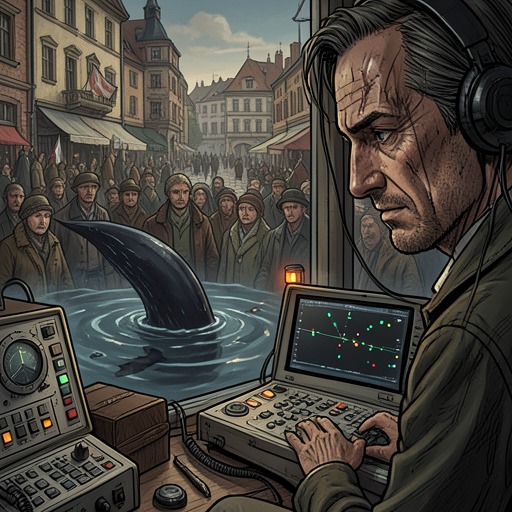
The Good ShepherdRadar is Keeling’s electronic lookout: its rotating antenna continually searches beyond the ship, while reports of faint returns give George Krause bearings and ranges with which to make tactical decisions. It can reveal a possible submarine contact, but its uncertain pips, unreliable screen, and dependence on a fast reporting chain make it an aid to judgment rather than a guarantee of knowledge.
Installation and role
A radar antenna turns above Keeling’s mast, its spring-like form revolving methodically as the ship rolls and pitches. From the bridge, the antenna’s steady rotations are visible even as the mast traces changing cones against the sky. The equipment is presented as the ship’s seeing eye, complementing sonar’s hearing ear: radar searches outward, while sonar listens for echoes in the water. Neither image makes detection effortless. Lookouts still sweep assigned sectors with binoculars, pausing to wipe spray from their lenses; the narrative stresses that a brief glimpse of a periscope could determine the convoy’s fate, while the electronic instrument offers another means of extending the search.
Radar therefore belongs to a larger system of surveillance, not a solitary machine that settles what is happening at sea. Its returns must be reported, interpreted, and connected to the ship’s position and course. The distinction matters especially when the return is only a pip: an appearance on the screen that may indicate a target, may vanish, and may leave the captain deciding without confirmation.
A return and a costly delay
One report gives Krause a concrete but fleeting contact: a radar pip bearing 219 degrees at a range of eight thousand yards. He has just returned to the pilothouse after leaving Carling with the conn. The delay in getting back is unavoidable and lasts about a minute; during that interval, Keeling has remained on course 080, almost certainly diverging from the submarine’s course. Once Krause receives the report, he takes the conn, orders a hard turn to starboard, sets course 170, and directs Carling to turn toward the target again.
The episode makes radar’s operational value inseparable from the organization around it. The instrument supplies a bearing and range, but it cannot itself steer Keeling or restore lost time. Krause’s later judgment is pointed: he should not have gone below while leaving Carling in charge, because the ship’s course during the delay wasted the opportunity to close on the contact. Detection has occurred, yet the usefulness of that detection depends on who is at the controls and how quickly the report reaches the person able to act.
Weak pips and uncertain identification
Later, a radar operator reports a possible pip at bearing 092 and a range of nine miles. The screen is very poor; the return disappears, then seems to reappear, and the operator cannot be sure it is real. Krause keeps the ship on its present course because it is already moving to interpose between the possible contact and the convoy. In this instance, uncertainty does not produce an immediate turn toward the return: the existing course is judged satisfactory for the next few minutes.
Krause knows the radar has behaved as well as could be expected for several days, but anticipates that it may begin malfunctioning. He also weighs the limits of what the screen could reveal. At that range, a submarine trimmed down close to the water would hardly show on a radar screen. He performs a mental calculation rather than treating the displayed range as a complete measure of the threat, and asks how the return would bear from Dodge. The answer—070 degrees at thirteen and a half miles—does not verify the contact: Dodge’s antenna is lower than Keeling’s, so it cannot confirm the pip, and no cross-bearing is possible.
The report that the pip’s range and bearing remain constant offers a further clue, but not certainty; the return may be a feature of the screen rather than a submarine. Eventually the voice-tube reports that the pip can no longer be seen. Krause acknowledges the disappearance without claiming that the contact has been identified. Radar has provided a sequence of observations, not a definitive answer.
Reporting, limits, and tactical meaning
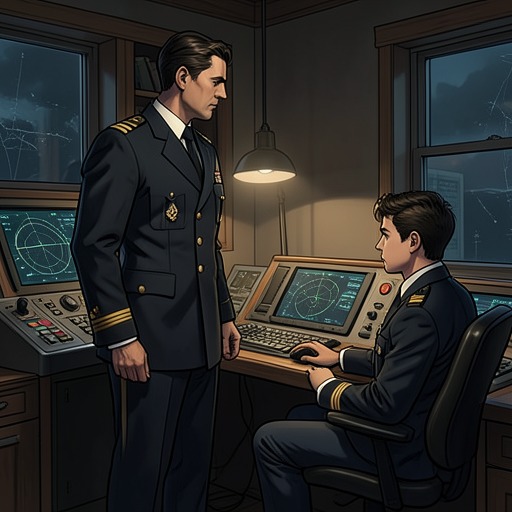
The radar scenes repeatedly show how a weak signal travels through people as well as equipment. A report arrives by voice-tube, giving the bridge a bearing, range, and description of the screen’s condition; Krause then compares that information with Keeling’s course and the convoy’s position. His query about Dodge tests whether another ship can add independent confirmation. Because Dodge’s antenna is lower, that potential redundancy is unavailable, and the contact remains unresolved. The detection chain is thus vulnerable not only to a bad screen but also to the limits of another ship’s equipment and the time required for information to reach the captain.
This uncertainty is consequential because a possible submarine matters even when it cannot be confidently plotted. Keeling’s course is chosen partly to place the ship between the possible pip and the convoy, while Krause considers whether a submarine at the calculated range could appear at all. The instrument contributes to tactical judgment by narrowing possibilities, yet the same scene refuses to turn a return into proof. A steady pip might still be the screen; a lost pip might mean only that the screen no longer shows it.
Narrative significance
Radar’s recurring appearances set visible, measurable information against the hidden threat it is meant to expose. Its rotating antenna offers a regular, almost reassuring motion, but the reports are qualified by poor display, doubtful identification, and the possibility of failure. The difference between seeing a pip and knowing what caused it preserves the uncertainty of the encounter rather than resolving it through technology.
The contrast with the lookouts’ labor also keeps detection human in more than one sense. The men search continuously with binoculars, while radar produces returns that must be interpreted by operators and acted upon by officers. In the first contact, a minute spent away from the bridge lets Keeling continue on a course that carries it away from the likely target; in the later one, a possible return is examined against the course, range, and limitations of a second ship’s antenna. Radar extends the ship’s awareness, but the scenes show that awareness remains partial, procedural, and dependent on timely judgment.