The Cost of Victory and the Moral Burden of Killing
The Good ShepherdThe human cost of victory is the moral counterweight to successful command in the novel’s naval engagements. George Krause must act on incomplete reports, preserve the convoy’s defenses, and attack when the evidence warrants it; yet the destruction of an enemy vessel means the deaths of its crew, and survival elsewhere does not settle the full count of the dead. The narrative makes victory both an operational achievement and an irreversible human consequence, then places that consequence amid threats that allow little time for mourning.
Decisions Under Uncertainty
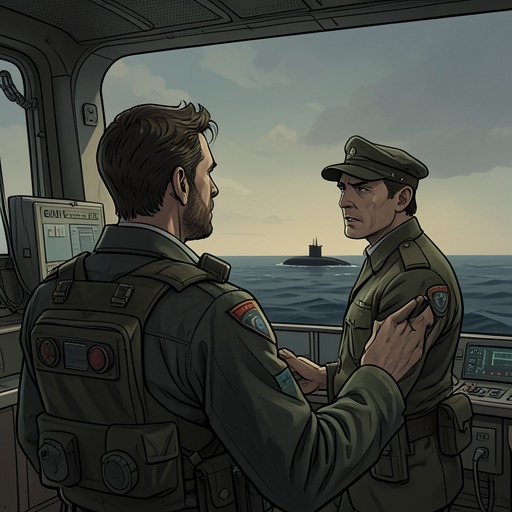
Before any confirmed kill, Krause’s choices show how the cost of combat begins in judgment rather than in its outcome. When James reports a distant contact and asks permission to attack, the report does not establish that a U-boat is present. Krause weighs the possibility against the convoy’s need for its full escort screen: detaching one of only four fighting ships could leave gaps through which other submarines might pass. Fuel is another constraint. James could spend hours searching away from the convoy, then use more fuel at high speed to catch up. The convoy is due to change course in fourteen minutes, turning away from the suspected threat. Leaving the contact alone is therefore a decision about the risks to many ships, not indifference to a possible enemy.
A later high-frequency direction-finding report changes the balance. It places a foreign transmission on a bearing close to the convoy’s path and estimates the source at fifteen to twenty miles. Krause treats this as substantially more certain than James’s possible sonar contact and orders that it be run down. Yet even then, the evidence does not reveal exactly what the submarine will do. After it disappears, possible explanations range from an attempt to intercept the convoy to a routine dive or an exercise. Krause must keep those alternatives open while bringing Keeling within sonar range. The search area expands as the submarine may move, making delay consequential without making its location certain.
The later arrival of an Admiralty warning sharpens the irony of acting with incomplete information. It reports an enemy concentration at the position where Keeling is now operating, but the message is already two hours old. Its timely receipt cannot undo the time needed to relay a course change throughout a convoy or the disorder an unscheduled maneuver might cause. The warning confirms the danger without offering an easy escape from it. The sequence presents command as a series of choices made before their consequences can be known, with the lives at stake extending beyond the combatants visible to Krause.
The Attack and Its Human Consequence
When sonar reports a close contact ahead, Krause orders the depth charges fired. The abrupt change in the contact’s bearing suggests that the U-boat has turned toward Keeling, but the precise positions of both vessels remain uncertain. The submarine may be directly beneath the destroyer, just ahead, or to one side; the sonar equipment works at its shortest range, and underwater explosions will temporarily deafen it. Keeling’s K-guns send charges out on either side in response to that uncertainty. The attack is not a cleanly observed strike but an attempt to cover a small, fast-changing window with weapons whose success cannot be assumed.
The first pattern produces no visible confirmation. Krause sees the explosions, but no submarine emerges and nothing on the surface establishes that it has been hit. He recognizes that the odds of one pattern scoring a hit are low. He also realizes that he has been outside the pilot-house and has lost several seconds before ordering Keeling around again. The episode connects the possibility of a successful attack to the danger of delay and to Krause’s own lapse in concentration: the aim is to save the convoy, but the means require speed and expose the commander to the consequences of his decisions.
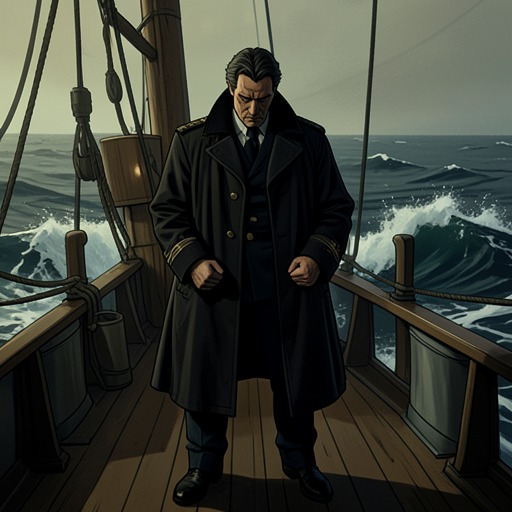
Confirmation comes through Viktor, which reports hearing the submarine break up. Krause’s response is not uncomplicated satisfaction. He understands that fifty men have died below Keeling and that the sinking is also the culmination of more than twenty years of training as a fighting man. The achievement he has pursued and the deaths that constitute it arrive together. The narrative’s fencing comparison gives this contradiction a precise shape: what should have been a controlled contest, with a weapon stopped harmlessly at an opponent’s guard, has instead become a real wound. The image does not undo the tactical success; it makes clear why that success carries a moral burden.
Victory Amid Continuing Loss
The submarine’s destruction does not give Krause time to remain in that moment. His brief numbness ends when he is called again; he returns to duty, with further decisions and responsibilities awaiting him. The movement from confirmed victory back to command is itself part of the theme. The dead are not forgotten, but neither can reflection suspend the defense of the convoy. Combat produces an outcome that must be acknowledged while leaving the living responsible for what happens next.
The same uneasy balance appears when Cadena reports its speed after a torpedo strike on a merchant ship. Krause estimates that the rescue vessel is six miles from the convoy and will take more than two hours to return to station. Behind it, the damaged ship hangs nearly vertical, with only about twenty feet of its bow above the sea. Two abandoned lifeboats mark where the rescued crew boarded Cadena, but Krause does not know how many people died when the torpedo struck. Rescue is real, yet it does not supply the missing number or cancel the loss. He turns Keeling back to the pressing task of avoiding a submarine within torpedo range and preparing the report he will have to make.
Later, the threat appears in the convoy’s own lanes: a submarine attacks nearby, a ship burns, and a machine-gun burst from a ship in the convoy sweeps across Keeling’s pilot-house. The gun crew has mistaken the destroyer for a submarine in the darkness and confusion. The bullets are therefore not enemy fire but fire from a friendly ship, and the glass is broken above Krause’s head. He asks whether anyone is hurt, then moves on without waiting for an answer. The scene complicates the idea of victory further: danger does not come only from the opponent, and the confusion of combat can turn a defender’s weapon against its own side.
Narrative Significance
Across these episodes, the human cost of victory is shown through specific limits on what Krause can know. A possible sonar contact is not proof; a transmission improves the case for action without disclosing the submarine’s movements; explosions offer no immediate confirmation; and a rescue leaves the number of deaths unknown. Later information changes the situation, but it cannot make the earlier decisions simple or restore those already lost. The contrast is between the commander’s obligation to decide and the uncertainty that no successful decision can eliminate.
The narrative also refuses to isolate combat from its wider responsibilities. Krause’s attack is directed at an enemy vessel, but its purpose is the protection of a convoy whose ships may be attacked while the escort pursues a contact. The choice to preserve the screen, the later effort to find the submarine, the rescue by Cadena, and the need to resume defensive maneuvers all place individual deaths within an ongoing collective danger. None makes the losses abstract. The fifty men reported dead remain present in Krause’s understanding of his achievement; the unknown dead from the torpedo strike remain absent from the count; and the friendly-fire incident shows how quickly protection can become another source of peril. Victory matters, but the novel measures it alongside the lives taken, the lives saved, and the lives whose fate cannot yet be known.