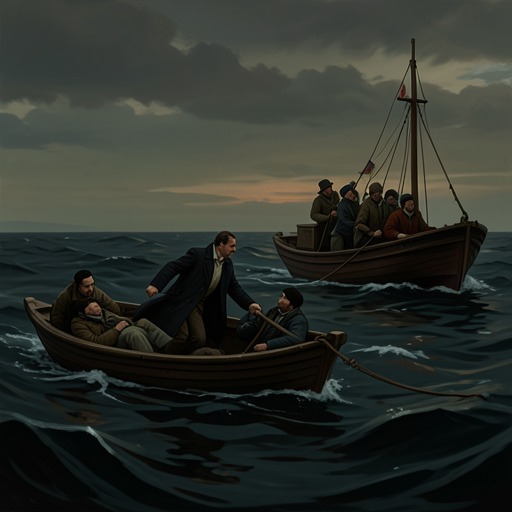
Torpedoing of a convoy ship and the rescue by Cadena
The Good ShepherdThe torpedoing of a convoy ship turns an alarm into a double emergency: survivors must be taken off a vessel already close to capsizing, while the convoy remains exposed to the attacking U-boat. Keeling diverts to cover the rescue, but the ship’s sinking leaves its human cost uncertain. Cadena completes the pickup; the damaged ship and the lifeboats left behind mark both the rescue’s success and its limits.
Warning and sudden change
The incident enters the watch through a talker’s announcement that the after look-out has seen two white rockets from the convoy. Krause understands at once that they signify a torpedoing, yet takes two seconds to react. The delay is rendered as a momentary failure of movement rather than of comprehension: his mind has identified the danger before his body responds. He compares the shock to a fencing bout at the Olympic Games in Antwerp, when an opponent’s riposte touched him just as he was preparing a decisive lunge. The analogy gives the report the force of an unexpected counterstroke, but here the stakes are a ship and its crew.
Krause goes onto the bridge wing and tries to see back along the convoy, which stretches several miles behind Keeling. The after look-out locates the trouble near the last ship in the line. A further signal arrives from the Commodore: general alarm. As Keeling rises on a wave, Krause can make out that the third ship in the second column is out of position and that the ship following it is swerving to avoid it. The damage has already disturbed the formation. Sending the Canadian corvette back would leave it behind the convoy for a long time; between Keeling and Viktor, Keeling is nearer and a destroyer is needed. He commits his own ship to the diversion.
Keeling’s diversion
Keeling answers the emergency with speed and controlled navigation. The engine-room reports all engines ahead full, and the ship is ordered to hold course 275. She passes the leading merchant ship at a distance of about a hundred yards, on opposite courses, narrowly clearing the starboard line. The convoy ships continue plodding forward; they cannot stop to help their damaged sister without disrupting their passage through the threatened waters. Their steady movement contrasts with Keeling’s rapid turn away from its station.
From a gap between the third and fourth ships, Krause catches sight of Cadena, the convoy’s designated rescue ship, already astern of the convoy. Beyond her, two boats rise into view on the waves. Then the sinking ship appears: almost bottom-up, three-quarters turned over and nine-tenths submerged, though still afloat. The long dark line Krause sees is her exposed bilge. Its scale and position make the rescue’s urgency visible before any count of survivors or losses is known.
Rescue alongside Cadena
Keeling resumes its sonar search as the rescue proceeds. The two lifeboats come alongside Cadena, which rolls in the trough to give them a lee and has its scramble-nets lowered. Through his glasses, Krause can just make out men as small specks climbing up Cadena’s dark starboard side. The pickup is practical and exposed: the rescue ship uses its position against the waves to bring the boats close enough for the survivors to climb aboard.
Krause later receives the signal F for fox from the merchant ship. The typewritten signal code identifies it as meaning that the rescue is complete. Completion settles one urgent question, but not the full human accounting. Cadena reports a speed of eleven and a half knots. Krause estimates that the convoy is already six miles away, and that it will take well over two hours for Cadena to regain station. The rescue has succeeded in getting the boat crews aboard, but the time and distance required to rejoin leave the convoy’s escort arrangement altered in the meantime.
Aftermath and cost
The sinking ship remains in sight as Keeling turns back to its protective duties. It hangs vertically, with only about twenty feet of its bow above the sea. Two miles away, the abandoned lifeboats rise and fall on the waves, marking where the crew had climbed aboard Cadena. Wreckage floats nearby. Krause recognizes the debris as the trophies of a Nazi victory, but cannot tell how many people died when the torpedo struck. The narrative does not supply a casualty total or identify the damaged ship by name in this episode; rescue completed is not the same as everyone accounted for.
There is little time to dwell on the loss. With a U-boat still within torpedo range, Keeling cannot remain on the same course for long. Krause orders a turn and directs Cadena to rejoin the convoy at best speed on a modified zigzag. He cautions that the message must not be sent too quickly: Cadena’s recipient is a merchant seaman unpractised in reading signals, and the instruction matters. Even after the boats have been picked up, communication and formation remain part of the rescue’s unfinished work.
Significance within the escort action
The episode sets the limits of protection against the duties of rescue. Keeling can divert to the endangered ship, but its passage through the convoy, the torpedoed vessel’s continuing descent, and the hidden U-boat all demand attention at once. Cadena can lift the survivors from the boats, yet the delay in returning to station leaves the convoy temporarily short of its designated rescue ship. The event therefore resolves one immediate danger without restoring the original security of the formation.
The response also depends on disciplined observation and signaling. Look-outs have to maintain a methodical search because even a brief sighting may decide a convoy’s fate; here their report of the rockets makes the attack legible to Keeling. The Commodore’s alarm, the bridge’s visual assessment, the engine-room’s response, the coded completion signal, and Krause’s carefully paced order to Cadena form a chain in which each report enables the next decision. That chain secures the pickup, but cannot reverse the sinking or establish the number lost. The episode ends with Keeling back at work, steering against another possible attack while the wreckage and unanswered casualty question remain behind.