buck-fever
The Good ShepherdBuck-fever is the name the narrative gives to the acute tension that can impair judgment and action when a submarine encounter makes every response consequential. It is not presented as cowardice: the danger lies in a capable person becoming flustered, clumsy, or slow at the moment precision matters. Krause experiences it himself, so the term describes a human vulnerability within command, not a failing confined to the crew below him.
Meaning and Operational Stakes
The narrative defines the condition through its possible effects on performance. A person may become flustered simply because success depends on accurate manipulation and rapid thought; fingers can seem clumsy and quick wits slow. Fear of failure need not amount to fear of punishment, or even a conscious calculation of the danger. In the sonar room, the stakes are concrete: an inaccurate estimate or delayed reaction can put a depth-charge pattern too far from its target. A charge falling within ten yards could mean a probable victory, while one twenty yards away would mean certain failure.
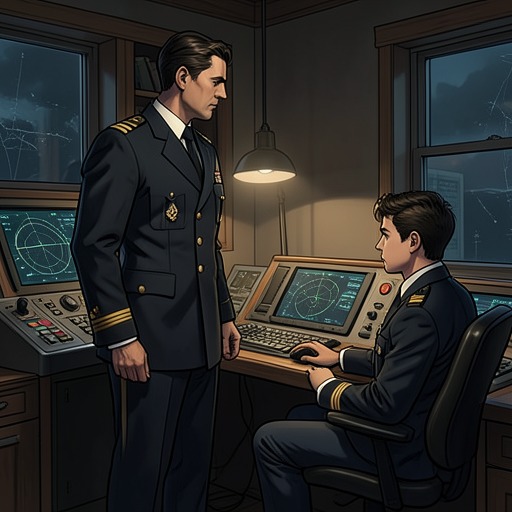
Tom Ellis is the operator whose work makes this vulnerability especially consequential. He had graduated from the Key West Sound School and served aboard Keeling since the war began, but his months listening to sonar pings at sea had not given him practical experience of hearing an enemy submarine’s echo. His training had included a friendly submarine and hurried lessons in enemy countermeasures; he had never played hide-and-seek with a hostile one. The narrative therefore makes uncertainty about his recognition and judgment a training and experience problem as well as a question of nerve. Buck-fever names one possible human interference in a task for which both practiced interpretation and prompt action are essential.
Krause Under Contact
Krause’s first clearly recognized attack of buck-fever arrives as the talker reports contact bearing zero-nine-one, with the range indefinite. He manages only a brief acknowledgment. Sharing the others’ tension, he feels his heart beating and his throat suddenly dry; when he gestures to Watson, he knows his own hand would tremble if he let it. Watson moves to the compass repeater to pass the order to McAlister. Krause’s awareness of the tremor does not make him immune to the condition; it makes the physical signs part of his recognition of the pressure on the bridge.
The pressure returns after Keeling drops a depth-charge pattern. Krause has gone out onto the bridge wing to watch the explosions, but when he comes back into the pilot-house he realizes that five seconds have passed since the last blast—enough time for the U-boat to travel a hundred yards toward safety. He identifies the delay as buck-fever and a neglect of duty, then orders a hard turn. Here the term attaches not merely to a sensation but to a consequence: attention fixed on the spectacle of the attack has displaced the immediate work of maneuvering.
Later, when sonar reports contact bearing two-zero-five, Krause makes prevention explicit: there must be no buck-fever on the bridge, and he would rather spend a second now than allow confusion to arise later. He gives Watson the conn so he can direct two ships himself. The episode shows command as an allocation of attention: Krause recognizes that the risk is not removed by willing himself calm, and separates responsibilities before excitement can muddle them.
A Changing Condition, Not a Simple Cure
The narrative marks a change in Krause’s response during the prolonged engagement. As the deeper-set charges take longer to sink and explode, he can stand still through the interval; their lower, more muffled boom accompanies the observation that buck-fever is less evident. This is a partial easing, not proof that fatigue or danger has disappeared. The condition fluctuates with the demands of the encounter rather than resolving once and for all.
That distinction matters aboard Keeling, where continuous readiness and inadequate rest create a wider context for human limits. Krause cancels the routine general-quarters call before dawn so the watch below can have a full four hours unless an emergency occurs. The ship is already strained by Condition Two, new weapons and instruments, extra personnel, and too few trained ratings for three watches. Buck-fever is thus one acute form of impaired performance in an operation also shaped by workload and rest; the narrative does not reduce every lapse to character or courage.
Narrative Significance
The repeated term links bodily signs, tactical errors, and practical safeguards. A dry throat and a potentially trembling hand belong to the same continuum as delayed maneuvering and the danger of confused orders, but they do not establish cowardice. Krause’s response is to notice the impairment, correct the immediate lapse, and arrange the work so that one person’s excitement does not become the bridge’s confusion. By showing the commander subject to buck-fever himself, the narrative makes self-command a continuing task under pressure rather than a quality that command rank guarantees.