Andrei Ivanovich's letter to the Mayor
The Government InspectorAndrei Ivanovich's letter to the Mayor is the private warning that makes an unseen government inspection feel imminent. It reports that an official from Saint Petersburg has instructions to inspect the government, especially the district, and may already be hiding in town under the appearance of an ordinary traveler. The letter gives the officials a reason to fear scrutiny—and a pattern by which they will misread what they see.
The Warning and Its Delivery
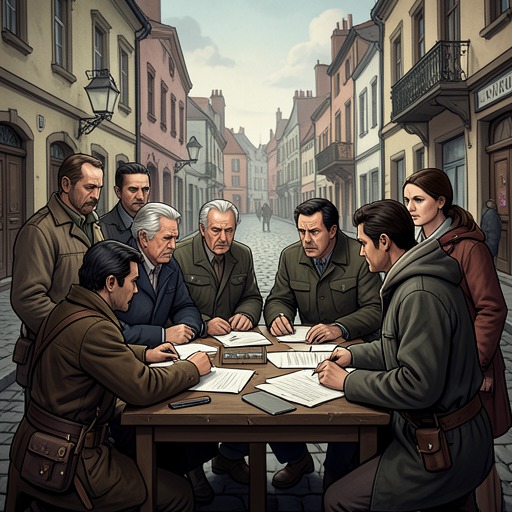
Anton Antonovich Skvoznik-Dmukhanovsky reads the letter aloud to the assembled officials. Before he reaches it, he mentions a presentiment and a dream of two enormous black rats; these are his own forebodings, not details reported in the letter. He then scans the page rapidly, sometimes mumbling and pausing as he reads, while the prospect of an inspector with secret instructions takes hold of his listeners.
The letter says its information comes from highly trustworthy sources. It warns that the official is pretending to be a private person, advises Anton Antonovich to take precautions, and says the inspector may arrive at any hour—or may already be staying somewhere incognito. That last possibility gives the warning its practical force: an ordinary guest can now be interpreted as a concealed agent of the state.
A Threat Mixed with Ordinary News
The letter does not sustain its alarm from beginning to end. After warning Anton Antonovich about his little peccadilloes and urging him to be on guard, Andrei Ivanovich turns to family news: his sister Anna Krillovna is visiting with her husband, Ivan Krillovich, who has grown fat and is always playing the fiddle. Anton Antonovich dismisses these details as family matters and returns to the danger facing the town.
The abrupt shift from covert inspection to domestic gossip makes the letter feel like an ordinary piece of correspondence carrying an extraordinary warning. Its casual familiarity between sender and recipient also sharpens the contrast between private communication and public authority: a friendly note becomes the source of a crisis for the entire local administration.
From Warning to Official Panic
The warning prompts Anton Antonovich to suspect that the merchants and townspeople have denounced him. He asks Ivan Kuzmich Shpekin to open letters passing through the post office and look for information against him, presenting the intrusion as being for the common benefit. Ivan Kuzmich replies that he already opens letters, less as a precaution than from curiosity. The episode turns the letter's report of hidden surveillance into a local appetite for surveillance of its own.
The officials respond to the possibility of inspection with appearances rather than reform. Anton Antonovich directs that a sergeant stand on the bridge, that a broken-down fence near a bootmaker be made to look like a grading project, and that dissatisfied residents be made to give reassuring answers. His proposed show of activity sits beside his complaint about the rubbish dumped against the fence and his plan to levy wax from the merchants for a candle if the crisis passes. The letter's warning thus exposes the gap between the orderly district officials claim to present and the coercion and disorder they scramble to conceal.
Incognito and the Comedy of Rank
By announcing that the inspector may be traveling incognito, the letter helps create the conditions for a mistaken identity: the officials are primed to treat a private-looking stranger as a powerful representative of the center. The news is about inspection, but its effect spreads into a broader performance of rank. Ammos Fiodorovich Liapkin-Tiapkin introduces himself by his judicial office and college-assessor rank; the supposed inspector later boasts of access to ministers and of once directing a department, while Anton Antonovich imagines that association with such influence might bring him a generalship.
These later displays do not verify the letter's report; they reveal how completely its threat governs the officials' interpretations and ambitions. The letter supplies no name for the inspector and no means of distinguishing him from an ordinary traveler. In that gap, the town's fear turns a warning about concealed authority into a license to mistake, flatter, and hope for advancement.