Behind his laughter you feel the sad tears
The Government InspectorBehind his laughter you feel the sad tears names the double force of The Government Inspector: its comic misrecognitions and extravagant boasts provoke laughter, while the abuses they reveal make that laughter painful. The expression also marks a shift in Gogol’s own understanding of the play, from an intended comedy of fun toward a work that gathered injustice into a single, forceful object of ridicule.
Meaning and Development
Pushkin’s remark about sorrow beneath Gogol’s laughter became especially apt for The Government Inspector. Gogol began writing the comedy at the end of 1834, when he was twenty-five, and continued revising it after its first production in 1836; its final form was not reached until 1842. The account of this eight-year process describes the subject’s possibilities as unfolding gradually. What began as an ambition to make a comedy of pure fun became a more serious artistic undertaking, one that changed the direction of Gogol’s work.
Gogol himself described the change as a movement away from childish amusement and toward ideas he considered truthful. Encouraged by Pushkin to take the subject seriously, he resolved to collect the injustices he knew from Russian places and human relationships where justice was especially required, and to laugh at them together. He recognized that the resulting laughter was unusually forceful and that readers sensed profound sorrow through it. The expression therefore does not mean that the comedy merely conceals a private sadness: it identifies how laughter becomes the means by which the work makes injustice perceptible.
Comic Misrecognition and Performance
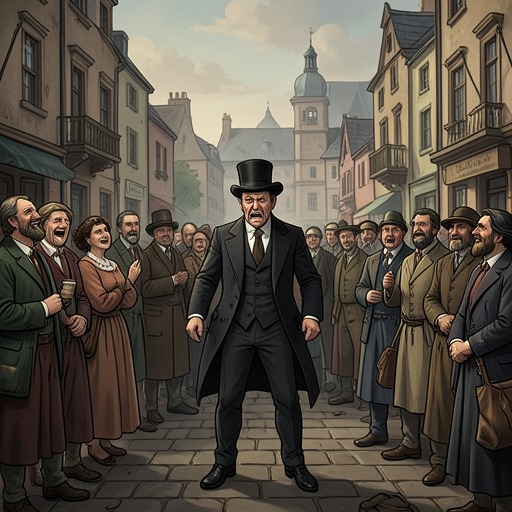
The play gives that double effect a comic engine in the town’s mistake about Khlestakov. Piotr Ivanovich Dobchinsky reports that the young visitor has been staying at the inn for a second week, has not left, and has not paid; the innkeeper says he is an official from Saint Petersburg traveling toward Saratov. Dobchinsky treats these circumstances as signs that something exceptional is happening. The Governor, hearing the report, reacts with terror, and Dobchinsky insists that the visitor must be the expected inspector. What looks to the officials like evidence of authority is, to the audience, a description of a stranded guest in debt. Their alarm turns the gap between appearance and reality into comedy.
Khlestakov’s own uncertainty intensifies the contrast. When the Governor offers the town’s chief magistrate’s services to prevent visitors of rank from suffering inconvenience, Khlestakov begins haltingly, explaining that he is not at fault and will pay when money arrives from home. His embarrassed dependence does not resemble the authority the officials project onto him. The scene makes their fear comic, but it also shows how readily a system organized around rank and inspection reads even an ordinary predicament as a threat.
Later, Khlestakov’s boastful account of life among ministers, ambassadors, counts, and princes sends the Governor and the other officials rising in awe. He claims that his mail is addressed to him as Your Excellency and recounts being asked to take charge of a department, with thirty-five thousand couriers supposedly summoned to urge his acceptance. The boasts grow more extravagant as he speaks, and the officials tremble with fright. Their response makes the scene a comedy of performance and credulity; beneath it lies a society so anxious about status that an invented display of power can command obedience.
Laughter and the Evidence of Injury
The sorrow beneath the comedy becomes harder to separate from its laughter when people harmed by the Governor speak for themselves. A merchant tells Khlestakov that the Governor has quartered soldiers on them, taken goods from their shop for his household, and treated them abusively. The merchant’s account gives concrete substance to the corruption that the officials’ fear and ceremony had obscured: the Governor’s power reaches into trade, property, and the merchants’ ability to make a living.
A locksmith’s wife brings another specific grievance. The Governor, she says, ordered her husband to be shaved and sent as a soldier before his turn, although he was a married man and the action was against the law. Her complaint shifts the scene from the town’s comic confusion to the personal consequences of arbitrary authority. The contrast does not cancel the comedy; it reveals what its targets cost other people.
The final report that the man they took for a Government Inspector is not one exposes the mistake on which the officials’ performance depended. The announcement produces collective astonishment, but it also turns their earlier certainty against them: the power they feared was largely their own projection. The reversal is funny because their confidence collapses at once, and troubling because the abuses described by the merchants and the locksmith’s wife remain real regardless of the imposture.
Social Force and Critical Tension
The expression also points to a tension in the play’s interpretation. Gogol’s stated moral emphasis fell on individuals: he believed that if people acted morally, the system he did not question could work well. On this view, the comedy holds characters’ actions up to ridicule and invites personal self-correction. Yet the play’s effect exceeds that intention. Its presentation of a whole municipality’s officialdom makes corruption appear not as an isolated flaw but as a recurring feature of public power, while the complainants’ testimony supplies the human consequences.
The play’s first reception reinforced the seriousness carried by its laughter. Under the strict censorship of Nicholas I’s reign, permission to stage it required influence; Zhukovsky secured the Czar’s personal intercession, and Nicholas attended the April 1836 premiere, laughing and applauding. Official Russia nevertheless reacted with indignation. Critics called the work improbable, coarse, plotless, and populated by caricatures, objecting that its town had not a single honest person. The dispute shows that the comedy’s laughter did not remain safely within entertainment: it made the conduct of officialdom a public subject of argument.
For the Russian audience described in the account, the work endured as a sharp satire of a system they did not expect to be regenerated while its governing arrangements persisted. The phrase about sad tears thus describes both a dramatic experience and a critical recognition. The audience can laugh at the officials’ panic, Khlestakov’s grand inventions, and the eventual exposure of the mistake; it can also see the injuries that their world produces. The comedy’s lasting force lies in keeping those responses together rather than allowing laughter to soften the charge of injustice.