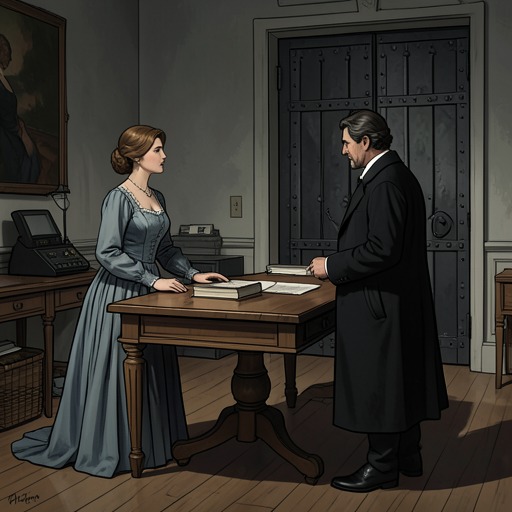
Bob Chinkowski and Dobchinsky mistook Khrystakov for a special envoy
The Government InspectorThe mistaken identification of Khlestakov by Piotr Ivanovich Bobchinsky and Piotr Ivanovich Dobchinsky transforms a routine visit to the inn into a crisis for the whole town. After the Governor hears that an inspector from Saint Petersburg has arrived incognito, with secret instructions, the two men report that a young traveler lodging at the inn must be that inspector. Their inference is wrong, but the details they assemble make it persuasive to frightened officials—and set in motion a succession of efforts to look orderly, win favor, and protect private interests.
The Warning and the Inn Visit
The report arrives against a background of uncertainty. Anton Antonovich Skvoznik-Dmukhanovsky has been warned that an official is coming to inspect the government, especially his district. He tells the assembled officials that the inspector is from Saint Petersburg, is traveling incognito, and has secret instructions. He also recalls dreaming of two enormous black rats shortly before receiving the news. The dream gives the warning an ominous, almost prophetic cast, but no evidence yet identifies the inspector or confirms that he has reached the town.
Bobchinsky and Dobchinsky begin their account with an ordinary errand. They had gone to obtain a small keg of French brandy, then changed direction toward the inn because Dobchinsky had not eaten since morning and had heard that fresh salmon was available. There they saw a young man walking about in civilian clothes. Bobchinsky recalls an unusual, full quality in the stranger’s face and manner, and accompanies his description with a conspicuous hand gesture at his forehead. The impression is vague; what matters is that the pair already takes the stranger’s appearance as a clue that something unusual is happening.
How Suspicion Becomes Certainty
The men ask Vlas, the innkeeper, who the traveler is. His account supplies the circumstantial facts that they take for proof: the young man is an official named Ivan Aleksandrovich Khlestakov, traveling from Saint Petersburg to the Saratov Governorate; he has been at the inn for a second week, has not left, and has not paid his bill, taking everything on account. His postchaise is also ordered for Saratov. These details establish that Khlestakov is a stranded traveler with debts and a destination beyond the town, not that he has secret orders to inspect local officials.
Bobchinsky and Dobchinsky nevertheless connect the traveler to the warning they have just heard. Their repeated exclamation of recognition marks the leap from possibility to certainty: because an official from Saint Petersburg is staying at an inn and behaving in a way they cannot explain, he must be the inspector. Bobchinsky stresses that Khlestakov seemed alert and had looked closely at the food on their plates while they were eating salmon. The scrutiny is trivial and ambiguous, but the two men interpret it as the watchfulness of an investigator. The report offers no independent confirmation of Khlestakov’s identity; its force comes from the way the details are fitted to the Governor’s fear.
The Report’s Immediate Effects
Anton Antonovich Skvoznik-Dmukhanovsky reacts with terror, asking whether the stranger can really be the expected official. The visitors’ certainty gives the rumor practical authority: the officials now behave as though they face an inspection, even though the identifying evidence remains circumstantial. The Governor’s earlier warning that the inspector is incognito and has secret instructions has made concealment itself seem like proof of danger.
The response reveals what the officials believe an inspection threatens. Anton Antonovich orders visible signs of activity: a tall sergeant is to stand on duty at the bridge, and an old fence near a bootmaker’s is to be pulled down and replaced with a post and straw to suggest roadwork. He directs officials to report themselves satisfied and threatens anyone who says otherwise. The hurried staging does not correct the town’s problems; it makes the appearance of administrative diligence the immediate priority. His distracted departure with a hat-box instead of his hat gives the scramble a farcical physical detail.
The same fear prompts Anton Antonovich to ask Ivan Kuzmich Shpekin, the postmaster, to open letters passing through the office and look for information against him. Shpekin says he already opens letters out of curiosity. A mistaken guess about one traveler thus encourages a broader invasion of correspondence: the officials attempt to control not only what the inspector sees, but also what might be known about them.
A Mistake That Governs the Plot
The mistake becomes consequential because Khlestakov’s actual circumstances can be read as signs of hidden power by people already expecting surveillance. When Anton Antonovich offers assistance to the apparently money-strapped visitor, Khlestakov asks to borrow two hundred rubles so that he can settle his account with the innkeeper. The Governor treats the request as part of an encounter with a dangerous superior rather than as the straightforward need of a traveler who cannot pay. Later, Khlestakov boasts of a life among ministers and ambassadors and claims to have taken charge of a department; the officials rise in awe, while his escalating claims deepen their mistaken view of his rank.
The consequences reach beyond the officials’ private panic. Ammos Fiodorovich Liapkin-Tiapkin presents himself formally as the local district judge, then eagerly lends money to Khlestakov. A merchant later accuses Anton Antonovich of quartering soldiers on residents, taking goods from shops, and demanding cloth for his household. At the other end of this chain of misreading, the Governor imagines that closeness to Khlestakov and his supposed access to ministers might bring promotion to general. Each response extends the original error: the man whom the officials fear and flatter becomes a channel through which they attempt to secure advantage, even as residents use his apparent authority to voice complaints.
The episode’s comedy depends on the gap between what the two visitors know and what their conclusions claim. They accurately relay Khlestakov’s name, destination, delay, debt, and the innkeeper’s account, yet turn those observations into an unsupported identification. The audience sees the mechanism of the error as it happens: an official warning creates an expectation, ordinary details are made to fit it, and the Governor’s fear converts conjecture into action. In Gogol’s larger satirical design, the encounter exposes a local administration more alert to the possibility of being watched than to the abuses taking place under its own authority.