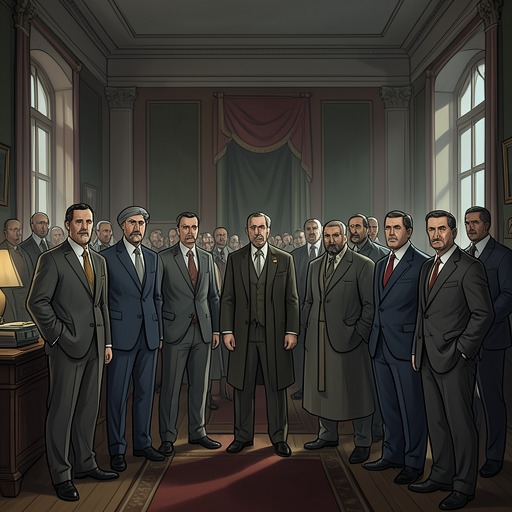
Everybody gets it, and I most of all
The Government Inspector“Everybody gets it, and I most of all” is the Czar’s reported response to the premiere of The Government Inspector in April 1836. The remark condenses the comedy’s central paradox: a play that ridiculed municipal officials could be received as a joke by the sovereign, even as its attack on bureaucratic corruption reached beyond the town and toward the state’s highest servants.
The Remark at the Premiere
Strict censorship under Nicholas I made permission to stage the comedy difficult to obtain. Gogol’s friend Zhukovsky secured the Czar’s personal intercession, and the Czar attended the first production in April 1836. He laughed and applauded; he was then said to have observed, “Everybody gets it, and I most of all.” The qualification matters: the reported response places the ruler inside the circle of those touched by the satire, rather than presenting him as a detached spectator, though the account does not establish precisely what he meant by including himself.
The remark belongs to the play’s reception as well as to its history on stage. It points to a public occasion on which the comedy’s targets and its audience briefly converged: the sovereign who had helped make the production possible was also, by his reported words, among those who recognized its reach.
What “Everybody” Is Made to See
The comedy’s immediate objects of ridicule are the officials of a typical Russian municipality. Its action turns on their mistaken belief that Khlestakov, a visiting official from Saint Petersburg, is an inspector travelling incognito with secret instructions. The premise lets their own conduct supply the evidence against them: they fear scrutiny because corruption and abuse already shape the administration they are trying to defend.
The visitor’s circumstances sharpen the comic mismatch. Khlestakov is headed for Saratov Governorate, has remained at the inn for a second week without leaving, and has been taking services on account rather than paying. When the Governor confronts him, Khlestakov initially speaks haltingly and says money will be sent from home. Yet the officials read their own anxieties into his presence and treat him as a powerful examiner. The contrast between the modest predicament they can observe and the authority they imagine gives the satire its dramatic irony.
As Khlestakov’s boasting grows, the officials’ fear grows with it. He describes a seven-hundred-ruble watermelon, soup supposedly sent from Paris by steamer, and card games with foreign ambassadors and the Minister of Foreign Affairs. He also claims that his mail is addressed “Your Excellency” and recounts being asked to take charge of a department after thirty-five thousand couriers supposedly crowded the streets. The Governor and the other officials rise in awe and then tremble as Khlestakov works himself up. Their response makes the phrase’s “everybody” concrete: the false inspector’s performance is sustained by an audience eager to believe in the rank and power it fears.
Satire Beyond the Town
The play’s social force lies in the scale of its target. Its realistic form presents municipal officials directly as objects of ridicule, while its treatment of their corruption points indirectly to the same graft among higher servants of the crown. The account of the comedy describes it as an attack, under the cover of humor, on officialdom as an instrument of government. The Czar’s reported remark resonates with that two-level design: the town is the immediate setting, but the joke does not stop at its borders.
The phrase also stands against the officials’ own assumptions about rank. In the play, authority is treated as something to fear and imitate; the Governor, after hearing Khlestakov’s claims, imagines that proximity to ministers and the court might bring him promotion to general. The officials’ readiness to mistake an indebted visitor for a powerful inspector shows how status anxiety makes their error possible. They are not merely deceived by Khlestakov; they supply the importance they believe he must possess.
Controversy and the Joke’s Afterlife
The reported amusement at court did not settle the comedy’s reception. Official Russia and its supporters reacted with indignation. Bulgarin led the attack, and critics described the play as unoriginal, improbable, coarse, vulgar, plotless, and dependent on a stale anecdote; they also objected that its town contained no honest person. These complaints register the force of the work’s collective portrayal: the satire was not confined to one corrupt official but implicated an entire local administration.
Gogol was distressed by the uproar. Four days after the first production in Saint Petersburg, he wrote to Shchepkin that he was sick of the play and the fuss, that people abused him while going to see it, and that tickets could not be obtained for the fourth performance. The account says he fled his enemies beyond Russia. At the same time, leading literary figures, including Pushkin and Bielinsky, supported him. The phrase therefore survives in a divided reception: laughter and applause at the premiere, a storm of hostile criticism, packed performances, and influential literary backing.
Laughter with a Serious Edge
Gogol’s own explanation gives the comedy’s laughter a moral and political weight. He said that Pushkin had led him to take his writing seriously and that he resolved to gather the injustice he knew in Russia into one heap and laugh at it. He also acknowledged that readers sensed profound sorrow through the laughter, and that this laughter no longer resembled his earlier, carefree writing. The reported line at the premiere acquires force against this account: amusement does not cancel the indictment but coexists with it.
The introductory account presents The Government Inspector as a turning point in Russian literature because it challenged accepted theatrical conventions while exposing the corruption of government officials. Its claim that the play helped establish a tradition followed by later major writers places the remark within a larger change in what comedy could address. “Everybody gets it, and I most of all” thus names more than a witty response: it captures the unsettling reach of a comedy whose targets could recognize themselves even as they laughed.