Fevronya Petrova Poshliopkina
The Government InspectorFevronya Petrova Poshliopkina is a townsman’s wife who brings a complaint of unlawful conscription before Khlestakov. Identified as the wife of a locksmith, she says that a local official ordered her husband to be taken for military service before his turn, despite the protection she claims his married status affords him. Her short appearance turns the play’s exposure of municipal misconduct into a specific grievance carried by someone directly affected by it.
Identity and Introduction
The play’s cast list identifies Fevronya Petrova Poshliopkina as the locksmith’s wife. When she appears in Scene XI, the designation is made more precise: she gives her full name and identifies her husband as a locksmith and a burgess of the town. The repeated identification anchors her not in the official hierarchy but in the local population subject to it. Her husband remains unnamed; she enters the scene as the person who can state what has been done to him and why she believes it is unlawful.
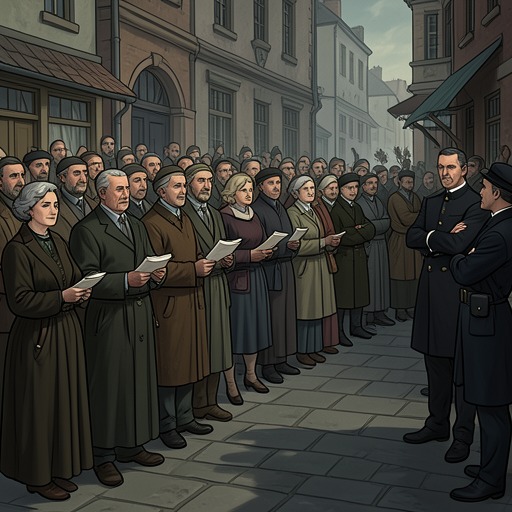
She arrives together with the Widow of a non-commissioned officer, another petitioner seeking redress. Their joint appearance places Fevronya among ordinary residents who bring injuries caused by town authorities directly to the person they take for an inspector. The scene gives her no separate biographical history or account of life before this visit. Instead, her identity is established through her local standing, her marriage, and the claim she has come to make.
The Conscription Complaint
Fevronya’s account is concrete: an official ordered her husband to have his forehead shaved for military service, although their turn had not come. She argues that the order also violated the law because her husband was a married man. Her petition thus rests on two stated grounds—the premature timing of the conscription and her husband’s marital status. The text presents these as her claims; it does not supply an independent ruling on the law or explain the official’s reasoning.
The injury is conveyed through the forced shaving, a bodily consequence that makes the administrative abuse more immediate than a general accusation of unfairness. Fevronya does not describe a distant policy or speak abstractly about the town’s government. She identifies the order, the person it affected, and the circumstances that made it wrong in her view. Her complaint gives the audience a household-level instance of authority reaching into private life.
Her Audience and the Scene’s Dramatic Irony
Fevronya brings her case before Khlestakov, whom the town’s officials have mistaken for an inspector from Saint Petersburg. After hearing her allegation, he asks how the official could have done such a thing. The exchange establishes that her grievance has been voiced and registered in the encounter, but the supplied scene does not show a judgment, remedy, or later consequence for her husband. The limits of what is shown matter: the petition is heard, but its practical outcome is left unstated.
The setting gives the appeal a sharp irony. Fevronya addresses someone treated as a powerful inspector, while the audience knows that Khlestakov is not the authority the town believes him to be. Her complaint therefore reaches the apparent center of state oversight through a mistaken identity. The scene does not establish what Fevronya herself knows about him; it shows only that she presents the grievance and receives his response.
Narrative Role and Significance
Fevronya’s appearance supplies a specific example of the harm concealed by official titles and administrative routines. The reported order concerns a named family relationship and a claimed legal protection, not merely an untidy office or a failing public department. Through her, the play’s wider picture of local misrule acquires a petitioner’s voice and a visible consequence for an individual household.
Her role remains brief and narrowly focused. She is not shown pursuing the complaint beyond this audience, and the text does not reveal whether the conscription is reversed. That unresolved ending keeps attention on the imbalance within the encounter: Fevronya can state the wrong, but the scene offers no confirmation that anyone with genuine authority will correct it. Her petition consequently stands as both testimony to a particular abuse and an example of how much depends on the unreliable appearance of official power.