Graft no higher than your rank
The Government Inspector“Graft no higher than your rank” is a rule of corrupt administration in The Government Inspector, not a prohibition on taking illicit advantage. It sets a limit: subordinates may participate in graft, but must not reach beyond the authority and status assigned to them. The Governor enforces this hierarchy even as he exploits his own position, making the maxim a compact expression of a system that regulates corruption rather than ending it.
Meaning and Reach
In the play’s broader account of Russian officialdom, the rule passes down through the town administration to the policemen, though they do not always observe it scrupulously. The commentary extends its reach beyond the town, suggesting that the same arrangement operates in villages and hamlets. The maxim thus describes not one isolated abuse but a pattern in which each rank has its own scope for predation, with those below expected to recognize the boundaries set by those above.
The rule’s force comes from its plain hierarchy. It does not ask officials to serve the public or obey the law; it tells them how far their self-interest may extend. The play’s satire rests on this contrast between formal administrative responsibility and the private conduct that takes its place. In the accompanying critical account, such corruption is connected to Russian despotism: officials wield power over people with little prospect of redress, while the ranking order gives their abuses a shape and a limit.
The Governor’s Enforcement
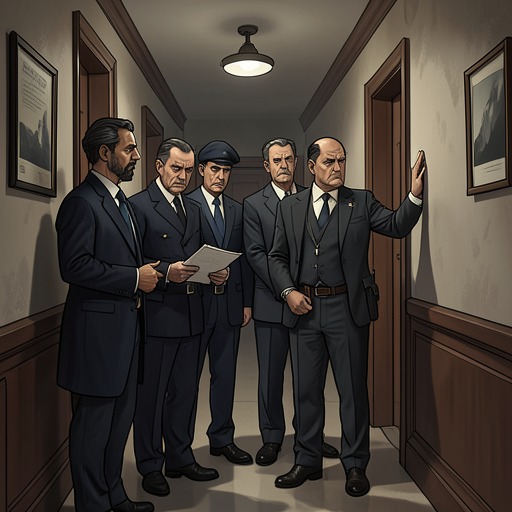
The Governor makes the principle concrete when he rebukes a Sergeant for taking an entire piece of cloth that had been given for a uniform. He accuses him of pocketing more than his station permits, reminds him that he is only a Sergeant, and orders him not to graft above his rank. The rebuke is not a call for honesty. It is a superior’s warning that a subordinate’s theft has become too conspicuous or ambitious, and a demonstration that the Governor claims authority to police the distribution of illicit gain.
The same scene places this reprimand beside the Governor’s own grievance against a merchant who has not supplied him with a new sword. He complains that the merchant is a sharper and suspects that petitions against him are being prepared. He then orders the Sergeant and policemen to sweep the street to the inn, while warning them against stealing silver spoons from the inn or taking more uniform cloth than they are entitled to. His concern for orderly conduct is inseparable from private advantage: the town must appear prepared for inspection, and subordinates must not embarrass the authority that profits from the system.
Inspection and Official Performance
The rule operates in a town suddenly threatened by an inspector from Saint Petersburg, said to be travelling incognito with secret instructions. The Governor’s response is not to investigate the administration’s failures but to arrange appearances and control what the visitor might learn. He orders the hospital patients to be made presentable and tells the judge to remove geese from the courthouse entrance hall, where petitioners usually wait. These details show how an inspection threat turns administrative responsibility into hurried concealment rather than reform.
The Governor also instructs officials to assure the inspector that they are perfectly satisfied, warning that anyone who says otherwise will face consequences later. He even plans to make a neglected fence look like evidence of road work by putting up a post with straw, reasoning that visible debris will suggest activity. Such preparations reveal the same logic as the rank-based rule: officials manage the signs of misconduct and obedience, while the underlying practices remain in place. His desire to levy wax from every merchant for a candle if the inspection ends well further shows how public office and private extraction merge in his thinking.
Hierarchy, Fraud, and Irony
The rule’s significance sharpens when the supposed inspector, Khlestakov, boasts of imagined influence at the center of government. He claims that his mail is addressed “Your Excellency,” describes taking charge of a department, and says that thirty-five thousand couriers filled the streets when he was summoned to lead it. The Governor and the other officials rise in awe. Their response exposes how completely they measure power by rank and proximity to the highest offices; the rule that disciplines a Sergeant also shapes their fear and ambition before an authority they believe stands above them.
The Governor immediately turns that mistaken belief into a vision of his own advancement. Since he imagines Khlestakov to be close to the ministers and the court, he asks Anna Andreyevna whether he can become a general. His hope of promotion does not challenge the hierarchy but seeks a higher place within it. Across the play, therefore, the maxim is both an instruction to subordinates and a key to the officials’ larger ambitions: corruption is tolerated as long as it respects rank, while rank itself remains the measure of who may take, command, and aspire.