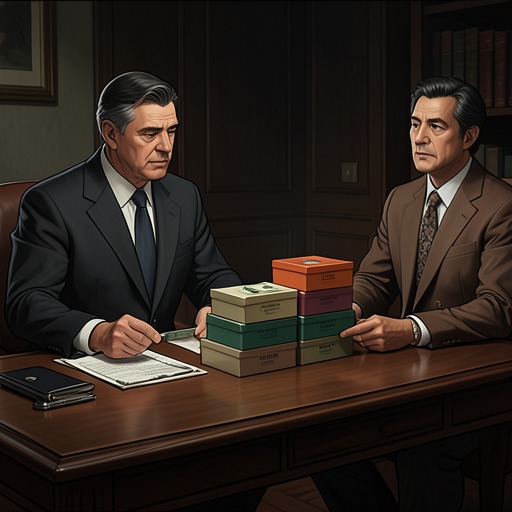
Local officials competed to bribe Khrustalov
The Government InspectorThe officials’ payments to Khlestakov are the central comic transaction of their mistaken-identity panic: fearing an incognito inspector, they offer cash as purported loans, and he accepts without recognizing the officials’ calculations. The sequence exposes a local administration in which public duty is repeatedly displaced by private self-protection. Its irony lies in the gap between the officials’ anxious understanding of the money and the uncomplicated language of borrowing through which Khlestakov receives it.
Background: An inspector feared in secret
The payments begin with the Governor, Anton Antonovich Skvoznik-Dmukhanovsky, treating the report of an inspector from Saint Petersburg as a threat to his position. The visitor is said to be incognito and to carry secret instructions. The Governor’s alarm is already entangled with suspicion: he tells Ivan Kuzmich Shpekin that merchants and townspeople trouble him, and asks the postmaster to open letters passing through the office to discover whether any contain information against him. Shpekin admits that he already opens letters, ostensibly out of curiosity. The proposed use of private correspondence as a channel of official surveillance shows how quickly fear of inspection turns into another abuse of office.
The Governor also orders cosmetic preparations for the visitor. Sergeant Pugovichyn is to stand on the bridge for appearance’s sake; a fence near the bootmaker’s is to be pulled down and replaced with a post and straw to suggest road work. The Governor notes that about forty cartloads of rubbish lie against the fence, then instructs officials to report themselves as perfectly satisfied and threatens anyone who says otherwise. His wish to look active and keep complaints quiet gives the later money offerings a context: the administration is trying to manage what an inspector might see, not to correct the conditions under scrutiny.
The Governor’s offer and Khlestakov’s requests
When the Governor meets Khlestakov, he reads the young man’s behavior as a calculated attempt to conceal his intentions. He decides to try anyway, then offers financial help as a duty owed to a stranger in town. Khlestakov answers plainly that he needs money to settle with the landlord and asks for two hundred rubles, adding that even less would do. The exchange carries two meanings at once: the Governor is trying to accommodate a person he takes for a powerful inspector, while Khlestakov treats the offer as a convenient loan.
The pattern recurs as other officials come to present themselves. Ammos Fiodorovich Liapkin-Tiapkin, the district judge, introduces himself formally as a College Assessor. After he becomes visibly distressed, Khlestakov tells him to lend the money; Ammos responds eagerly. The scene makes the unequal understanding legible through action: the judge arrives with the bearing of an official presenting himself to authority, but the encounter becomes a payment before any substantive inspection has taken place.
With Ivan Kuzmich Shpekin, the transaction is more explicitly calculated on Khlestakov’s side. He first thinks to himself that he will ask the postmaster for a loan, then tells him that an accident on the road has left him short of cash and asks for three hundred rubles. Shpekin agrees readily. He has just acknowledged that opening letters is a practice he enjoys, and the contrast is pointed: a man who intrudes on other people’s correspondence now hands over money to the person he believes can judge the town’s administration.
Khlestakov makes the same request to Luka Lukich Khlopov, the school superintendent, presenting his lack of cash as an accident on the road and asking for three hundred rubles. He asks Artemy Filippovich Zemlianika for four hundred on the same pretext, and Artemy agrees. The repetition turns the supposed accident into a reusable formula. Each official receives the request within the climate of fear created by the inspector’s supposed authority; Khlestakov, meanwhile, presents it as a simple personal need.
Bribes disguised as loans
The officials’ euphemism matters because neither side needs to name the bargain aloud. Khlestakov calls the money a loan, while those who provide it are acting under the pressure of a perceived inspection. The Governor’s earlier offer to help a stranger becomes the first instance of a sequence in which public standing and private cash flow together. The sums rise from the Governor’s proposed two hundred rubles to repeated requests for three hundred and Artemy’s four hundred, but the material differences do not alter the transaction’s basic structure: the officials supply money, and Khlestakov accepts it.
Khlestakov’s own claims intensify the officials’ fear. He boasts of extraordinary access to ministers and ambassadors, says that his mail is addressed to him as Your Excellency, and recounts having been invited to take charge of a department after its head disappeared. In his account, thirty-five thousand couriers fill the streets to summon him to the post, and he describes his command over the department as so intimidating that its employees tremble. The Governor and the other officials rise in awe as he speaks, then tremble with fright. Against that display, their payments look less like ordinary lending than a response to the authority they imagine him to possess.
The merchants’ appeal makes the distinction between a claimed loan and a gift or bribe still sharper. They accuse Anton Antonovich of forcing them to quarter soldiers, taking goods from their shops, and demanding cloth for his household; one says the Governor has taken nearly forty yards of cloth. When the merchants offer bread, salt, sugar, and a basket of wine, Khlestakov says he does not take bribes but would accept a loan of three hundred rubles. His response does not end the exchange of benefits; it relocates it into a form he is willing to accept. The merchants’ account also supplies a concrete counterpoint to the officials’ anxious performances: the local corruption feared by the residents is not merely a possibility anticipated by the inspection but a grievance they describe from experience.
Dramatic and political significance
The sequence makes mistaken identity a mechanism that brings concealed habits into the open. The officials believe they are managing the risk posed by an inspector, yet their attempt to manage him reproduces the self-serving conduct they should be prepared to answer for. Their rush to provide money, set beside the Governor’s threats against dissatisfied residents and his staged repairs, shows that apparent compliance is being organized for display. The visitor’s supposed authority changes their behavior, but only into forms of concealment and appeasement.
The comedy also depends on the difference between Khlestakov’s ignorance of the officials’ motives and their certainty about his power. He requests sums because he has run out of cash; they deliver them because they think their careers and conduct are under scrutiny. A loan is therefore both the literal name of the transaction and its protective disguise. By allowing the repeated offers to accumulate—from the Governor, the judge, the postmaster, the school superintendent, and Artemy—the play turns individual acts of payment into a portrait of an administration whose members approach authority through private favors rather than accountable service.