Luka Lukich Khlopov
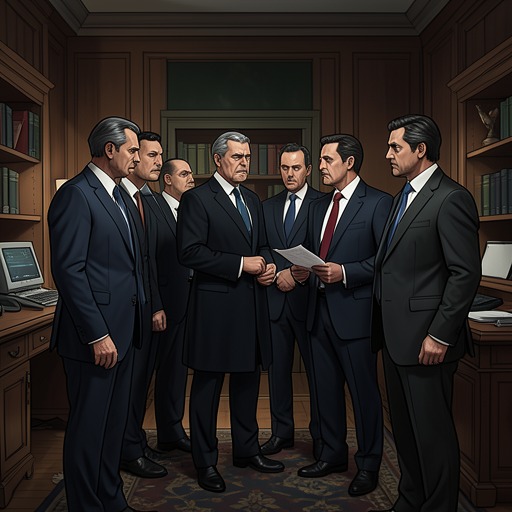
The Government InspectorLuka Lukich Khlopov is the Inspector of Schools in the town, a minor official whose authority over local teachers is overshadowed by his fear of authority above him. When an inspector from Saint Petersburg is expected to arrive incognito, Khlopov becomes one of the officials who must face the supposed visitor. His entrance, nearly pushed onto the stage and visibly trembling, gives bodily form to the town’s anxiety about being examined from above.
Identity and Official Position
Khlopov’s title establishes a specific administrative responsibility: he oversees the town’s schools and is expected to keep an eye on their teachers. The Governor addresses him in that capacity while preparing the officials for inspection. The distinction matters because Khlopov is not merely among those who fear exposure; he has a supervisory role of his own, and must answer for the conduct of people working under his area of oversight.
That responsibility is exercised in the shadow of a distant authority. The expected visitor is said to be an inspector from Saint Petersburg, travelling incognito and carrying secret instructions. The possibility of an unseen, centrally empowered observer turns ordinary local behavior into a potential liability. Khlopov’s position is therefore both official and precarious: he is charged with watching others, yet fears what an inspector might see and how that sight might be interpreted.
Teachers and the Threat of Inspection
The Governor’s warning to Khlopov focuses not on a school’s teaching or results but on a teacher’s manner. One teacher, remembered by his fat face, has a habit of screwing up his features when he sits down, then slipping a hand beneath his necktie to smooth his beard. The Governor admits that the behavior may be harmless in the classroom, but fears that a visitor could take a grimace as a personal insult. The danger lies in how conduct might appear to the inspector, rather than in any stated educational failing.
This instruction makes Khlopov’s oversight a matter of managing appearances. He is told to keep watch because a teacher’s involuntary-looking gesture could acquire political meaning in the presence of a powerful stranger. The scene does not show Khlopov correcting the teacher or responding to the Governor’s order; it establishes instead the anxious terms under which he is expected to supervise. Even a face or a hand movement may need to be controlled when the authority observing it is unknown.
Audience with the Supposed Inspector
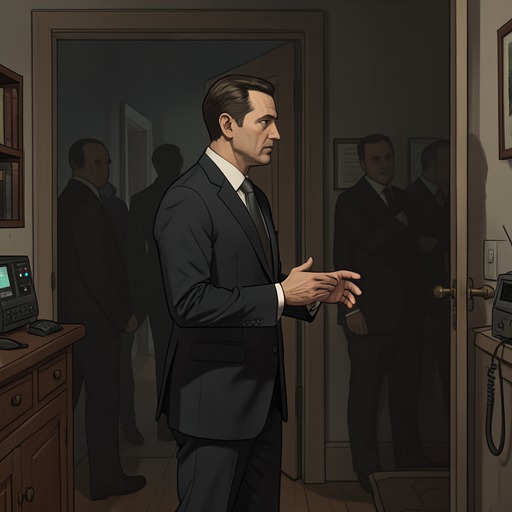
When Khlopov is brought before the supposed inspector, the stage direction presents him as nearly pushed in from behind. A voice urges him not to be chickenhearted. He draws himself up, trembles, and keeps a hand on his sword. The attempted posture of official dignity and the visible signs of fear occupy the same moment: he performs composure without achieving it.
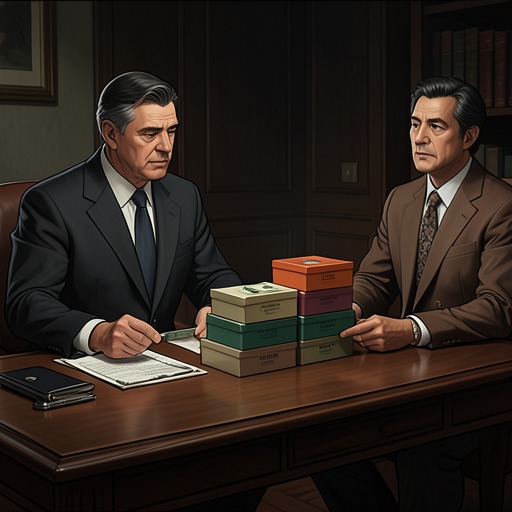
In the audience, Khlopov asks for a loan of three hundred rubles. He explains that he has run entirely out of cash on the road and frames the request as a practical need. His companion clutches at his pockets at the request. The amount and the immediate physical reaction give the encounter a concrete, awkward shape: the official who has entered in fear of scrutiny makes a personal appeal for money to the man he believes possesses superior standing.
The request is for a loan, not an explicitly described bribe, and the available episode does not establish whether Khlopov receives the money. Its dramatic force comes from the reversal it creates within the audience. Khlopov’s formal appearance before a powerful visitor becomes an occasion for private financial need, while the mistaken status of the visitor allows the exchange to take place under a false understanding of rank.
Fear, Rank, and Dramatic Function
Khlopov’s trembling entrance connects the Governor’s preparations to the officials’ actual encounters with the supposed inspector. Before the visit, the concern is anticipatory: a teacher might make an unfortunate face, or a visitor might misread a gesture. In the audience itself, that abstract fear becomes physical. Khlopov’s hand remains on his sword as he tries to stand upright, making the gap between official appearance and personal unease visible onstage.
His scenes also show how the inspection’s power travels through the town. The expected official need not have revealed his true identity or demonstrated any actual authority for local officials to alter their behavior; the belief that he carries secret instructions from Saint Petersburg is enough to prompt apprehension. Khlopov is both an instrument of local oversight and a subordinate exposed to the possibility of being judged in turn. The comedy of his encounter rests on this unstable hierarchy, where a nervous official seeks aid from a supposed superior whose standing has itself been misread.
The evidence presents no decisive change in Khlopov’s position or resolution to his request. What it does establish is a consistent contrast: his title calls for supervision, while his gestures reveal fear; he is expected to regulate the appearance of teachers, yet must himself manage his appearance before an inspector. Through this small official, the play makes inspection feel less like a neutral administrative procedure than a chain of anxious acts of watching, interpreting, and trying to stay safe within rank.