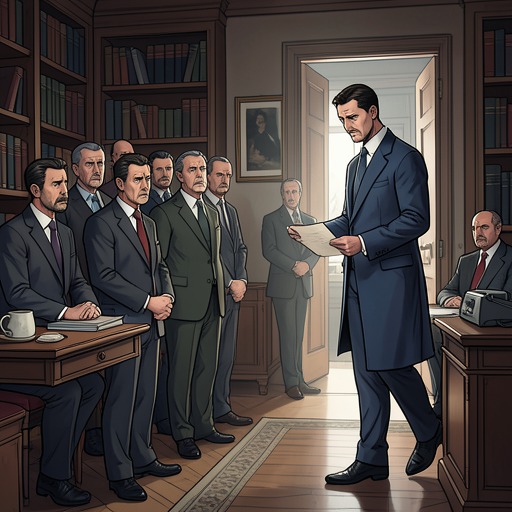
Officials became panic and blamed each other after finding out they had been deceived
The Government InspectorThe officials’ discovery that they have been deceived turns their practiced fear of inspection into open panic and recrimination. The Governor, Anton Antonovich Skvoznik-Dmukhanovsky, swings from imagining himself ruined to condemning his own credulity, while the assembled officials argue over who first gave Khlestakov the false identity of a government inspector. Their humiliation is personal, but the chain of events that brought them here also exposes the habits of a local administration built around concealment, flattery, and private advantage.
Causes and Conditions
The panic began with the Governor’s report of an inspector from Saint Petersburg, traveling incognito and carrying secret instructions. His warning included a letter describing an official sent to inspect the whole government, with the district singled out for particular scrutiny. Before any inspection had taken place, the possibility of being watched had already made the officials anxious about what might be revealed.
That anxiety shaped their response. The Governor asked Ivan Kuzmich Shpekin to open letters passing through the post office and check for information against him, proposing that correspondence be resealed or delivered after it had been read. Shpekin admitted that he already opened letters, not principally as a precaution but from curiosity. Information that might have served public oversight was thus subject to a private, unauthorized reading, and the Governor hoped to turn that habit to his own protection.
The Governor also ordered visible repairs and staged signs of activity. A tall policeman was to stand on the bridge; an old fence near the bootmaker’s was to be pulled down, with a post and straw arranged to suggest roadwork. He even noted that about forty cartloads of rubbish lay against the fence. If the inspector asked whether officials were satisfied, they were to answer that they were, while the Governor threatened consequences for anyone who said otherwise. These preparations did not correct the town’s conditions; they arranged how those conditions would appear to an observer.
The Visitor’s Reception
When Khlestakov was treated as the inspector, the officials’ fear encouraged them to read his presence as confirmation of their suspicions. The Governor presented the town’s administration as vigilant and orderly, claiming that its sole concern was winning the government’s esteem through efficiency. The claim sat uneasily beside the hurried staging of the bridge and fence, and beside the Governor’s private effort to monitor correspondence and silence dissatisfaction.
Khlestakov’s own extravagant account of high office deepened the officials’ reverence. He described a department suddenly left without a head, thirty-five thousand couriers crowding the streets, and his own appointment as director. He claimed that even his mail arrived addressed to “Your Excellency.” As he embellished his imagined authority, the Governor and the others rose in awe and trembled. Their deference gave his boasts an audience ready to mistake performance for proof.
The officials’ belief was not simply a response to his claims. It also made the visitor an apparent channel to advancement. After the supposed inspector became connected with the Governor’s family, Anton Antonovich asked Anna Andreyevna whether his association with a man close to the ministers and visiting court might bring him a generalship. The episode reveals how quickly fear of central scrutiny could mingle with hopes of promotion and proximity to power.
The Deception Exposed
Once the error is exposed, Anton Antonovich first describes its consequence as a total collapse. He says he is finished and can see nothing but pigs’ snouts instead of faces; he calls for Khlestakov to be caught and throws out his hand. The frantic gesture cannot undo the visitor’s departure or restore the authority the Governor had performed in front of him. His language shifts from managing an inspection to confronting the fact that he has been made a fool of.
The Governor then turns on himself. He recalls thirty years in service, insisting that not one merchant or contractor had managed to impose on him, and that he had outmaneuvered swindlers and fooled three governor-generals. That record makes the present mistake sting more sharply: the man who takes pride in recognizing cheats has failed to recognize a harmless impostor. His boast of experience becomes evidence of how completely confidence in his own cunning has failed him.
He imagines the humiliation spreading beyond the town. Khlestakov’s coach bells, he says, are already jingling along the road, and the visitor will publish the story to the world. The Governor fears not only ridicule but its transformation into comedy: he foresees a writer turning his mistake into a play, where neither rank nor station will protect him from laughter. His anger at scribblers and his accusation that the audience is laughing at him show that he recognizes the public force of the exposure even as he resists it.
Blame and Collective Reckoning
Anton Antonovich describes the deception as a collective mental failure, invoking the saying that the gods first make those they want to punish mad. He asks how anyone could have seen an inspector in Khlestakov, whom he now judges wholly unlike one, and demands to know who first spread the identification. Artemy Filippovich Zemlianika answers that it seemed as if a mist had clouded their brains and the devil had confused them. His explanation treats the mistake as a shared bewilderment rather than the decision of one person.
Ammos Fiodorovich Liapkin-Tiapkin points instead to Piotr Ivanovich Dobchinsky and Piotr Ivanovich Bobchinsky as the pair who began the talk. The two are surrounded by the others, but Bobchinsky denies that he was first and says Piotr Ivanovich was responsible. The accusation therefore produces no clean resolution: even as the officials recognize the false identification, they dispute its origin. Their attempt to assign blame reproduces the uncertainty that had helped the error take hold.
The scene turns the officials’ earlier conformity into a different kind of spectacle. Before Khlestakov they had risen, trembled, and presented a united account of good administration; after his exposure they crowd around one another, contradict, and accuse. The Governor’s imagined future comedy has already begun in the room, as their loss of control supplies the public ridicule he dreads. Their panic is both the immediate consequence of the deception and a concentrated display of the habits that preceded it: protecting appearances, seeking advantage, and passing responsibility from one official to another.