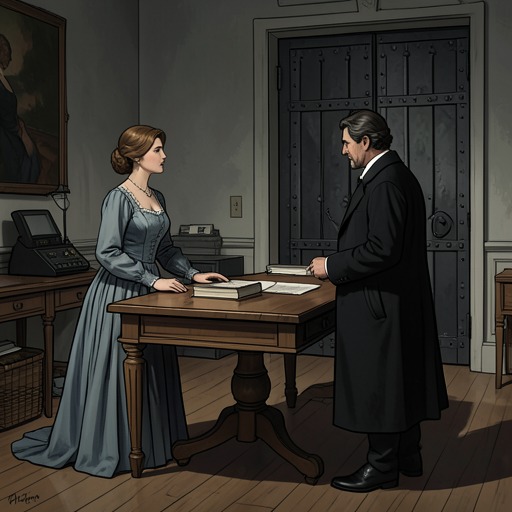
Piotr Ivanovich Bobchinsky
The Government InspectorPiotr Ivanovich Bobchinsky is a country squire whose hurried report about a stranger at the inn helps bring the town’s fear of an inspector into focus. He is paired with Piotr Ivanovich Dobchinsky, but their partnership is also a comic contest over who gets to tell the story. Bobchinsky’s importance lies less in authority than in transmission: he notices, interprets, and relays details, then asks that his own name travel beyond the town to the people at the top of the hierarchy.
Identity and Place in the Town
The play identifies Bobchinsky as a country squire and presents him alongside Dobchinsky among the town’s local figures. He has no administrative office in the supplied scenes. His influence instead comes through the information he brings: the account of a young man at the inn reaches the Governor and officials already alarmed by news of a secret inspection from Saint Petersburg.
That timing gives Bobchinsky a consequential, if unofficial, place in the town’s response. The supposed inspector’s arrival makes the officials look toward their departments and the appearance of order: the Governor warns that the hospital’s patients must be clean and its night-caps presentable, while the courthouse is to be cleared of the geese and goslings occupying its entrance hall. Bobchinsky is not shown directing these preparations. His report belongs to the chain of local information that helps turn the threat of scrutiny into urgent action.
The Report from the Inn
Bobchinsky and Dobchinsky enter together, out of breath, announcing an extraordinary occurrence. Bobchinsky describes the young stranger as well dressed in ordinary citizen’s clothes and pacing in the room. What catches his attention is not a stated official credential but the man’s face and manner, which Bobchinsky calls unusually deep and suggestive. To convey the impression, he raises a hand to his forehead and turns it around several times, then recounts feeling that something was happening and that this was no ordinary matter.
His account proceeds by way of a question put to Vlas, the innkeeper. Bobchinsky includes Vlas’s recent domestic news—the birth of a large baby three weeks earlier—before returning to the identification of the guest. The young man, according to Vlas, is an official from Saint Petersburg named Ivan Aleksandrovich Khlestakov, travelling toward a government posting. These details give the town a name, a place of origin, and an official-sounding destination to attach to its suspicions. Bobchinsky supplies the report rather than proof of the stranger’s authority; its force comes from how readily the town can fit it to the warning it has already received.
The storytelling itself is part of the scene’s comedy. Bobchinsky asks Dobchinsky not to interrupt and insists that his companion cannot tell the story properly, teasing him for lisping and for having only one tooth in his mouth. The exchange makes the report a shared discovery but also a performance over ownership: Bobchinsky wants the account heard in his own order and voice. His physical gesture, digressions, and corrections make the delivery as memorable as the information it carries.
Partnership and Performance
Bobchinsky and Dobchinsky arrive as a pair, investigate the stranger together, and bring their news to the officials together. Yet Bobchinsky’s impatience with Dobchinsky’s interruptions reveals a small rivalry inside that partnership. He treats the report as something he can narrate better, even while its crucial information has passed through both men and the innkeeper. The comedy therefore makes local knowledge collective and untidy: it travels through questions, hearsay, interruptions, and competing claims to tell it correctly.
Bobchinsky’s manner also contrasts with the official preparations that follow. The Governor responds to the prospect of inspection by ordering visible repairs and threatening dissatisfied townspeople; Bobchinsky contributes no such orders. His role is to notice and relay, while the officials control how the news is acted upon. That difference keeps his importance distinct: he helps supply the occasion for the town’s anxious response without holding the authority that shapes it.
The Request to Be Remembered
When Khlestakov receives visitors, Bobchinsky makes a request that shifts attention from the stranger’s supposed status to his own. Addressing Khlestakov as a person of exalted rank, he asks that, on returning to Saint Petersburg, he tell the senators and admirals that Piotr Ivanovich Bobchinsky lives in this town. He even provides the short message he wants conveyed: that he lives there.
The request is strikingly modest in its stated content and ambitious in its imagined audience. Bobchinsky asks for no intervention on a particular grievance; he wants his existence carried to prominent people in the capital. The moment gives a precise form to the town’s fascination with rank: proximity to a figure believed to move among high officials appears to offer a route, however small, out of provincial obscurity. His wish also echoes the plot’s larger confusion, since the visitors’ deference to Khlestakov rests on a mistaken understanding of who he is.
Narrative Significance
Bobchinsky’s part in the play joins two kinds of comic exposure. His report shows how quickly impressions and secondhand information can acquire the weight of official knowledge; his later appeal shows how powerfully the idea of recognition from the capital shapes local self-importance. He does not establish the stranger’s identity, and the evidence he reports does not amount to verification. Instead, his observations become useful to a town already primed to interpret an arrival as the promised inspection.
His small request to have his name remembered completes that pattern on a personal scale. The officials want to appear orderly before central authority; Bobchinsky wants central authority to know that he exists. Both responses turn the imagined gaze of the capital into a force within the town, but his is expressed not through a department or an order, only through a name he hopes will be repeated far away.