Russia
The Government InspectorRussia is presented as more than the geographical setting of The Government Inspector: it is the society whose political habits, public institutions, and literary culture give the comedy its national significance. The play’s provincial officials embody a wider administrative system, while its reception in Russia turns a comic work into an enduring public critique.
Russia and Literary Life
The introduction describes The Government Inspector as a national institution whose importance cannot be measured by literary ranking alone. Its comparison with Faust and Shakespeare concerns the breadth of associations it carries for educated Russians, not a claim that Gogol’s comedy equals Shakespeare’s finest plays. The distinction is central: the work matters because Russian literature is portrayed as woven into social, political, and economic life, expressing collective wrongs and hopes rather than serving merely as diversion.
The play is also credited with helping establish a distinct Russian literary tradition. Before Gogol, the introduction says, Russian writers often followed foreign models, particularly in drama. The Government Inspector, followed by Dead Souls, helped shape a line of Russian writing associated with major later authors. In this account, the play’s national importance derives both from its artistic achievement and from the close connection between literature and the life of Russian society.
Provincial Administration and State Power
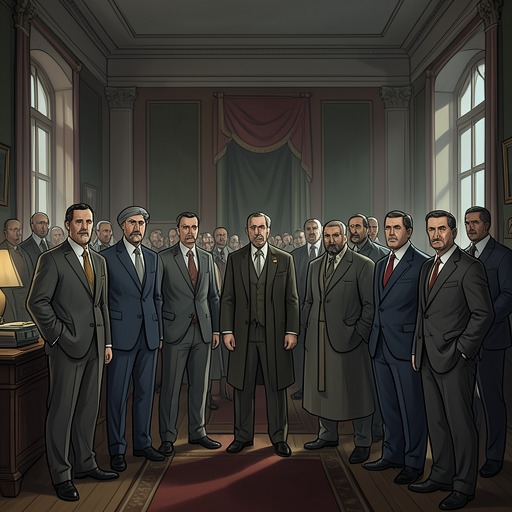
The action focuses on a municipality, but the introduction reads its corruption as representative of Russia beyond a single town. The local Governor is described as an almost absolute power, and a rule of graft limited by one’s rank governs the officials beneath him. The pattern is said to extend from towns to villages and hamlets. The comedy thus makes a local administration stand for a broader hierarchy in which official authority enables persecution and extortion.
The plot’s fear of inspection makes that hierarchy visible. The Governor announces that an inspector has arrived from Saint Petersburg incognito and with secret instructions. The possibility of scrutiny from the capital unsettles local officials, whose conduct is exposed through their efforts to manage the visit. The introduction links such abuses to Russian despotism, arguing that ordinary redress is unavailable within the system it describes. Its account consequently treats bureaucratic corruption not as an isolated collection of personal failings but as a condition sharpened by concentrated power.
Satire, Testimony, and Moral Judgment
The comedy attacks officialdom through realistic representation and ridicule. Its objects include both the conduct of individual officials and, indirectly, the system of graft among higher servants of the crown. The introduction stresses that Gogol himself was conservative and directed his satire chiefly at effects rather than at the political system that produced them. He understood the play’s lesson as a moral one: an individual might recognize and correct personal faults, while society, in his account, had little to learn from the work.
The Russian audience, however, gave the play a broader social meaning. The introduction says that readers and spectators did not expect officials to reform while the system that produced their behavior remained in place. Their reception therefore exceeded Gogol’s own estimate of his comedy: they valued it as an incisive exposure of the machinery of a hated system. The merchants’ complaint in the play supplies a concrete counterpoint to official self-presentation: they describe soldiers quartered on them, goods taken from their shop, and demands that extend beyond what they provide for the Governor’s family. A locksmith’s wife adds a separate grievance, reporting that her husband was ordered to be shaved as a soldier before his turn, despite being married. These complaints make the satire’s social reach legible through the people subject to official power.
Censorship and Public Reception
The comedy’s passage to the stage was itself shaped by Russian political conditions. Under the strict censorship of Nicholas I’s reign, permission required powerful support. Zhukovsky secured the Tsar’s personal intervention, and Nicholas attended the first production in Saint Petersburg in April 1836, laughing and applauding. The introduction reports his response as evidence of the work’s reach, even within the ruling order it satirized.
Official Russia and its supporters reacted differently. Bulgarin led attacks that called the play unoriginal, implausible, coarse, plotless, and populated by caricatures; one objection was that its town contained no honest person. Gogol was shaken by the hostility and wrote, four days after the premiere, that he was weary of the play and its commotion. Yet the account also records intense public demand, alongside the attacks, and the support of leading literary figures including Pushkin and Bielinsky. The dispute shows how the comedy’s public meaning could not be confined to a debate about theatrical form: its portrayal of Russian officialdom made its reception politically charged.
Russia as the Measure of the Comedy
Gogol’s work on the play began in 1834 and continued through revisions until its final form in 1842. The introduction describes a change in his artistic purpose during that process: he moved from aiming at uncomplicated amusement toward gathering injustices he knew into a single comic design. Its laughter consequently carries sorrow as well as ridicule. Russia is the measure of that transformation because the play’s comedy draws force from recognizable abuses and from the audience’s conviction that they belong to a persistent social order.
The introduction ultimately holds two interpretations together. Gogol’s own account emphasizes the moral correction of individuals, while the play’s Russian readers found in it a lasting indictment of institutional corruption. That tension helps explain why the comedy became more than a portrait of one provincial town: its local hierarchy could be read as a miniature of Russia’s wider relations between rank, authority, and ordinary people.