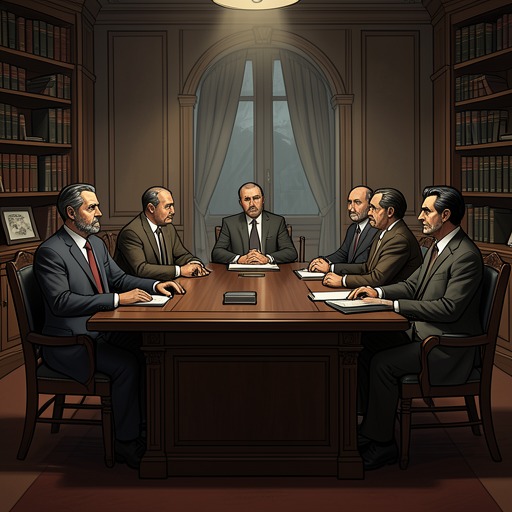
That's the way God made the world
The Government Inspector“That's the way God made the world” is the Governor’s fatalistic defense of corruption in The Government Inspector: a claim that abuses are part of the natural order, not a reason to change it. Its force comes from the gap between the phrase’s air of worldly resignation and the concrete misconduct surrounding it. The Governor invokes it while excusing officials’ sins, but the play makes visible what that excuse leaves untouched: a local administration in which public duties repeatedly yield to private convenience and gain.
The phrase and its occasion
The Governor uses the expression while discussing what a letter calls the officials’ “little peccadilloes.” He first treats sin as universal, then invokes the world’s supposed design and dismisses the Voltairean freethinkers who might argue against it. The move shifts attention from the officials’ choices to an allegedly unalterable order: misconduct becomes ordinary, and challenging it seems futile. The phrase does not describe a specific offense so much as supply a ready-made permission to tolerate them.
That permission sits uneasily beside the Governor’s instructions for preparing the town for inspection. He tells Artemy Filippovich to provide clean nightcaps for hospital patients, who otherwise look as grimy as blacksmiths. At the courthouse, Ammos Fiodorovich Liapkin-Tiapkin is to remove the geese and goslings from the entrance hall where petitioners wait. These directions acknowledge visible failures of care and administration, but frame them as matters to tidy up before an inspector arrives, not as evidence that the underlying practices need reform.
A maxim tested by the town
The same pattern appears in the Governor’s orders about the streets. He directs that Sergeant Pugovichyn stand on the bridge for appearance’s sake and that an old fence near the bootmaker’s be pulled down, with a straw-stuffed post put in its place to suggest road grading. He even notes that about forty cartloads of rubbish have accumulated against the fence. The rush to manufacture signs of activity exposes the difference between public service and the appearance of public service: the maxim’s acceptance of things as they are coexists with frantic efforts to disguise them when scrutiny threatens.
Elsewhere, official self-interest is stated more openly. Ammos Fiodorovich Liapkin-Tiapkin admits that he takes bribes, distinguishing the greyhound puppies he accepts from what he considers more serious forms of bribery. The Governor, meanwhile, asks Ivan Kuzmich Shpekin to open letters and look for information against him, presenting the request as being for everyone’s common benefit. These episodes give the expression a wider setting: misconduct is not an isolated lapse but part of a town administration where private advantage, access to information, and public responsibility are entangled.
The Governor’s self-justification
The Governor’s account of himself sharpens the irony. He describes the work of keeping the town clean and managing repairs as overwhelming, and claims that even at night he thinks about how to satisfy the government. He professes to value a clear conscience and the town’s order more than honors. That self-presentation clashes with his instructions to stage activity, threaten dissatisfied officials, and extract wax from merchants for a candle if the inspection ends well. Against these details, the appeal to the world’s design sounds less like detached wisdom than a shield for conduct the play has already shown.
The merchants’ complaint supplies a contrasting account of that conduct. They say the Governor quarters soldiers on them, takes goods from their shop, and demands cloth for his household; they also describe his insults and his treatment of them despite their obedience to regulations. A locksmith’s wife reports that he ordered her husband to be shaved as a soldier before his turn, contrary to the law because he was married. Their testimony replaces the Governor’s general language about unavoidable sin with particular injuries and consequences. The phrase’s fatalism cannot erase those accounts; it helps explain how an official might treat such abuses as ordinary while those subjected to them recognize them as harm.
Satirical and social significance
The play’s introductory commentary presents the expression as characteristic of a system in which town officials exercise power over those beneath them, and subordinate administrators follow the governing example, however imperfectly. It describes the resulting corruption as rooted in Russian despotism and observes that the play’s social force exceeded Gogol’s own conservative account of its lesson. Gogol concentrated on exposing individuals and their actions, yet the work came to be read as a striking picture of the system that shaped and protected them.
Within that tension, “That's the way God made the world” is both a character’s excuse and a compact expression of the habits the comedy exposes. Its apparent resignation makes corruption sound inevitable; the play’s accumulating particulars—neglected patients, geese in the courthouse, rubbish at the fence, coerced merchants, and a threatened household—show that these conditions are maintained through human decisions. The joke is therefore not simply that the Governor believes his maxim. It is that a claim of inevitability can serve the people who benefit from the disorder, even as the disorder itself gives the phrase its grim plausibility.