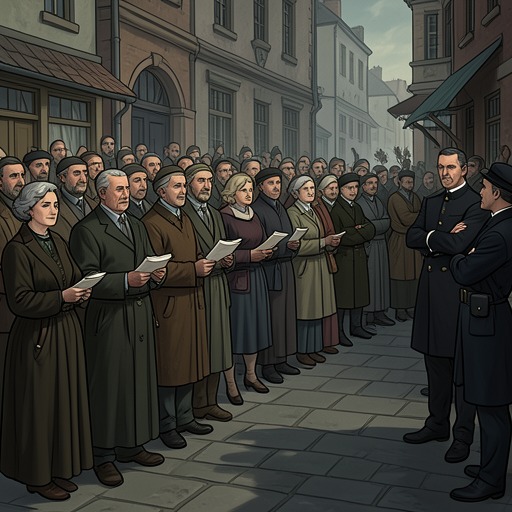
The mayor, after learning of the marriage, boasted and retaliated against the merchant
The Government InspectorThe Governor’s apparent elevation through his daughter’s impending marriage to Khlestakov becomes, for Anton Antonovich Skvoznik-Dmukhanovsky, both a family triumph and an opportunity to punish the Town merchants who have protested against his rule. He moves almost instantly from astonishment at the match to imagining a higher rank for himself, then orders his subordinates to summon his accusers. The scene makes private ambition and public authority indistinguishable: the prospect of advancement does not temper his abuses but gives them fresh force.
The news as a change in fortune
The sequence opens with Anton Antonovich addressing Anna Andreyevna as though they have jointly won an extraordinary prize. He contrasts her former position as a provincial governor’s wife with the prospect of joining the family of a powerful official. Anna answers that she had anticipated the outcome, while suggesting that her husband is too unsophisticated to have seen it coming. Their exchange establishes an uneven response to the news: she presents herself as socially perceptive, while he is still trying to grasp the scale of the advancement he imagines.
The marriage matters to the Governor not only as a change in his daughter’s prospects. He quickly connects Khlestakov with ministers and the court, and asks Anna Andreyevna whether the connection could help him become a general. Her assurance encourages that ambition. A match that should concern the family becomes, in his account, a possible route upward through the imperial hierarchy. The scene does not confirm that such promotion is available; it shows Anton Antonovich treating the presumed influence of his future son-in-law as a basis for expectation.
Turning celebration into public display
His excitement immediately takes administrative form. Anton Antonovich calls for a sergeant and orders him to bring the merchants before him. He wants the news announced widely, not kept within the household: the public is to hear that the Governor’s daughter is marrying someone he describes as without equal and capable of everything. He even calls for the triumph to be made audible to the whole town. The order converts a private engagement into a declaration of status, intended to reshape how the town sees its ruler.
That display also lets him recast his recent vulnerability as a victory. The Town merchants had brought complaints and petitions against him; now he treats their attempt to seek redress as an affront that can be answered from a position of presumed superiority. His language moves from celebration to threats of renewed punishment. The reversal is not a change in his conduct but in his estimate of the risks: newly confident that he has an influential connection, he believes he can retaliate without restraint.
The confrontation with the Town merchants
When the merchants arrive wishing him well, Anton Antonovich confronts them with their complaints and calls them dishonest traders. Anna Andreyevna objects to the language he uses, but he refuses to moderate himself. Instead, he invokes the marriage as the decisive answer to their protest: the very official to whom they complained is, he says, going to marry his daughter. He presents that connection as a reason the merchants have misjudged their power to challenge him.
His attack then widens from their petition to their commercial practices. He accuses them of cheating the Government through a contract worth a hundred thousand, supplying rotten cloth, and offering only fifteen yards of cloth without charge while expecting a reward. He contrasts their claims to social importance with what he describes as a trade founded on deception from childhood, including short measures and false weights. These accusations are spoken by a Governor who has just been challenged by the merchants; the scene establishes his denunciation as part of an angry confrontation, not an impartial inquiry into the contract.
The exchange recalls the substance of the merchants’ earlier complaint. They said the Governor billeted soldiers on them, took goods from their shops, and accepted clothing for his wife and daughter, while also describing intimidation and the seizure of a large piece of cloth. Their prior testimony gives the confrontation a sharper irony: Anton Antonovich now condemns them as cheats and treats their petitions as insolence, although their complaint had described his own extraction of goods and his use of official power against them.
The pattern of authority and retaliation
The scene’s consequences depend on the Governor’s belief that the visitor’s apparent rank can protect or elevate him. Earlier, he had presented his administration to Khlestakov as orderly and efficient; elsewhere, fearing denunciation, he had asked the postmaster to open letters for information against him. He had also threatened dissatisfied officials with later punishment while arranging appearances of activity around the town. The marriage celebration therefore intensifies an established pattern: Anton Antonovich manages what others may report, stages a favorable public image, and answers complaint with coercion.
The episode also draws force from the mistaken identity at its center. Khlestakov had been identified to the town officials as an inspector from Saint Petersburg, traveling incognito with secret instructions. Anton Antonovich now treats that supposed official’s family connection as a ladder toward a generalship and as leverage over the merchants. The comedy’s social criticism lies in the ease with which fear of inspection turns into confidence in imagined favor. As the play’s framing account observes, its characters’ conduct carries a wider indictment of the administrative system they inhabit: here, the Governor’s celebration reveals not a reformed official but an officeholder who expects rank to validate ambition and to silence those seeking redress.