The silent scene
The Government InspectorThe silent scene is the play’s closing theatrical image, in which an announcement of a genuine official’s arrival converts the characters’ panic into a carefully composed tableau. Its force depends on the contrast between the talk, boasting, and mistaken certainty that have driven the action and the final group’s abrupt, prolonged stillness. The scene is not simply an ending without further dialogue: the stage directions make its timing, movement, and arrangement essential parts of the play’s meaning.
Design and Performance
The directions single out the last scene for particular attention. The final spoken announcement is to strike suddenly, like an electric shock; the entire group is to change position at the same instant, and the women are to cry out together as if with one throat. The instructions warn that neglecting these effects may ruin the ending. This emphasis makes coordination—not just the words of the announcement—a central dramatic event. A single piece of news becomes an impact passed through the company at once, visible in the shift of every body and audible in the women’s collective cry.
The stage direction then holds the characters in their new positions for almost a minute and a half before the curtain falls. That duration matters: the shock does not dissipate in a quick reaction or a return to conversation. The company remains fixed long enough for the audience to read the arrangement as an image. The theatrical action thus moves from a sudden change to an extended refusal of movement, making stillness the scene’s final, emphatic action.
The Announcement and Its Reversal
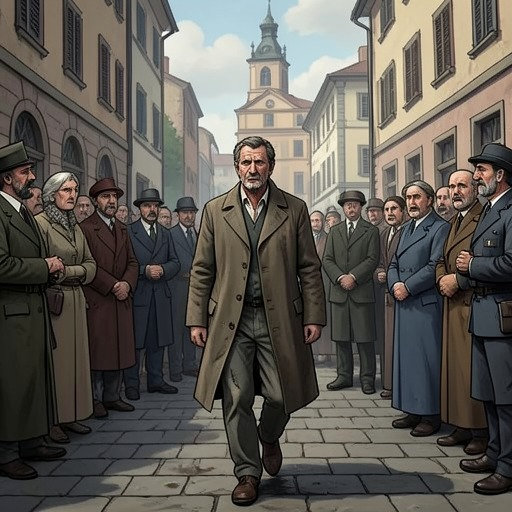
The final shock resolves the mistaken identity around which the officials’ anxieties have gathered. Earlier, Piotr Ivanovich Dobchinsky recounts how he and Piotr Ivanovich Bobchinsky took the young man at the inn for an official from Saint Petersburg. The innkeeper’s account—that the stranger had stayed for a second week, had not left, and was taking everything on credit—helped the two men interpret his behavior as evidence that something important was afoot. Anton Antonovich Skvoznik-Dmukhanovsky responds with terror to the possibility that the stranger is the inspector. Their certainty has grown from suspicion and circumstantial signs, not from knowledge of the man’s identity.
The stranger’s own conduct deepens the contrast between appearance and fact. When confronted about his unpaid bill, Khlestakov begins haltingly and says he expects money from home. Later he boasts of extraordinary official power: he claims that his mail is addressed to him as Your Excellency and that he was called to direct a department after its head disappeared. The assembled officials rise in awe as his account escalates. The scene’s ending reverses the deference built up around that performance. The Postmaster has already announced that the man they took for a government inspector is not one; now the Gendarme reports that an official sent from Saint Petersburg by imperial order has arrived and wants to see them all immediately. The pretended authority gives way to the real one, and the people who had been trying to manage appearances are left exposed before a new summons.
The Tableau’s Composition
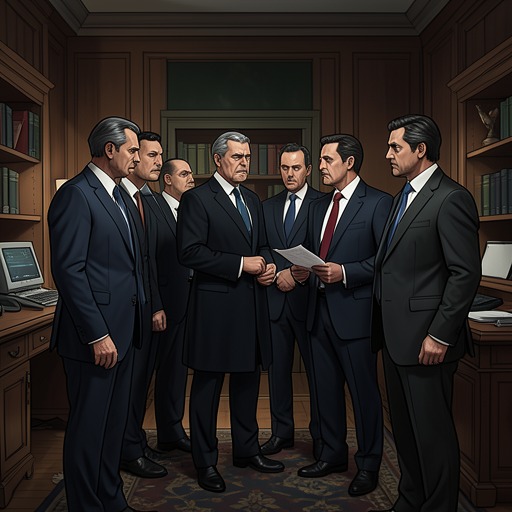
The final image makes the consequences legible through placement and gesture. Anton Antonovich stands at the center, rigid, arms outstretched and head thrown back. His wife and daughter strain toward him on his right. Behind them, the Postmaster faces the audience, his changed shape compared to a question mark. Three visiting ladies lean on one another at the edge of the group, their satirical expressions directed at the Governor’s family. The tableau places that family’s public collapse alongside the watching guests’ visible judgment.
On the Governor’s left, Artemy Filippovich Zemlianika tilts his head as though listening. Behind him, the Judge crouches almost to the ground, arms spread and lips pursed as if about to whistle or speak. Korobkin faces the audience with narrowed eyes and a hostile gesture toward the Governor. At the edge, Piotr Ivanovich Dobchinsky and Piotr Ivanovich Bobchinsky gesture toward one another, mouths open and eyes wide. The remaining guests stand stiffly. These distinct poses preserve different reactions—astonishment, scrutiny, mockery, and mutual gesticulation—inside one shared moment of paralysis.
Dramatic Significance
The silent ending concentrates the play’s reversal into a form that can be seen all at once. The officials’ earlier fear that they might be inspected had led them to treat a debtor at an inn as a person of rank; Khlestakov’s extravagant claims then magnified their deference. The true official’s arrival makes the error consequential, but the ending does not explain or soften the characters’ reaction with another exchange. Instead, their positions display the social relations and exposed anxieties that the announcement has abruptly rearranged.
The tableau also brings together two opposite theatrical impulses specified by the play: sudden, simultaneous movement and sustained rigidity. The group shifts as one, cries out together, and then remains frozen for nearly ninety seconds. What begins as collective shock becomes an image held before the audience, ending the action not with a spoken resolution but with the officials and their observers fixed in the consequences of their misjudgment.