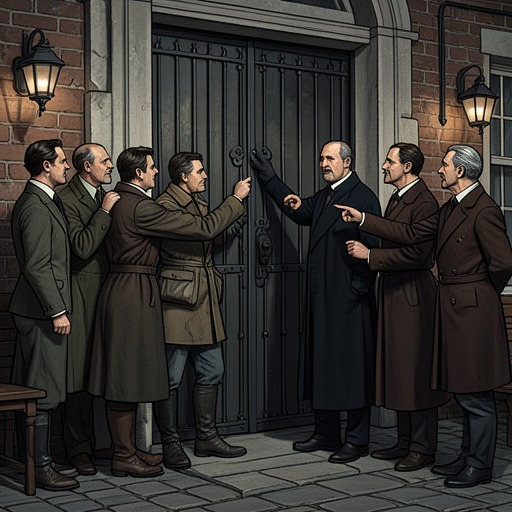
Victim women complain to Khrustalov
The Government InspectorThe appeals to Khlestakov give individual victims a brief hearing inside a town administration otherwise shown protecting itself from scrutiny. The locksmith’s wife reports that Anton Antonovich Skvoznik-Dmukhanovsky ordered her husband to be taken for military service before his turn, despite his being a married man. The Widow of a non-commissioned officer then describes being flogged after a market quarrel had already ended. Together, their petitions turn the anticipated inspection from an occasion for officials to manage appearances into an opportunity for residents to name the harm they have suffered.
An Appeal Before the Inspector
The scene identifies both women among the people who come to present grievances to Khlestakov. He stops the press of petitioners and asks them to speak one at a time. The exchange therefore has a modest order: each woman can state her complaint directly, rather than having her account reduced to the town administration’s version of events. Their appeals are personal and practical, directed to a man they believe has power to act against the Governor.
That expectation belongs to the play’s wider situation. The town has been warned that a government inspector from Saint Petersburg is present incognito and has secret instructions. Officials anticipate his questions and try to arrange what he will see and hear. Against that atmosphere of managed appearances, the women bring forward circumstances that cannot be made presentable merely by staging a display of official activity. Their complaints name the consequences of the Governor’s authority in the lives of residents.
The Locksmith’s Wife: Conscription Before Its Turn
The locksmith’s wife asks for Khlestakov’s aid against the Governor and explains that her husband was ordered to serve as a soldier even though his turn had not arrived. She also points out that he is married, making the order unlawful in her account. Her petition sets the force of an administrative command against both the expected order of conscription and a specific legal protection. She does not describe a distant policy dispute: the order threatens to take her husband from their household.
The complaint exposes how local authority can make formal rules feel insecure. The woman can identify the grounds on which the order is wrong, but she must appeal upward to a visitor whom she takes to have superior standing. Her appeal is thus also evidence of an imbalance: the official who issued the command controls the immediate consequences, while the resident seeks another authority to review it. The scene does not show the husband’s situation resolved, nor does it say that the order is reversed.
The Widow: A Punishment by Mistake
The Widow of a non-commissioned officer says that Anton Antonovich Skvoznik-Dmukhanovsky had her flogged. She explains that women had quarrelled in the market, but that the police arrived after the quarrel was over and took her away on the basis of a report. The punishment left her unable to sit for two days. Her account gives the abuse a precise sequence: a market dispute, a police intervention after the event, a report, and a physical penalty imposed on the wrong person.
The widow does not claim that an appeal can undo what happened to her. Instead, she asks Khlestakov to order the Governor to pay a fine for the mistake, explaining that the money would be useful to her. Her request registers both the injury and the limits of the remedy she can imagine: the flogging cannot be undone, but compensation could still matter. Khlestakov tells her to leave and says he will see to it. That is a promise, not a recorded judgment or payment; the scene supplies no evidence that the fine is imposed.
Petitions Against Official Self-Protection
The two accounts sharpen the contrast between a resident’s experience and the Governor’s management of inspection. Elsewhere, Anton Antonovich Skvoznik-Dmukhanovsky orders officials to assure an inspecting functionary that everyone is satisfied and threatens those who might say otherwise. He also instructs them to claim that a hospital church, funded five years earlier but never begun, had been started and then destroyed by fire. These efforts to control what the inspector hears give the women’s statements particular force: one reports an allegedly unlawful conscription order, and the other recounts a punishment arising from a mistaken police report.
The appeals do not establish that the visiting authority can deliver justice, and Khlestakov’s brief assurance remains untested in the evidence of the scene. Their significance lies instead in the momentary opening they create. The Governor’s subjects state concrete injuries in front of a figure they believe can overrule him, while the broader administration is busy concealing its failures. The encounter makes official abuse legible through the circumstances of two women: a husband taken before his turn, and a widow punished after the dispute was over.