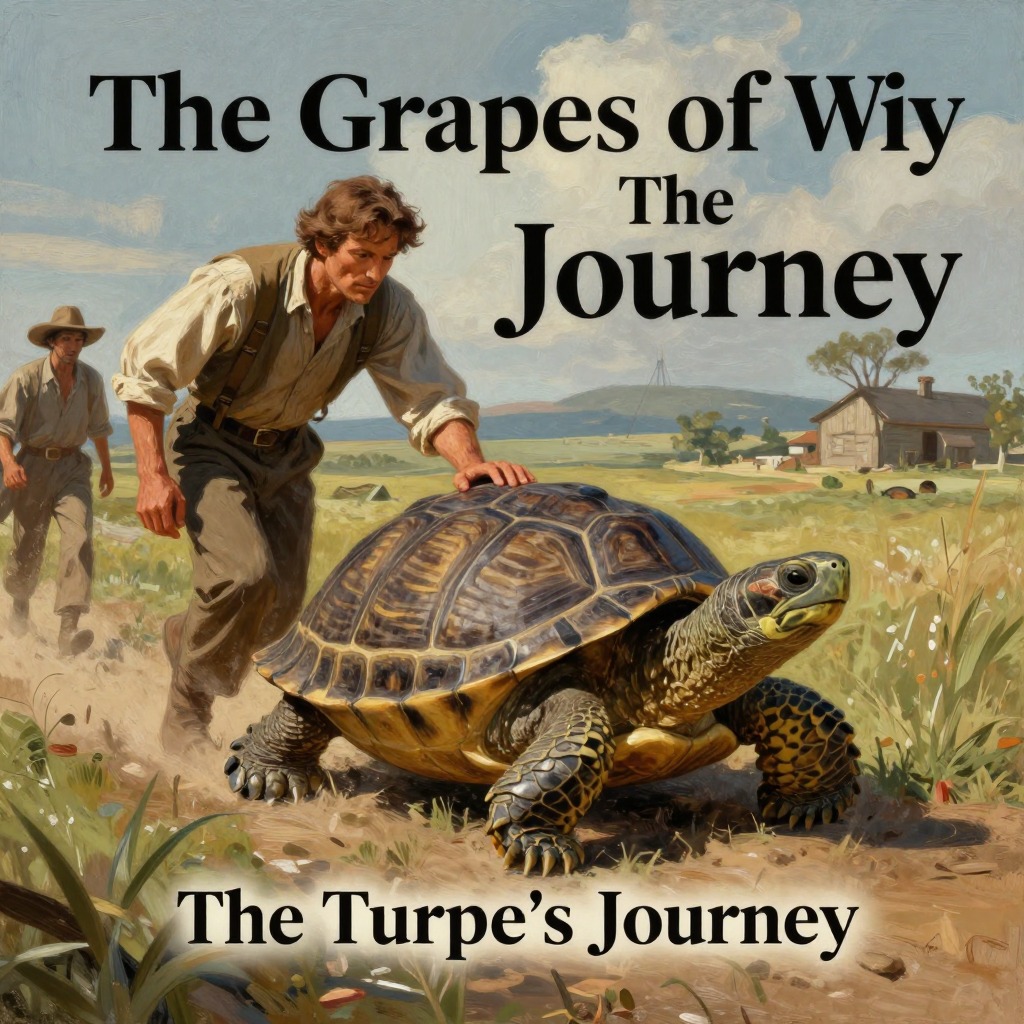
Land turtle
The Grapes of WrathThe land turtle is one of the most potent and compact symbols in John Steinbeck's The Grapes of Wrath, a creature whose brief, vivid appearance in Chapter 3 establishes a pattern of stubborn endurance that echoes through the entire novel. Its journey—a miniature epic of struggle against an indifferent and often hostile environment—prefigures the larger migration of the Dust Bowl refugees, and its unbreakable will to continue southwestward becomes a quiet, almost unconscious emblem of the human spirit under duress.
Appearance and the Journey of Chapter 3
The turtle first appears crawling through the dry roadside grass, its "high-domed shell" dragging over the ground, its "hard legs and yellow-nailed feet" threshing slowly. It is described with a kind of fierce, humorous dignity: its "horny beak" is partly open, and its eyes, "under brows like fingernails," stare straight ahead. The grass heads are heavy with burrs and foxtails, and the turtle's shell collects them—barley beards slide off, clover burrs fall and roll away—as it moves, a passive agent of seed dispersal. It climbs the highway embankment with immense effort, its hind legs straining and slipping, boosting the shell along until it meets a concrete wall four inches high. The turtle rests, then braces its front legs on the wall and lifts, the shell coming slowly up. A red ant runs into the soft skin inside the shell, and the turtle's head and legs snap in, crushing the ant. A head of wild oats is clamped into the shell by a front leg. After a long moment, the neck creeps out, the legs and tail emerge, and the hind legs boost the shell until the center of balance is reached and the turtle tips onto the pavement. It continues on, waggling from side to side. A sedan driven by a woman swerves to avoid it, the wheels screaming and dust boiling up. Then a light truck approaches, and the driver deliberately swerves to hit it; the front wheel strikes the edge of the shell, flipping the turtle like a tiddly-wink, spinning it like a coin, and rolling it off the highway. Lying on its back, the turtle is tight in its shell for a long time, but eventually its legs wave in the air, a front foot catches a piece of quartz, and little by little the shell pulls over and flops upright. The wild oat head falls out, and three of the spear-head seeds stick in the ground. As the turtle crawls down the embankment, its shell drags dirt over the seeds. It enters a dust road and jerks itself along, drawing a wavy shallow trench in the dust with its shell.
Encounter with Tom Joad and Symbolic Persistence
In Chapter 4, Tom Joad, walking home along the dusty side road, sees the turtle ahead of him. His shadow falls on it, and instantly the head and legs are withdrawn, the short thick tail clamped sideways into the shell. Tom picks it up, turns it over, and strokes the smooth, creamy yellow undershell. The turtle wets on his hand and struggles uselessly in the air. Tom wraps it in his coat with his shoes, feeling it pressing and struggling and fussing under his arm. He carries it to the Joad place, where he unwraps it and pushes it under the house. But in a moment the turtle is out, headed southwest as it had been from the first. The gray cat leaps at it and strikes at its straining head and slashes at its moving feet; the old, hard, humorous head is pulled in, and the thick tail slaps in under the shell. When the cat grows tired and walks off, the turtle heads on southwest again. Tom and the preacher watch it go, waving its legs and boosting its heavy, high-domed shell along toward the southwest. Tom asks, "Where the hell you s'pose he's goin'? I seen turtles all my life. They're always goin' someplace. They always seem to want to get there." The turtle's unvarying direction—always southwest, the same direction as the migrant stream—and its refusal to be deterred by capture, confinement, or attack make it a living emblem of the instinct to move, to persist, to reach a destination that may be unknown but is nonetheless compelling.
The Turtle as a Motif of the Migrant Journey
The turtle's journey is a microcosm of the Joads' own. It faces obstacles—a concrete wall, a deliberate assault by a truck, a predator's attack—that parallel the human barriers of tractors, deputies, and hunger. Its method of progress, "boosting and dragging" its shell along, is laborious and slow, much like the family's crawl across the country in their overloaded Hudson. The turtle's shell, which it carries everywhere, is both a burden and a protection, just as the family's possessions and their identity as a unit are both a weight and a shield. The turtle's encounter with the truck driver who swerves to hit it—a casual, almost playful act of cruelty—foreshadows the casual hostility the migrants will face from the settled people of California. And its survival, its righting of itself after being flipped, its continued crawl, is a promise of resilience. The turtle reappears in the intercalary chapter on the Panhandle (Chapter 16), where "the land turtles crawled through the dust and the sun whipped the earth," linking its image to the broader landscape of the migrant flight. The turtle is not a character with agency or consciousness in the human sense; it is a natural force, a piece of the living world that simply does what it does, and in that doing, it becomes a profound and unsentimental symbol of the will to go on.
Narrative and Thematic Significance
The turtle's role is established almost entirely through the novel's intercalary structure. Chapter 3, devoted entirely to the turtle's crossing of the highway, is one of Steinbeck's "general" or "pace changer" chapters, designed to "hit the reader below the belt" with the rhythms and symbols of poetry. The turtle's journey is presented with the same concrete, physical detail as the human narrative, but without any interiority or explanation. It simply is. This technique forces the reader to see the turtle's struggle as significant in itself, not merely as a metaphor for something else. The turtle's connection to the land is also crucial: it crawls through the same dust that chokes the crops, it carries seeds in its shell, it leaves a trail in the earth. It is part of the natural world that the tractors and the banks are destroying, and its persistence is a reminder that the land itself, and the life it supports, will continue even after the human drama has passed. The turtle's final appearance in the narrative—when Tom Joad picks it up, carries it, and releases it—ties it directly to Tom's own journey. Tom, like the turtle, is a creature of the road, heading southwest, carrying his own burdens, and refusing to be stopped. The turtle's "old humorous eyes" and its "fierce, humorous" expression suggest a kind of wry, unbreakable spirit that the novel ultimately attributes to the migrant people themselves. It is not a symbol of hope in any conventional sense, but of a more fundamental, almost biological drive to keep moving, to keep living, to keep heading toward the southwest, no matter what obstacles are placed in the way.