Muley Graves
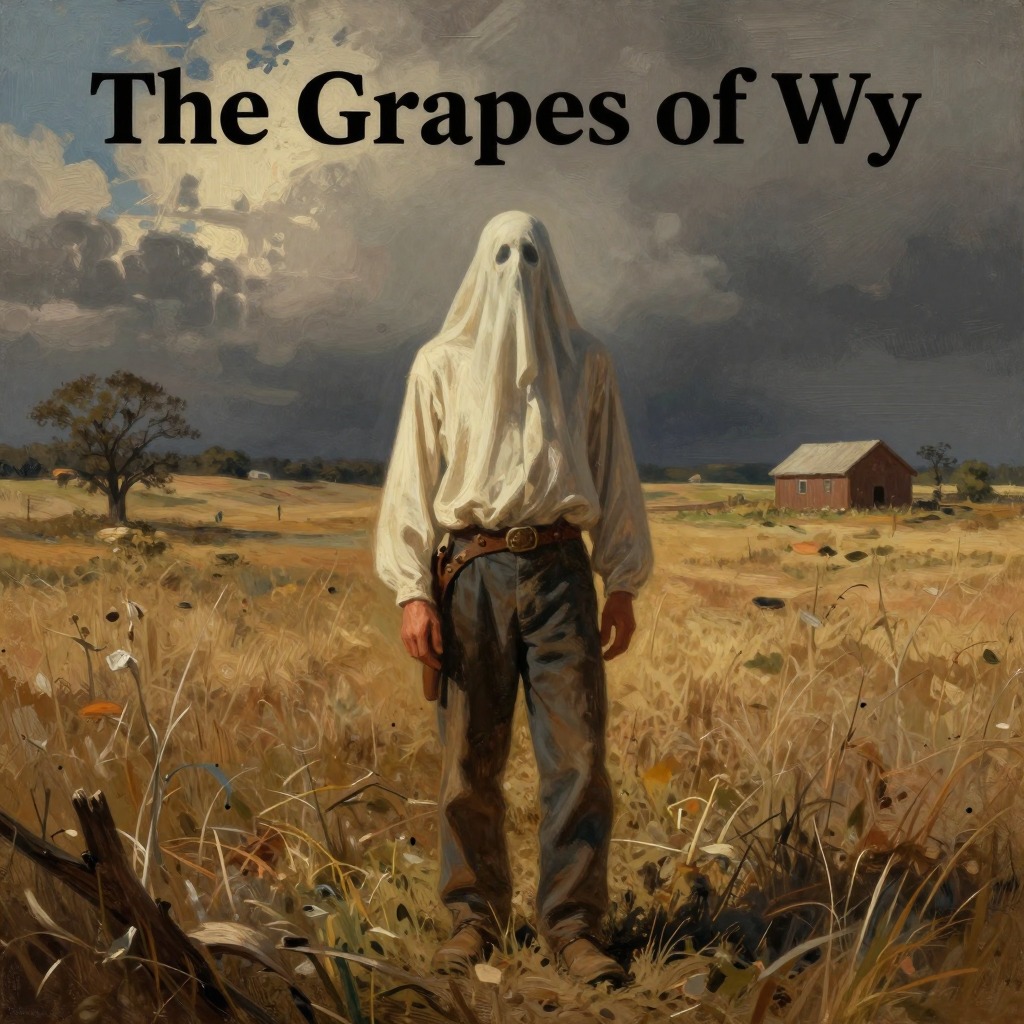
The Grapes of WrathMuley Graves is a lean, short man with jerky, quick movements, a truculent face like a bad child's, and a tight, small mouth. He wears an old black suit coat, stained and torn at the shoulders and elbows, and a black hat with a band half torn free. His blue jeans are pale at knee and seat, and he carries a gunny sack. He is one of the few tenants who, after the bank tractors come, refuses to leave the land where his father was gored to death by a bull and where his son Joe was born. His stubbornness transforms him from a mean, wolf-like hunter into a hunted, weasel-like figure who sleeps in a cave dug by Tom Joad and his brother Noah years before, covers it with brush, and survives by snaring rabbits and prairie dogs with wire nooses. He is a living ghost of the abandoned country, a "graveyard ghost" who wanders the empty houses at night, revisiting the places where his life happened.
Identity and Background
Muley Graves is a lifelong neighbor of the Joads, known to Tom Joad since childhood. His father came to the country fifty years ago, and Muley himself has lived there all his life. He is a tenant farmer, like the Joads, and his family has worked the same land for generations. When the bank and the Shawnee Lan' an' Cattle Company decide to tractor off all the tenants, Muley's wife, her brother, and his children go to California because there is nothing to eat, but Muley himself cannot go. He tells Tom and Jim Casy that something just would not let him leave. He is not a fool, he admits; he knows the land is not much good, never was much good except for grazing, and that it has been cottoned nearly to death. But because the bank told him he had to get off, he cannot go. "Jesus Christ, a man can't, when he's tol' to!" he cries.
Life as a Fugitive
After his family leaves, Muley becomes a solitary wanderer, never going far from his old place. He sleeps wherever he is, often in the cave he once dug as a boy with Noah Joad, and he survives by his wits and his wire nooses. He catches cottontails and jackrabbits, and sometimes skunks and coons get caught too. He carries a quart bottle of water in his hip pocket and a little cloth bag of salt. He is always on the move, sneaking around like a coyote, and he has become "mean like a weasel" because he is now the hunted, not the hunter. When a car approaches, he hides in the cotton field, lying down so the spotlight cannot find him. He has learned to time the deputy's tricks, knowing that Willy Feeley, now a deputy sheriff, always tries one last flash of the spotlight after he has driven away. Muley once knocked Willy cold with a fence stake from behind, and has taken a shot at the headlights once or twice, which keeps the deputies careful. He is proud of his skill at evasion, but he knows it has changed him: "When you're huntin' somepin you're a hunter, an' you're strong. Can't nobody beat a hunter. But when you get hunted—that's different. Somepin happens to you. You ain't strong; maybe you're fierce, but you ain't strong."
Relationships and Conflict
Muley's relationship with the Joads is one of long acquaintance and mutual respect. He is the one who tells Tom, after Tom returns from McAlester, what has happened to the Joad farm and where his family has gone. He shares his rabbits with Tom and Casy, though he is embarrassed about it, and he explains that a man who has something to eat when another man is hungry "ain't got no choice" but to share. He is fiercely loyal to the idea of the land and the people who belong to it. He tells the story of his father being gored to death by a bull, and how he put his hand on the ground where his father's blood is still part of it. He remembers the room where his son Joe was born, and his grandmother standing there saying "That's a daisy" over and over. These memories are what he clings to, and they are what the bank and the company have taken from him. "They jus' chopped folks in two for their margin a profit," he says. "Place where folks live is them folks. They ain't whole, out lonely on the road in a piled-up car."
Change and Ending
Muley does not change his mind. When the Joads are ready to leave for California, he comes to say goodbye, but he refuses to go with them. He knows he will not go, that at the last minute he would run and hide like a "damn ol' graveyard ghost." He asks the Joads to tell his family, if they come across them in California, that he is well and doing all right, and that he will come to them soon as he gets the money. But when Ma asks if he will, he says softly, "No. I won't. I can't go away. I got to stay now." He accepts that he will probably die out in the field someday, and sometimes that seems lonely, sometimes all right, and sometimes good. He takes the Joads' two remaining dogs and their chickens, and he stands forlornly in the dooryard, watching the truck crawl away toward the highway and the west. He is the last human figure of the old life, a stubborn remnant of a world that has been broken up and scattered.
Thematic Significance
Muley Graves represents the extreme of attachment to place that the Joads themselves feel but ultimately overcome. He is the one who cannot make the psychological break, who is so fused with the land that leaving it would be a kind of death. His transformation from a proud, mean hunter into a furtive, hunted creature illustrates the dehumanizing effect of dispossession on those who resist it most fiercely. He is a warning of what can happen when a person's identity is so bound up with a piece of earth that they cannot imagine any other life. Yet he is also a figure of tragic dignity, a man who chooses to remain a ghost in his own country rather than become a stranger in someone else's. His final act is to stand and watch the Joads go, carrying with him the memory of all that was lost.