Weedpatch
The Grapes of WrathWeedpatch is the location of the Farm Security Administration's government camp in Kern County, California, a demonstration project intended to provide humane, clean, and democratic temporary living conditions for the migrant workers flooding into the state from the Dust Bowl. For the Joad family, exhausted and demoralized after the death of Granma and the burning of the Hooverville, Weedpatch becomes a brief oasis where they are treated not as despised "Okies" but as people with dignity. The camp is a physical and social counterpoint to the squalid, police-ridden Hoovervilles and the company-owned labor camps that dominate the migrants' experience in California.
Location and Physical Setting
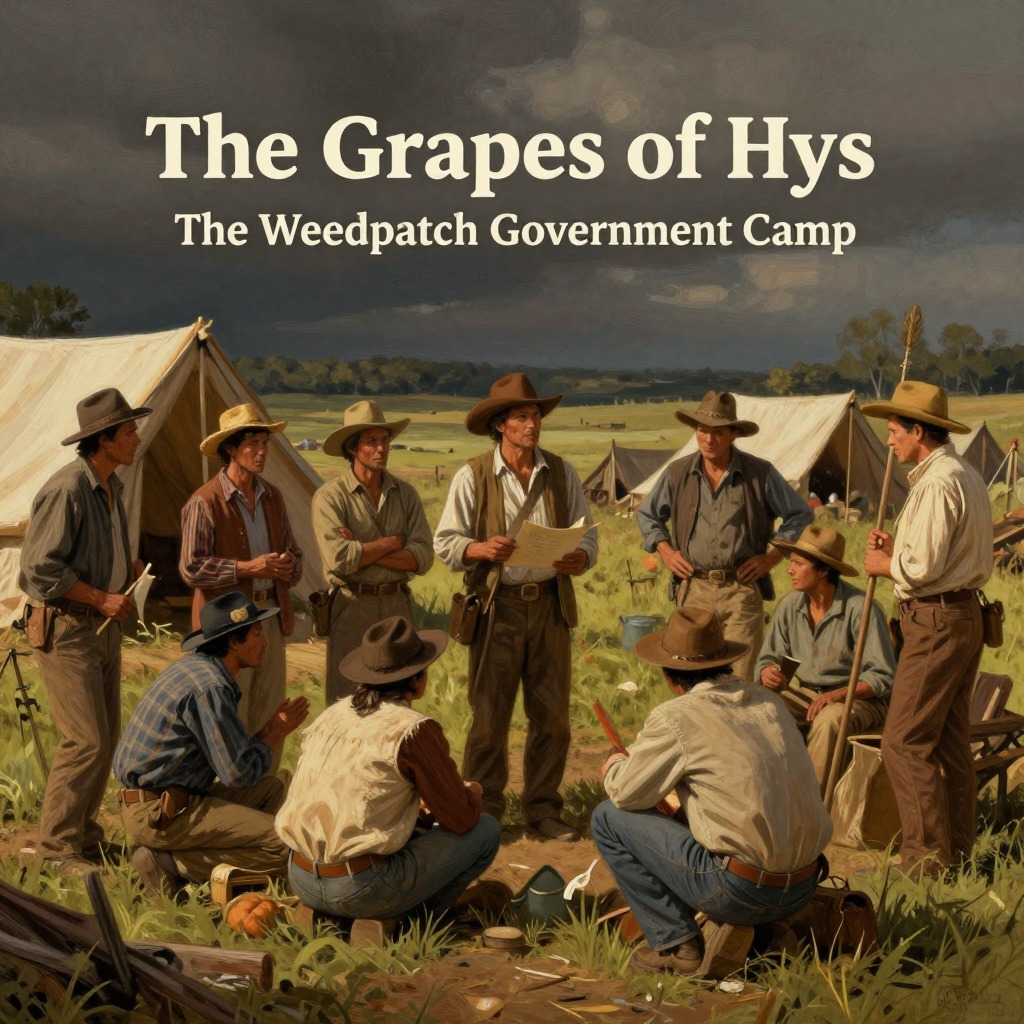
The Weedpatch camp is situated on a country road near the small town of Weedpatch, south of Bakersfield. It is enclosed by a high wire fence, and a wide-gated driveway leads into the grounds. Inside, the camp is organized into five sanitary units, each containing toilets, showers, and wash tubs with running hot water—a luxury the Joads have not enjoyed since leaving home. The tents are arranged in straight rows, the ground is swept and sprinkled, and there is no litter. A dance platform stands at one end of the camp, and a croquet court provides recreation for the children. The camp manager, Jim Rawley, lives in a small office building near the entrance, and a watchman is on duty at night. The physical orderliness of Weedpatch reflects the social order that the camp's residents have created for themselves.
Democratic Self-Governance and Community Life
Weedpatch is governed not by outside authorities but by its own residents. Each of the five sanitary units elects a representative to a Central Committee, which makes and enforces the camp's rules. The committee can warn, and ultimately expel, anyone who violates the camp's code of conduct. No police officer can enter the camp without a warrant. A Ladies' Committee visits new families, assigns duties, and runs a nursery and a sewing room. The camp maintains a credit account at a local store so that families who are temporarily without work can buy food; they repay the loan when they find jobs. On Saturday nights, the camp holds dances, which are the social highlight of the week. The residents police themselves: when outside agitators try to start a fight at the dance, the Entertainment Committee quietly escorts them out of the camp, preventing the deputies waiting at the gate from having an excuse to raid the camp. This system of self-rule gives the migrants a sense of agency and pride that is systematically denied to them everywhere else.
The Joads' Experience at Weedpatch
The Joads arrive at Weedpatch late at night, after being turned away from the Hooverville and forced to drive south to avoid a vigilante roadblock. They are assigned a spot in Sanitary Unit Number Four. The next morning, Tom Joad meets a family named Wallace, who share their breakfast with him and help him get a job digging a ditch for a local farmer. Ma Joad is overwhelmed by the camp's amenities: the hot showers, the wash tubs, the clean toilets. She tells the camp manager, "It's nice. 'Specially them wash tubs." The Ladies' Committee visits her and explains the camp's rules, and she is invited to join the Ladies' Club. Rose of Sharon is told about the nursery and the visiting nurse, and she begins to hope that her baby might be born in a safe place. For a few weeks, the Joads experience a semblance of normal life: the men work when they can find jobs, the children play croquet, and the family attends the Saturday night dances. But the work is sporadic, and the money runs out. When a handbill promises work picking peaches at the Hooper ranch, the Joads reluctantly leave Weedpatch, knowing that they are unlikely to find another place like it.
Narrative Significance
Weedpatch serves as a crucial counter-example in the novel's argument about the causes of the migrants' suffering. The camp demonstrates that the migrants are not inherently degraded or incapable of orderly life; when they are given decent facilities and the freedom to govern themselves, they create a community that is cleaner, safer, and more just than the towns that despise them. The camp manager, Jim Rawley, tells Ma Joad, "The people here worked me out of a job. They keep the camp clean, they keep order, they do everything." Weedpatch is a living refutation of the prejudice that the migrants are dirty, criminal, or incapable of self-discipline. Its existence also explains the hostility of the large growers and their allies: the Farmers' Association plots to provoke a fight at the Saturday night dance so that deputies can raid the camp and shut it down, because the camp's success threatens the system of exploitation that depends on keeping the migrants powerless and divided. The Joads' departure from Weedpatch marks the end of their brief respite and the beginning of their descent into the brutal labor camp at the Hooper ranch.