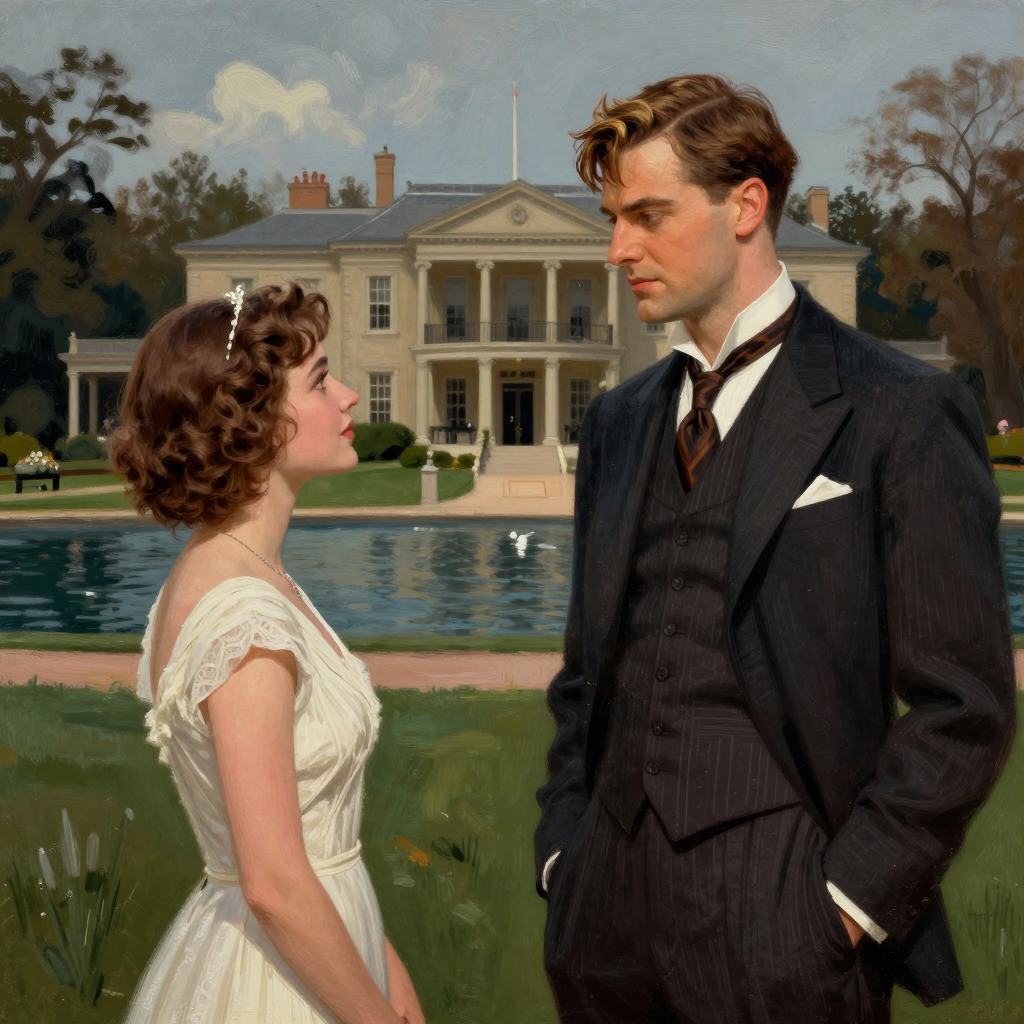
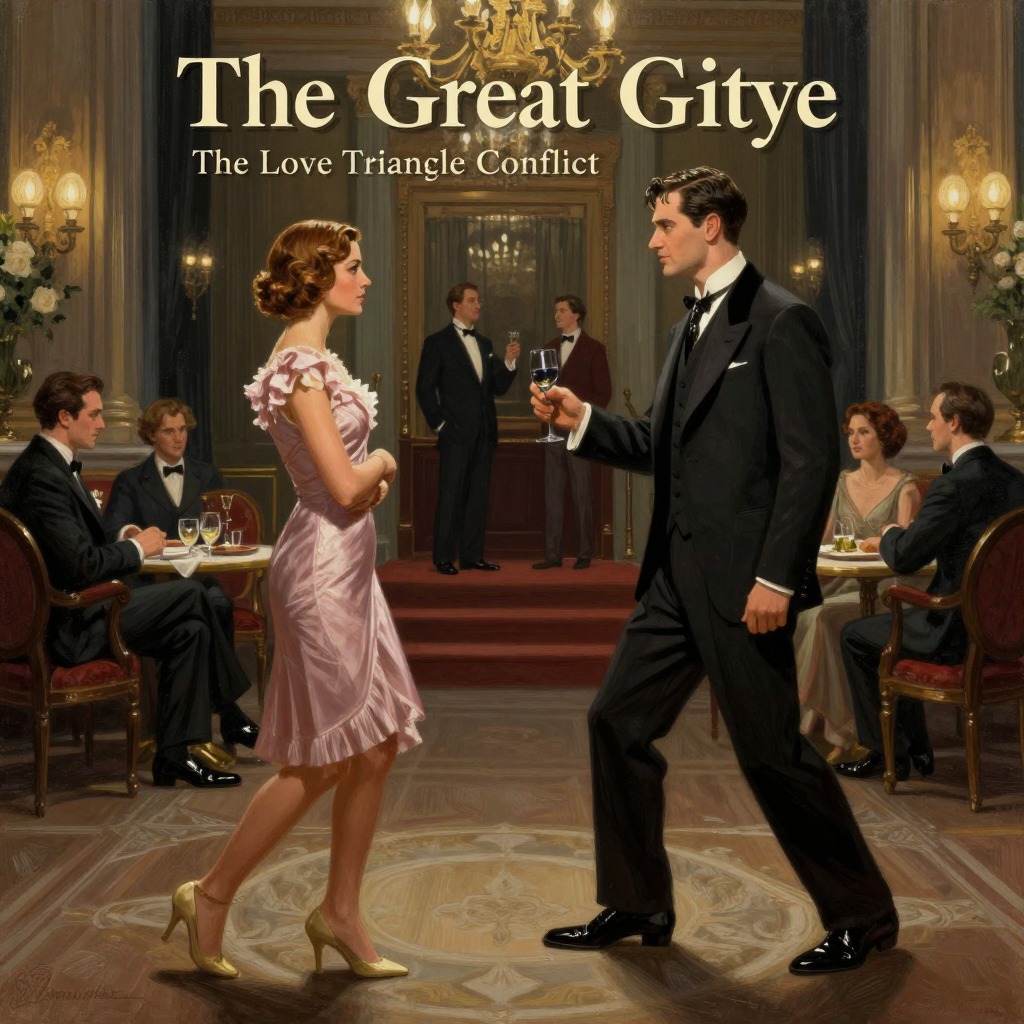
Spring 1922
Nick Carraway decides to go East
After returning from World War I, Nick Carraway feels restless in the Middle West and decides to go East to learn the bond business. His father agrees to finance him for a year, and Nick moves to New York, renting a small house in West Egg, Long Island, next to the mysterious Jay Gatsby's enormous mansion. This decision sets the entire story in motion, as Nick becomes the narrator and central observer of the summer's events.
early summer 1922
Nick dines with the Buchanans
Nick drives to East Egg to have dinner with his cousin Daisy Buchanan and her husband Tom. At their elegant mansion, he meets Jordan Baker, a professional golfer. The dinner reveals tensions in the Buchanan marriage: Tom receives a phone call from his mistress, and Daisy's voice carries a restless, magnetic quality. Tom expounds on racist theories from a book, and Daisy expresses cynical views about life. The evening ends with Nick learning from Jordan that Tom has a woman in New York.
early summer 1922, after dinner at the Buchanans'
Nick sees Gatsby reaching for the green light
Returning home late at night, Nick sees Gatsby standing on his lawn, stretching his arms toward the dark water. Nick looks seaward and sees only a single green light at the end of a dock, minute and far away. When he looks again, Gatsby has vanished. This moment introduces the green light as a symbol of Gatsby's longing and his connection to Daisy, whose dock across the bay holds that light.
a few days before the Fourth of July, 1922
Tom Buchanan introduces Nick to his mistress Myrtle
On a train to New York, Tom Buchanan forces Nick to get off at the Valley of Ashes, a desolate industrial wasteland. He takes Nick to George Wilson's garage, where Tom's mistress Myrtle Wilson lives with her husband. Tom and Myrtle arrange to meet in New York, and Nick accompanies them. The Valley of Ashes, with the looming eyes of Doctor T. J. Eckleburg, becomes a key symbolic landscape.
afternoon and evening of the same day
Party at Myrtle's Apartment
Tom, Nick, and Myrtle go to a small apartment in New York that Tom keeps for their affair. Myrtle buys a dog and changes into an elaborate dress, becoming haughty and affected. Her sister Catherine and neighbors the McKees arrive. The party becomes drunken and chaotic; Myrtle boasts about her affair, and Tom breaks her nose when she repeatedly shouts Daisy's name. Nick, drunk, later finds himself in the Pennsylvania Station waiting for a train.
a Saturday night in midsummer 1922
Gatsby's First Party
Nick receives a formal invitation to one of Gatsby's legendary parties. He attends and finds a lavish, chaotic scene with hundreds of guests, an orchestra, and endless champagne. He meets Jordan Baker again, and they hear rumors about Gatsby—that he killed a man, was a German spy, or attended Oxford. Nick finally meets Gatsby himself, who introduces himself with a disarming smile and calls him 'old sport.' Gatsby is called away to a phone call from Chicago.
late that same night
Car Accident After Gatsby's Party
As Nick leaves Gatsby's party, he witnesses a car accident: a new coupe has lost a wheel in a ditch. The driver, Owl Eyes, is bewildered and explains he wasn't driving—another man is in the car. A drunken passenger emerges from the wreck, and a crowd gathers. Nick walks home, glancing back to see Gatsby standing alone on his porch, his hand raised in farewell. The scene underscores the recklessness and emptiness behind Gatsby's glamour.
late July 1922
Gatsby tells Nick his background story
Gatsby invites Nick to lunch in New York, driving his cream-colored car. On the way, Gatsby nervously tells Nick about his past: he claims to be the son of wealthy Midwesterners, educated at Oxford, and a war hero who received decorations from every Allied government, including Montenegro. He shows Nick a medal and a photograph from Oxford. Though Nick is skeptical, the evidence seems authentic. Gatsby hints that he needs Nick's help with a personal matter.
later that same day
Gatsby introduces Nick to Meyer Wolfsheim
At lunch in a Forty-second Street cellar, Gatsby introduces Nick to Meyer Wolfsheim, a small, flat-nosed man with cuff buttons made of human molars. Wolfsheim reminisces about the shooting of Rosy Rosenthal at the old Metropole. After Wolfsheim leaves, Gatsby reveals that he fixed the 1919 World's Series. Nick is staggered by the implication that one man could manipulate the faith of millions. The meeting reveals Gatsby's connection to organized crime.
later that afternoon, at the Plaza Hotel
Gatsby asks Jordan Baker to arrange a meeting with Daisy
Jordan Baker tells Nick the story of Daisy and Gatsby's past romance in Louisville in 1917. Daisy was a popular young debutante, and Gatsby, a lieutenant, fell deeply in love with her. After Gatsby went to war, Daisy married Tom Buchanan, though she nearly called off the wedding after receiving a letter from Gatsby. Jordan reveals that Gatsby bought his mansion in West Egg specifically to be across the bay from Daisy, and he wants Nick to invite Daisy to tea so he can see her again.
a few days later
Gatsby asks Nick to invite Daisy to tea
Nick agrees to invite Daisy to tea at his house, allowing Gatsby to 'accidentally' drop by. Gatsby is nervous and offers Nick a business opportunity, which Nick declines. The plan is set for the day after tomorrow. Nick calls Daisy and invites her, warning her not to bring Tom. The stage is set for the reunion that Gatsby has been planning for five years.
a rainy afternoon, a few days later
Gatsby and Daisy's Reunion
On the appointed day, it rains heavily. Gatsby sends a gardener to cut Nick's grass and fills the house with flowers. He arrives, pale and nervous. When Daisy arrives, Gatsby disappears, then reappears, and the initial meeting is awkward. Nick leaves them alone for half an hour. When he returns, Gatsby is glowing with happiness, and Daisy has tears on her face. The rain stops, and Gatsby insists on showing Daisy his mansion.
later that same afternoon
Gatsby shows Daisy his mansion
Gatsby gives Daisy a tour of his opulent house, including a Marie Antoinette music room, a Merton College Library, and his own bedroom with a gold toilet set. He throws piles of shirts before her—linen, silk, and flannel—and Daisy cries, overwhelmed by their beauty. They look out at the rain and the green light on her dock. Gatsby shows her clippings about her that he has collected. The afternoon ends with Klipspringer playing the piano while Gatsby and Daisy sit together, lost in each other.
age 17, around 1907
James Gatz changes his name to Jay Gatsby
Nick reveals Gatsby's true origins: he was born James Gatz to shiftless farm parents in North Dakota. At seventeen, he changed his name to Jay Gatsby, a Platonic conception of himself as a son of God. The name change occurred at the moment he saw Dan Cody's yacht drop anchor on Lake Superior. Gatsby rowed out to warn Cody of a storm, and Cody took him on as a protégé, beginning Gatsby's transformation.
age 17, around 1907
Gatsby rows out to Dan Cody's yacht
Gatsby, then James Gatz, sees Dan Cody's yacht anchored on Lake Superior. He borrows a rowboat and informs Cody that a wind might break up his boat. Impressed by Gatsby's ambition and quickness, Cody takes him on as a personal assistant. Gatsby serves Cody for five years as steward, mate, skipper, and secretary, learning the ways of wealth and adventure. Cody's death leaves Gatsby with a legacy of $25,000, which he never receives due to legal machinations by Ella Kaye.
1917-1918
Gatsby serves in World War I
Gatsby serves in the American army during World War I. He becomes a captain before going to the front, and after the Argonne battles, he is promoted to major and given command of the divisional machine-guns. He earns decorations from several Allied governments. His war service is a key part of his self-invention, providing him with a heroic past and a uniform that allows him to enter Daisy's world.
1919
Gatsby studies at Oxford after the war
After the Armistice, Gatsby is sent to Oxford University for five months as part of a program for officers. This experience gives him the veneer of an Oxford education, which he later uses to bolster his persona. While at Oxford, he receives Daisy's letter announcing her marriage to Tom Buchanan, a devastating blow that fuels his determination to win her back.
a Saturday night in August 1922
Tom and Daisy attend Gatsby's party
Tom Buchanan, suspicious of Daisy's activities, accompanies her to one of Gatsby's parties. Daisy is fascinated by the celebrities and the glamour, but Tom is contemptuous and dismissive. Gatsby dances with Daisy, and they sit alone on Nick's steps. Tom's presence casts a shadow over the evening, and Daisy is ultimately appalled by the raw, vulgar energy of West Egg. After the party, Gatsby is depressed, feeling that Daisy didn't enjoy herself.
a broiling hot day, late summer 1922
Gatsby confronts Tom Buchanan at the Plaza Hotel
On the hottest day of the summer, Daisy, Tom, Gatsby, Nick, and Jordan go to the Plaza Hotel in New York. In a suite, Gatsby forces a confrontation, telling Tom that Daisy never loved him and that she loves Gatsby. Daisy admits she loved both, but Gatsby insists she never loved Tom. Tom exposes Gatsby's criminal background as a bootlegger and associate of Meyer Wolfsheim. Daisy recoils, and Gatsby's dream begins to shatter. Tom, triumphant, sends Daisy home with Gatsby.
later that same afternoon
Daisy hits and kills Myrtle Wilson with Gatsby's car
Driving Gatsby's yellow car back to East Egg, Daisy, who is at the wheel, accidentally hits and kills Myrtle Wilson, who had run into the road. Gatsby takes the blame, telling Nick that he will say he was driving. The car does not stop. Myrtle's husband, George Wilson, is devastated and becomes obsessed with finding the owner of the yellow car. The accident sets in motion the tragic climax of the novel.
that evening
Gatsby takes the blame for Myrtle's death
After the accident, Gatsby waits outside the Buchanan mansion, watching over Daisy. He tells Nick that Daisy was driving but that he will claim responsibility. He is determined to protect Daisy, even at the cost of his own life. Nick urges Gatsby to leave town, but Gatsby refuses, clinging to the hope that Daisy will leave Tom for him. Gatsby's vigil is a poignant symbol of his unwavering devotion and his tragic blindness to Daisy's true nature.
the next day, early afternoon
George Wilson shoots and kills Jay Gatsby
George Wilson, believing Gatsby killed Myrtle, traces the yellow car to Gatsby's mansion. He finds Gatsby floating on a pneumatic mattress in the swimming pool. Wilson shoots Gatsby dead, then turns the gun on himself. The murder-suicide is discovered by Nick, the chauffeur, the butler, and the gardener. Gatsby's death marks the end of his dream and the culmination of the novel's tragedy.
the days following Gatsby's death
Nick Carraway arranges Gatsby's funeral
Nick takes responsibility for Gatsby's funeral. He tries to contact Daisy, but she and Tom have left without an address. Meyer Wolfsheim refuses to attend, citing his rule of non-involvement. Klipspringer, the boarder, calls not to offer condolences but to ask for his tennis shoes. Gatsby's father, Henry C. Gatz, arrives from Minnesota, proud of his son's achievements. The funeral is sparsely attended; only Nick, Mr. Gatz, the minister, a few servants, and the owl-eyed man are present.
late October 1922
Nick Carraway confronts Tom Buchanan about Wilson's visit
Months after Gatsby's death, Nick encounters Tom Buchanan on Fifth Avenue. Nick confronts Tom, who admits he told George Wilson that Gatsby owned the yellow car, effectively sending Wilson to kill Gatsby. Tom shows no remorse, claiming Gatsby got what he deserved. Nick realizes that Tom and Daisy are careless people who smash things and retreat into their money. This confrontation solidifies Nick's disillusionment with the East.
autumn 1922
Jordan Baker and Nick Carraway break up
Before leaving the East, Nick meets Jordan Baker to end their relationship. Jordan accuses Nick of throwing her over on the telephone, and Nick admits he is too old to lie to himself. They part with a sense of mutual disappointment. The breakup marks Nick's final severance from the world of the Buchanans and Gatsby, and his return to the moral clarity of the Midwest.
autumn 1922
Nick Carraway decides to return to the Midwest
After Gatsby's death, the East becomes haunted for Nick. He decides to return to the Midwest, feeling that the story of Gatsby, Daisy, Tom, and Jordan is ultimately a story of the West. On his last night, he visits Gatsby's empty mansion and walks to the beach. He reflects on Gatsby's dream and the green light, concluding that we all beat on, boats against the current, borne back ceaselessly into the past. This final meditation gives the novel its enduring philosophical resonance.