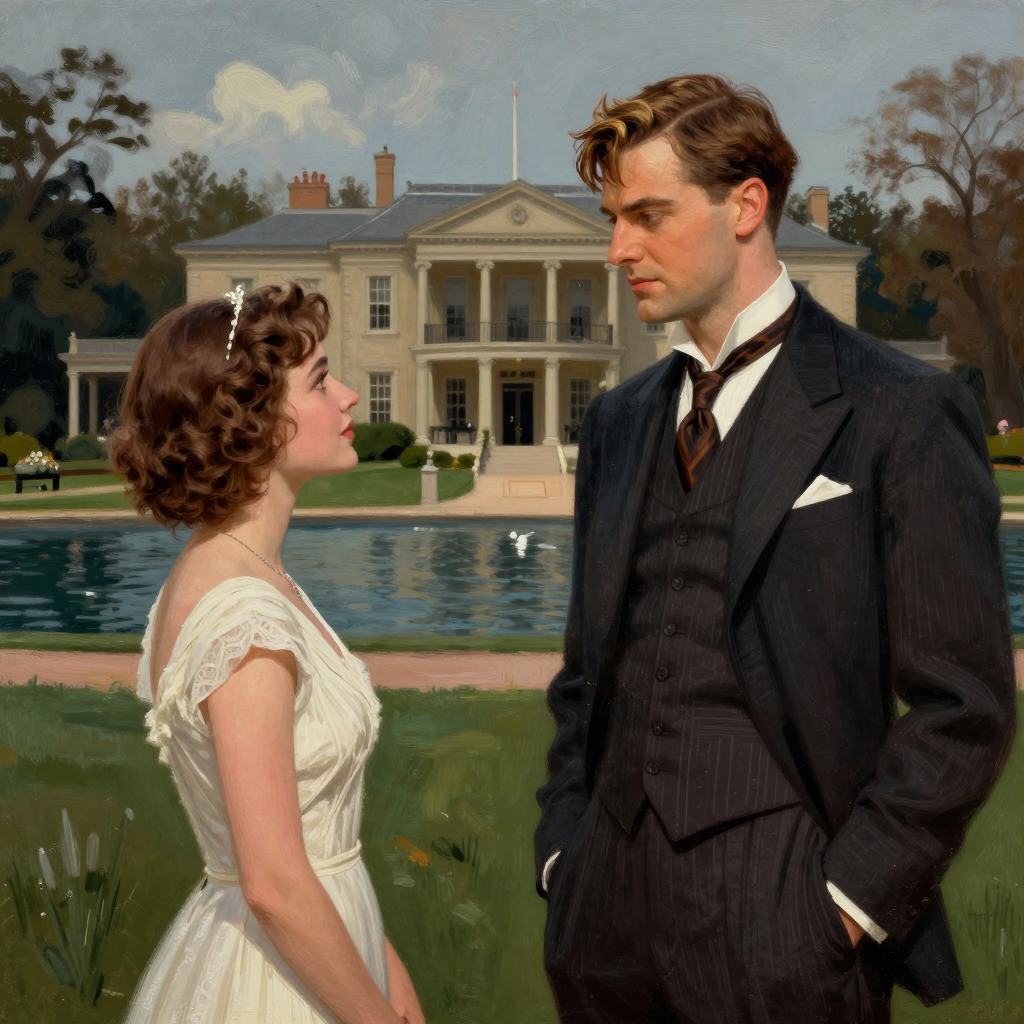
Death of Jay Gatsby
The Great GatsbyJay Gatsby's death is the culminating tragedy of F. Scott Fitzgerald's novel, the moment when the dream he had pursued for five years shatters irreparably. Shot by George Wilson in the swimming pool of his own mansion, Gatsby dies alone, his grand project of recapturing the past undone by a chain of misunderstandings, betrayals, and the careless violence of the wealthy. The event transforms the glittering promise of West Egg into a scene of desolate finality, leaving only the narrator, Nick Carraway, to reckon with the wreckage.
The Morning of the Murder
On the day of his death, Gatsby behaves with a strange, quiet detachment. He puts on his bathing suit and instructs the butler that if anyone telephones, word is to be brought to him at the pool. He stops at the garage for a pneumatic mattress that had amused his guests during the summer, and the chauffeur helps him pump it up. Then he gives an unusual order: the open car is not to be taken out under any circumstances, even though the front right fender needs repair. Gatsby shoulders the mattress and starts for the pool, pausing once to shift it, and disappears among the yellowing trees. No telephone message arrives; the butler waits until four o'clock, long after there is anyone to receive it. Nick Carraway later reflects that Gatsby himself probably did not believe the call would come, and perhaps he no longer cared. If that was true, Gatsby must have felt that he had lost the old warm world, paid a high price for living too long with a single dream. He must have looked up at an unfamiliar sky through frightening leaves and shivered at how grotesque a rose is, how raw the sunlight was upon the scarcely created grass.
The Shooting
George Wilson, having been told by Tom Buchanan that Gatsby owned the yellow car that killed Myrtle, traces Gatsby to West Egg. By half-past two, he has asked someone the way to Gatsby's house, and by that time he knows Gatsby's name. The chauffeur, one of Meyer Wolfsheim's protégés, hears the shots but later says he did not think anything much about them. Nick Carraway, driving from the station directly to Gatsby's house, rushes anxiously up the front steps, and his alarm is the first thing that alerts anyone. With scarcely a word, four of them—the chauffeur, the butler, the gardener, and Nick—hurry down to the pool. There is a faint, barely perceptible movement of the water as the fresh flow from one end urges its way toward the drain at the other. With little ripples that are hardly the shadows of waves, the laden mattress moves irregularly down the pool. A small gust of wind, scarcely corrugating the surface, is enough to disturb its accidental course with its accidental burden. The touch of a cluster of leaves revolves it slowly, tracing, like the leg of a compass, a thin red circle in the water. It is after they start carrying Gatsby toward the house that the gardener sees Wilson's body a little way off in the grass, and the holocaust is complete.
Aftermath and the Empty Funeral
In the days following the murder, Gatsby's world dissolves into a sordid spectacle of police, photographers, and newspapermen. Nick Carraway finds himself on Gatsby's side, and alone. He calls Daisy Buchanan instinctively, but she and Tom have gone away early that afternoon, taking baggage with them, leaving no address. Meyer Wolfsheim, Gatsby's business partner, refuses to attend the funeral, writing that he cannot get mixed up in it. Ewing Klipspringer, the boarder who lived in Gatsby's house, calls not to offer condolences but to ask for a pair of tennis shoes he left behind. Gatsby's father, Henry C. Gatz, arrives from Minnesota, a solemn old man bundled in a long cheap ulster, his eyes leaking tears. He shows Nick a ragged copy of Hopalong Cassidy in which the young James Gatz had written a schedule and general resolves for self-improvement. The funeral itself is a meager affair: a procession of three cars in a thick drizzle—a motor hearse, a limousine with Mr. Gatz, the minister, and Nick, and Gatsby's station wagon carrying four or five servants and the postman. Only one other person attends: the owl-eyed man who had marveled at Gatsby's library, who stands in the rain and, wiping his glasses, says, "The poor son-of-a-bitch." Daisy sends no message or flower.
Thematic Significance
Gatsby's death is the violent terminus of the American Dream as he embodied it. He had built his entire identity and fortune on the hope of recapturing a past moment with Daisy, a hope that Nick Carraway describes as an "extraordinary gift for hope, a romantic readiness." But the dream was founded on illusion: Daisy could not renounce her husband or her class, and Gatsby's wealth was built on criminal enterprise. The murder itself is a grotesque mistake—George Wilson kills the wrong man, having been misled by Tom Buchanan, who told him the owner of the yellow car. Gatsby dies in his own swimming pool, a symbol of the leisure and luxury he had amassed, but the water is stained with his blood. The novel's final image of Gatsby's empty house, with an obscene word scrawled on the steps, underscores the hollowness of his achievement. Nick Carraway, reflecting on the tragedy, concludes that Gatsby turned out all right in the end; it was what preyed on him, the foul dust that floated in the wake of his dreams, that was truly contemptible.