East Egg
The Great GatsbyEast Egg, the more fashionable of the two "enormous eggs" that jut into Long Island Sound, is the home of Tom and Daisy Buchanan and the embodiment of old-money aristocracy in the novel. Across the courtesy bay from West Egg, where Jay Gatsby's mansion blazes with gaudy parties, East Egg's "white palaces" glitter along the water, signaling a social order built on inherited wealth, cultural capital, and an unspoken code of exclusion. It is the fixed point against which Gatsby's aspirations are measured and ultimately shattered.
Geography and Social Position
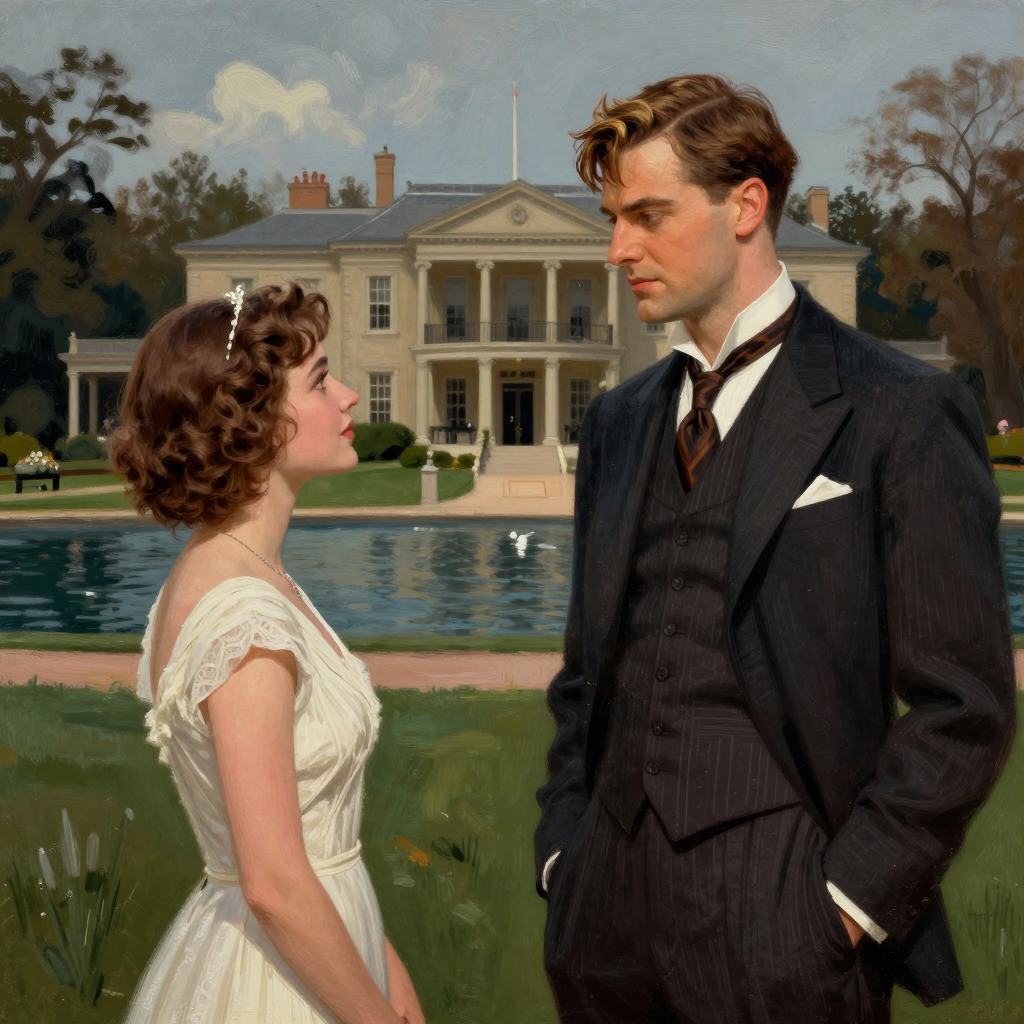
East Egg and West Egg are "identical in contour and separated only by a courtesy bay," but their social distance is vast. East Egg is the domain of families whose money has been established for generations, a world of "white palaces" and carefully maintained lawns that run from the beach to the front door. Nick Carraway describes the Buchanan mansion as a "cheerful red-and-white Georgian Colonial mansion, overlooking the bay," with French windows, a sunken Italian garden, and a half acre of roses. This is not the ostentatious, imitation-Hotel-de-Ville of Gatsby's West Egg; it is a residence that announces its owner's place in the social hierarchy without needing to shout. The very air of East Egg is one of effortless superiority, a place where the inhabitants "accepted Tom and me, making only a polite pleasant effort to entertain or to be entertained," their evenings conducted with a casual, unhurried grace that Nick finds "sharply different from the West."
The Buchanans and the Old-Money Ethos
Tom Buchanan, with his "cruel body" and his family's enormous wealth, is the archetypal East Egg figure. He has brought a string of polo ponies from Lake Forest, and his house belonged to "Demaine, the oil man." His conversation at dinner veers into racist pseudo-science from "The Rise of the Colored Empires," a performance of intellectual authority that masks a deeper anxiety about the erosion of his class's dominance. Daisy Buchanan, with her "low, thrilling voice" and her air of sad, lovely privilege, is equally a product of this world. Her voice, as Gatsby later realizes, is "full of money"—the "inexhaustible charm that rose and fell in it, the jingle of it, the cymbals' song of it." East Egg's power is not merely economic; it is a matter of style, of the right murmur, the right gesture, the right kind of carelessness.
East Egg's Condescension Toward West Egg
The social gulf between the two Eggs is dramatized when Tom and Daisy attend one of Gatsby's parties. Nick observes that the party from East Egg "assumed to itself the function of representing the staid nobility of the country-side—East Egg condescending to West Egg, and carefully on guard against its spectroscopic gayety." Daisy is "appalled by West Egg," by its "raw vigor that chafed under the old euphemisms" and its "too obtrusive fate that herded its inhabitants along a short-cut from nothing to nothing." Tom, for his part, immediately dismisses Gatsby as a "big bootlegger" and later, during the confrontation at the Plaza Hotel, sneers at him as "Mr. Nobody from Nowhere." East Egg's identity is defined as much by what it rejects—the vulgar, striving, newly rich world of West Egg—as by what it possesses.
The Green Light and the Unreachable Dream
From his West Egg lawn, Gatsby can see the green light at the end of Daisy's dock across the bay. That light, "minute and far away," is the symbol of everything East Egg represents: a world of grace, beauty, and belonging that Gatsby has spent his entire life trying to enter. He buys his mansion specifically so that Daisy will be "just across the bay," but the physical proximity only underscores the social impossibility. East Egg is not a place one can simply buy one's way into; it is a fortress of inherited status, guarded by people like Tom Buchanan who will use any means—including exposing Gatsby's criminal past—to keep the gates closed. In the end, after Gatsby's death, Nick reflects that Tom and Daisy are "careless people, they smashed up things and creatures and then retreated back into their money or their vast carelessness." East Egg, for all its beauty, is a place of moral emptiness, a gilded cage from which its inhabitants can destroy others without consequence.
Narrative Significance
East Egg functions as the novel's central symbol of the American aristocracy's impenetrability. It is the goal of Gatsby's quest and the source of his destruction. Nick's own journey—from being dazzled by East Egg's glamour to recognizing its "foul dust"—mirrors the reader's growing disillusionment. The two Eggs, identical in shape but worlds apart in meaning, are Fitzgerald's most powerful metaphor for the class divisions that define the Jazz Age and, by extension, the American Dream itself.