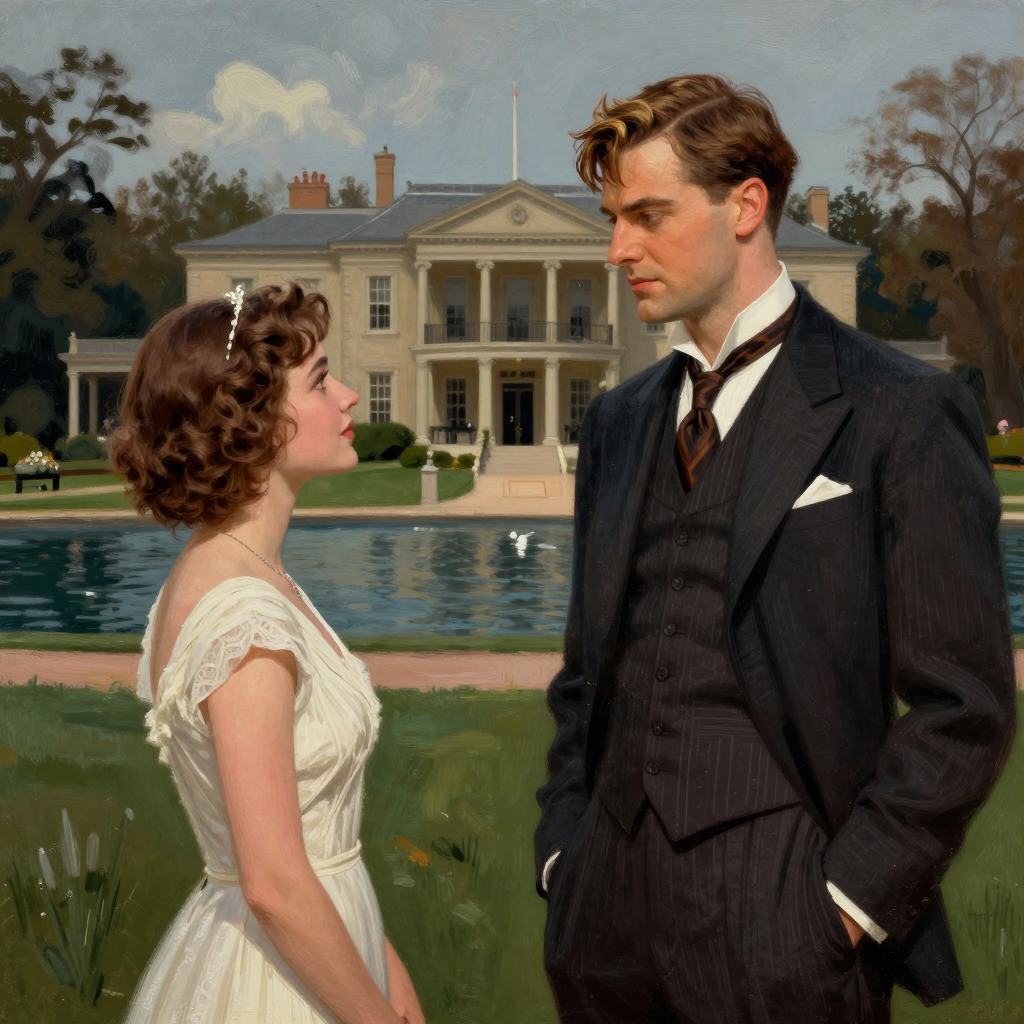
Plaza Hotel
The Great GatsbyThe Plaza Hotel, a luxurious Beaux-Arts landmark overlooking Central Park, becomes the stage for the most intense and decisive scene in The Great Gatsby. It is here, in a stiflingly hot suite rented on a summer afternoon, that the carefully constructed illusions of Jay Gatsby, Daisy Buchanan, and Tom Buchanan collide, forcing a public reckoning that shatters Gatsby's dream and sets the tragedy in motion.
Setting and Atmosphere
The Plaza Hotel is introduced as a destination of choice for the wealthy and fashionable. Jordan Baker and Nick Carraway meet there for tea in the tea-garden, a setting that feels both elegant and intimate, where Jordan recounts the story of Daisy and Gatsby's past. The hotel's grandeur is a fitting backdrop for the Buchanan's world of inherited wealth and social position. On the day of the confrontation, the suite they rent is described as "large and stifling," with the heat becoming a palpable presence. The oppressive atmosphere is heightened by the distant strains of Mendelssohn's Wedding March drifting up from a wedding in the ballroom below, a cruel irony that underscores the dissolution of Gatsby's romantic ideal. The room itself, with its closed windows and the hot shrubbery scent from the Park, becomes a pressure cooker for the emotional and verbal violence about to erupt.
The Confrontation
The confrontation at the Plaza Hotel is the novel's central dramatic event, a direct result of Gatsby's insistence that Daisy declare she never loved Tom. The scene begins with tense, coded exchanges. Tom, having already sensed the connection between Gatsby and Daisy, aggressively interrogates Gatsby about his claim to be an Oxford man, a line of attack designed to expose Gatsby's social fraudulence. Gatsby admits he attended Oxford for only five months after the Armistice, a program for officers. The tension escalates when Tom directly asks, "What kind of a row are you trying to cause in my house anyhow?" Gatsby, with Daisy present, declares, "Your wife doesn't love you," and insists, "She's never loved you. She loves me." Daisy, caught between them, initially tries to support Gatsby, telling Tom, "I never loved him," but her voice is cold and her hand trembles. When Tom reminds her of specific, intimate moments from their past, she breaks down, sobbing, "I did love him once—but I loved you too." This admission is the fatal blow to Gatsby's dream. Tom then reveals the results of his investigation into Gatsby's affairs, exposing him as a bootlegger who, with Meyer Wolfsheim, sold grain alcohol over the counter in drugstores. The accusation strips Gatsby of his carefully crafted persona, reducing him in Tom's eyes to a "common swindler." The scene ends with Tom, triumphant, ordering Daisy to go home with Gatsby, a cruel gesture of magnanimous scorn that signals his complete victory.
Consequences and Aftermath
The Plaza Hotel confrontation is the immediate cause of the novel's tragic climax. The emotional devastation of the scene leaves Daisy shattered and vulnerable, and it is in this state that she drives Gatsby's car back to Long Island. The argument has so thoroughly dismantled Gatsby's dream that when Myrtle Wilson runs into the road, Daisy, already panicked and distraught, strikes and kills her. Gatsby, still clinging to the hope of reclaiming the past, takes the blame. The confrontation also provides George Wilson with the information he needs to find Gatsby. Tom Buchanan, after the accident, tells Wilson that the yellow car belongs to Gatsby, directly leading to Gatsby's murder. The Plaza Hotel, a symbol of old-money elegance and social order, thus becomes the site where the fragile, new-money world of Jay Gatsby is irrevocably broken, setting in motion the chain of events that ends in his death and the exposure of the careless cruelty at the heart of the Buchanans' world.