Andy Moroney
The Greatest Beer Run Ever: A Memoir of Friendship, Loyalty, and WarAndy Moroney is a Protestant farmer, astronomer, and local FCA officer whose friendship with Sean McGahern’s father changes the young narrator’s access to books and intellectual life. Remembered through a sequence of vivid encounters rather than a conventional biography, Andy joins eccentricity to practical generosity: his household gives Sean a library, his farm gives him work and responsibility, and his father’s admiration for the Moroneys indirectly protects the boy’s freedom to read.
Identity and Background
Andy lives with his father, Old Willie, in a large stone house surrounded by stone outbuildings and an orchard. The Moroneys own 170 acres of fertile land on the lower plains of Boyle, though their manner of living gives them the appearance of people without means. Their farmhouse, extensive library, and well-built farm buildings speak of earlier resources; their modest food, worn domestic routines, and apparent delight in small sums from apple sales present a less prosperous daily reality.
Before joining the local company of the Fórsa Cosanta Áitiúil at the outbreak of war, Andy had led an isolated and eccentric life. He possessed an unusually broad store of knowledge and devoted himself to astronomy. His military career advanced from lieutenant to captain and company commander. He was also a crack shot, winning the Western Shield several times. On a radio quiz programme, he called himself a “gentleman farmer,” a description that amused the local community through the incongruity of its two familiar words.
Andy and Sean’s father differed in upbringing and temperament, but formed a genuine friendship through their shared involvement in drilling, rifle practice, and marches through the village. Sean’s father held Protestants in exceptionally high regard, considering them more honest, morally correct, well-mannered, and abstemious than Catholics generally. His admiration for Andy and Old Willie was personal as well as religious, and the memoir later connects it to the unusual permission he gave his son to read freely.
Astronomy, the Farm, and Old Willie
Astronomy occupied much of Andy’s time, despite the frustrations of north Roscommon’s low skies and heavy rainfall. On clear nights he observed outdoors through a telescope. His precise charts and notes reflected his clipped military manner, while his genteel but careless dress offered a contrast between orderly thought and untidy appearance. He slept during the day, keeping to a rhythm shaped by his nocturnal pursuit of the stars.
Old Willie’s devotion was to bees. In his wife’s lifetime he had travelled around the country lecturing to beekeeping societies; after her death he no longer ventured beyond the house and its immediate grounds. His hives stood at the foot of the orchard. The father and son lived simply on tea, bread, and honey, with an occasional stew, and let their dishes accumulate until, every month or so, they washed them all at once. They gathered apples, stored them on wooden shelves in the outbuildings, and sold them by the bucketful.
The memoir treats the two men with affection as beautiful, gentle, impractical figures, but it does not make their strangeness abstract. A summer morning at the house fixes Old Willie in a particular scene: while he and Sean talk over tea, bread, and raspberry jam, bees begin buzzing in the old man’s long beard. Willie rises, delicately removes them with his fingers, and tosses them into the yard without breaking the conversation. Andy’s household is thus remembered through its intimate routines as much as through its eccentric pursuits.
The Library and Sean’s Education
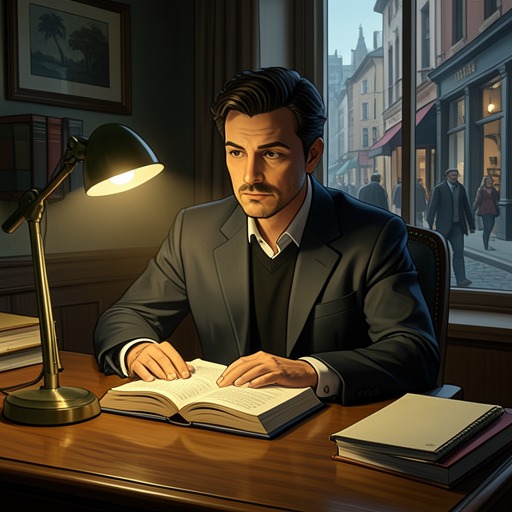
Sean first comes to the house to buy apples. A conversation with Old Willie about books earns him unrestricted use of the library. Its shelves hold Scott, Dickens, Meredith, Shakespeare, popular romances, books by Zane Grey and Jeffrey Farnol, and numerous volumes about the Rocky Mountains. The young reader chooses for pleasure, without guidance or a prescribed course, and returns every week or fortnight with five or six books in an oilcloth shopping bag, exchanging them for another handful.
Old Willie’s questions—“Master Sean, what are you reading? Master Sean, what do you think?”—are less an attempt to direct the boy than an expression of his need for company. Though he no longer reads himself, he gives Sean’s reading a place in the life of the house. The library makes culture available without instruction or gatekeeping: a tall, slender ladder reaches the high shelves, and the boy is free to follow whatever interests him. After Old Willie dies, Sean continues visiting, but the conversations about books cease. The loss alters the meaning of the place even before its eventual sale.
Trust, Work, and the Tractor
After Old Willie’s death, Andy spends less time on astronomy and more on the land, sometimes asking Sean to help him. Their work is mostly silent; Andy has little inclination for small talk. His trust in the boy can seem almost foolhardy. When he needs wood, cement, or hardware from Sloan’s in Boyle, he sends Sean on the farm’s small tractor, although Sean has never driven a mechanical vehicle. Andy demonstrates the starter, clutch, gears, and brakes, gives him a few lessons and a practice run in the field, and then sends him out onto the road.
Sean reaches Boyle in second gear and grows confident enough to experiment until he is travelling in third. At the shop he has the trailer loaded and the tractor turned for home. Remembering that his father sometimes switched off a car engine on steep hills to save fuel, Sean tries the same thing on the descent from Ardcarne toward the Moroneys’ gate. The tractor gathers speed in silence. Sean can only hold on as it bounces off the grassy margins; neither the tractor nor the trailer overturns, and he meets no one on the road. Shaken, he eventually turns back and drives slowly into the yard. Andy’s reply, “I told you there was nothing to it,” turns the near-disaster into a dry exchange, while Sean’s quiet admission that care was needed leaves much of his fear unspoken. The episode captures Andy’s combination of confidence in practical instruction and extraordinary willingness to entrust a boy with adult responsibility.
Marriage, Departure, and Narrative Significance
Sean’s father later helps arrange Andy’s marriage to Annie Beirne, a young local woman nursing in Belfast. Andy converts to Catholicism in order to marry her, with Sean’s father serving as one of his sponsors at baptism. The conversion changes Andy’s position in public religious life: before it, he had to remain outside the church door while his men presented arms; afterward, he could lead them up to the high altar during sung Masses and give the commands before and after the consecration.
Annie is intelligent and practical. After several years together, she and Andy sell the beautiful but run-down house and lands, pay their debts, and buy a smaller property in Kildare. The Leydens, whose wealth came from the Arigna coal mines, acquire the Moroney estate and have no interest in its bees, library, or stars. By then Sean is moving on as well, and no longer needs the library. The house’s sale closes the material setting of his childhood reading, replacing a private world organized around books, bees, and observation with new ownership and different priorities.
Andy’s importance to Sean’s story lies not only in his hospitality but in the indirect influence he exerts within the family. Sean later wonders why his father, usually harsh and ungiving, never curtailed the boy’s reading. He attributes this exception to his father’s close, almost infatuated attachment to the Moroneys: their approval mattered so much that Sean’s father tolerated the hours his son spent with books. Andy is therefore both a generous individual and the center of a relationship that gives Sean room to develop. The remembered episodes—an open library, a tractor on a steep hill, bees lifted from a beard—make that freedom concrete, while the eventual sale of the farm gives it an ending.