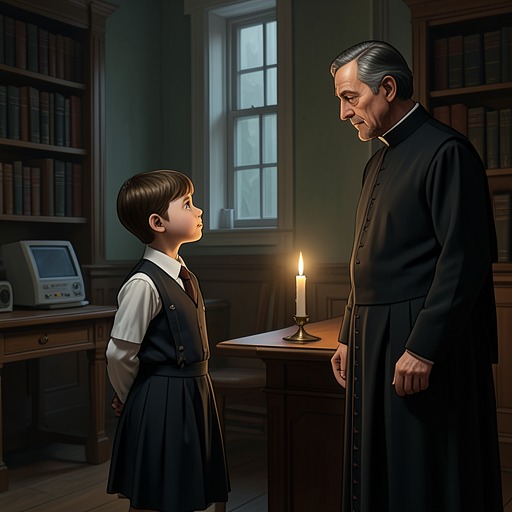
Canon Reilly beats the boy who broke into the poor box
The Greatest Beer Run Ever: A Memoir of Friendship, Loyalty, and WarCanon Reilly beats the boy who broke into the poor box in a schoolroom scene that makes religious authority physical and public. A boy is made to choose between being taken to the guards and being punished by the priest; the beating that follows becomes an example presented to the whole school, and a lasting measure of Canon Reilly’s power in the community.
Background and Authority
Canon Reilly was the parish priest in Ballinamore and had once managed Lisacarn School, which John McGahern attended as an infant with his mother. He was already a formidable presence in the narrator’s memory. The school learned to fear him when he appeared carrying a small brown suitcase, said to contain the viaticum and the holy oils used to anoint the sick.
The beating took place within a society where religious practice structured ordinary time. Prayers were said each morning, work stopped at the Angelus, and the day ended with the Rosary. In the school, however, religious authority was also exercised through discipline. In the Diocese of Kilmore, teachers were required to hold catechism classes after Second Mass on Sundays; Canon Reilly enforced the requirement in Ballinamore by waiting at the church gates and returning children to class by the ear. The schoolroom beating belongs to this wider pattern of authority made immediate through the control of children’s bodies.
The Beating in the Schoolroom
One lunch hour, Canon Reilly arrived at the school in a rage. A boy from the poor, large Canning family on Willowfield Road had broken into the church poor box and later enjoyed a feast of chocolates and sweets in town. After extracting a confession, the priest gave him a choice: be taken to the guards or accept punishment there and then. The pale, whimpering boy chose the priest’s punishment.
Canon Reilly unlocked the brown suitcase and removed a length of electric flex. In the clearing between the two sets of benches, he held the boy with one arm and struck him with the flex in the other. The beating moved in a slow circle as the child tried to drop to the floor and move away from the wire cutting into his bare legs. The assembled school watched in stricken fascination. When it ended, the boy returned to his bench crying and bleeding, burying his head in his arms. The priest put the flex back in the suitcase and delivered a short lecture to the school about the example they had witnessed.
Witnesses and Consequences
John McGahern remembers watching in awe, but he also understood that Canon Reilly’s reputation extended beyond the school. In town, the priest was regarded as a man who was his own law. One story told of him lifting heavy railway gates from their hinges when they blocked his way to a sick call, then driving across the tracks in front of a train and nearly causing a terrible accident. The tale reinforces the impression created by the schoolroom scene: Canon Reilly acted with an authority that others feared to challenge.
The Sunday catechism rule had a practical consequence for the narrator’s family. Knowing that Canon Reilly stood at the church gates and would accept no excuses, John explained to his father why they should leave early and attend Mass at another church on the way to Clones. The episode therefore sits alongside, rather than apart from, the family’s attempts to avoid the priest’s uncompromising enforcement of religious obligations.
Religious Form and Physical Power
The suitcase gives the event its sharpest contrast. It was associated with the viaticum and holy oils, sacred provisions for the sick; from it Canon Reilly drew the electric flex used to hurt a child. The object that carried signs of care and sacrament also concealed the instrument of punishment. The boy’s confession, forced choice, and beating were then converted into a public lesson, with the priest controlling both the act and its interpretation.
The episode is not presented as an isolated account of violence detached from religion. Elsewhere, the narrator remembers church ceremonies as an education in beauty, mystery, and a moral authority he believed stood beyond bullying. The schoolroom beating reveals the tension within that world: religious practice could offer ceremony and meaning, while a priest’s local power could also impose fear and bodily pain. The whole school’s enforced attention, followed by the lecture, makes the scene an illustration of how authority sought not merely obedience but witnesses to its force.