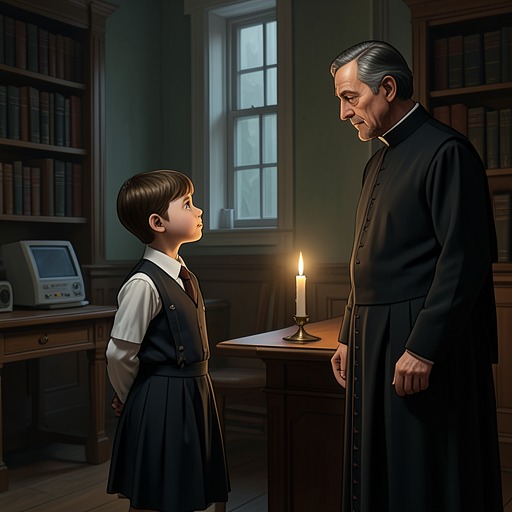
Father Glynn
The Greatest Beer Run Ever: A Memoir of Friendship, Loyalty, and WarFather Glynn is the elderly parish priest in Cootehall whose unassuming presence became inseparable from the narrator’s experience of Catholic worship. Gentle and seemingly old before his time, he presided over an ordinary parish life of altar service, instruction, and recurring ceremonies; through them, the church offered the child beauty, meaning, and an authority beyond the rule of his father.
Identity and Parish Setting
Father Glynn lived with his brother Danny in a blue-and-white presbytery at the end of a long avenue of lime trees. The church grounds, with yew and cypress trees, priests’ graves, and laurel hedges along the paths to the doors and sacristy, gave his parish a distinct physical setting. The recollection also preserves local rumor: Father Glynn and Danny were said to drink in the evenings, and a late visitor seeking business at the presbytery might be answered by Danny and turned away. The account presents this as village talk, not as an established description of the priest’s conduct.
The church was the parish church, while Crossna and Drumboylan were served by curates. Its position in the village made it readily accessible, but its importance exceeded convenience. For the narrator, it was a place that opened outward from the household and barracks, governed by different laws and a higher authority. Father Glynn’s ministry belonged to that alternative order, though the recollection makes the church’s force larger than any one priest.
Altar Service and the Work of Worship
After the family moved from Aughawillan, the narrator served at Mass in an old white surplice and a new red soutane, the change in vestment colour accompanying a diocesan change. Before Mass, the altar boys prepared the church while the priest robed: they lit the altar candles, poured wine and water into small cruets, and arranged the finger bowl and fresh linen. They waited for the second bell, then bowed to the cross at the priest’s signal and went out in pairs, separating on either side of the altar steps as Father Glynn followed with the covered chalice.
The service had a precise rhythm of preparation, silence, gesture, and movement. After Mass, Father Glynn chatted pleasantly with the boys as he unrobed; they then walked with him along the laurel hedges out of the churchyard. These small encounters locate him not only at the centre of the sacrament but also in an easy, familiar relationship with the children who assisted him. The narrator’s remembered religious life is built from such repeated acts as much as from formal teaching.
Confirmation and the Guinea Fowl Classes
During the first winter and spring in the barracks after the narrator’s mother died, when he was ten, he prepared for confirmation. Doctrinal instruction took place at school, while Father Glynn held evening classes in the church on certain nights. They were remembered as ineffectual and often late: the children would gather at the appointed time while the priest walked up and down the lime avenue reading his breviary, leaving them to play among the cypresses and headstones.
One boy in the class, Mikey Flanagan, could imitate the cry of guinea fowl so convincingly that birds at farms around the village answered him. He climbed a large cypress near the gate to make the call, and the piercing response did not interrupt Father Glynn’s prayers. The episode acquired a life of its own: Mikey became known as Guinea Flanagan for the rest of his life. The narrator remembered the cry vividly but retained almost nothing of the instruction. The contrast captures the class as it survives in memory: the solemn church and the priest at prayer on one side, a child’s startling performance and the surrounding village answering on the other.
Ceremonies and the Beauty of the Church
The church ceremonies gave the narrator pleasure, and their importance endured beyond childhood. In a time of poverty, they were his first introduction to indoor beauty, ornament, ceremony, sacrament, and mystery. Even the plain cardboard boxes that brought red, white, and yellow tulips by bus remained part of this memory, because flowers were scarce and the altar’s colour and arrangement made a visible difference to the church interior.
The narrator particularly recalled the Stations of the Cross during Lent and the feast of Corpus Christi. At the Lenten devotions, only a handful of people gathered around the organ loft. In the dim church, with rain and wind at the windows and the great trees stirring outside, three altar boys moved from Station to Station: one carrying a cross, two carrying lighted candles. Father Glynn named each Station and genuflected; his words echoed through the nearly empty church. The remembered scene joins ritual to weather, sound, and movement, making the small congregation’s ceremony feel expansive without making it grand.
Corpus Christi transformed the village streets. Rhododendron branches from the Oakport woods decorated the road margins, while banners and streamers crossed the road and flowered altars were erected at several stops. A large procession carried the Host beneath a gold canopy, pausing for ceremonies at each altar as hymns sounded and girls in white First Communion dresses scattered rose petals. A guard stood at each of the village’s three entrances. For the narrator, the feast made the sacred pass through ordinary roads beneath the sky: a public ritual whose order, beauty, and collective participation differed sharply from the violence of domestic life.
Pastoral Authority and Narrative Significance
Father Glynn fell ill for a time and was replaced for several months by a young priest whose quiet, plain-language sermons connected Christianity with people’s lives. He spoke against character assassination, marital violence, child beating, dishonesty, and hypocrisy, and placed humility, charity of mind, and love of others at the centre of Christian conduct. The narrator’s father, sitting in the front pew, showed his anger by lifting and crashing the heavy kneeler onto the flagstones three times. The young priest paused, looked directly at him, and continued. Many parishioners criticized the sermons and welcomed Father Glynn’s return, preferring the forceful language of hell and damnation that could be turned against other people.
The contrast clarifies the limits and possibilities of the priestly office in the narrative. Father Glynn is not presented as a reforming preacher; his remembered gentleness, routine pastoral contact, and participation in the ceremonies stand apart from the young replacement’s explicit challenge to violence. Yet the church’s religious authority, encountered by the narrator at the priest’s side, was understood as something his father could not simply dominate. The father had to subscribe to that authority while occupying the front seat at Mass, even as his own household rule turned inward toward darkness, violence, lies, and suppression.
The narrator calls the church his first book: its recurring cycle of Christmas, Ash Wednesday, Lent, Easter, Pentecost, Ascension, and All Souls gave depth and shape to both the year and his life. Father Glynn’s altar and parish are central to that education, not because he supplies a remembered body of doctrine, but because his ceremonies made faith tangible through movement, vestments, music, sacrament, and shared attention. The priest’s quiet presence thus belongs to a larger refuge that opened outward from the barracks toward understanding, freedom, and joy.