Francis McGahern’s proposal that Sean move in with him
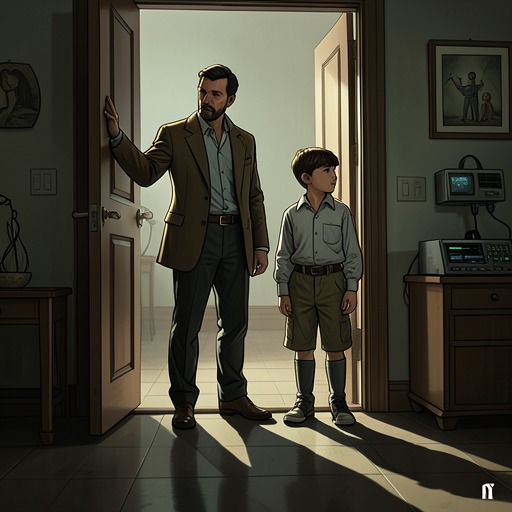
The Greatest Beer Run Ever: A Memoir of Friendship, Loyalty, and WarFrancis McGahern’s proposal that Sean move in with him begins as an evening rabbit hunt and becomes a quiet attempt to draw his son away from Aughawillan. Francis presents the barracks as a place for male companionship, work, and freedom from a house of women; Sean’s hesitation, his concern for his mother, and his father’s concealed anger expose the pressure beneath that invitation. The scene makes the proposal consequential not because Sean accepts it, but because he recognizes what is being asked and declines to keep it separate from the rest of his family.
The hunt and the approach
The evening before Sean was due to return to Aughawillan, Francis took him to Oakport to shoot rabbits with a .22 rifle. Low on ammunition, Francis gave Sean the three remaining shells to carry. They followed the broken stone avenue beside the lake, past fallen iron gates and towards the old estate. Gulls wheeled and cried overhead; as the light faded, they waited at a breach in a wall for rabbits to emerge into the short-grassed fields. Francis tried to line up two rabbits for one shot. When the shot rang out, he told Sean to run after the wounded animal, then killed it with one stroke of his hand.
The return walk gives the proposal its particular setting. Sean carried the rabbit while the sinking sun reddened the lake and the trees at Oakport. Near the stone piers and fallen gates, Francis asked, “Would you think of coming to live with me in the barracks?” The invitation follows the shared hunt, but it is not simply an extension of their evening together: Francis has brought the question to a point where the landscape and the silence around them leave Sean to answer directly.
An offer framed as belonging and work
Sean did not know what to say. His first response was to ask what would happen to the others. Francis replied that they would remain in Aughawillan and that everything there would stay as it was. The proposal thus divided the household rather than moving it together: Sean alone would join his father, while his mother and siblings stayed behind.
When Sean asked what his mother would do, he understood that the offer meant more than a change of address. Francis said she had enough to contend with and would have “one less” person to worry about. He also suggested that it must be hard for Sean to live in a house of women. That justification made the move sound like relief for his mother and a remedy for Sean, while leaving the separation itself unaddressed.
Francis attached practical tasks to the invitation. He proposed bringing the jennet and Toby to the barracks and cutting turf there rather than in Aughawillan, where he considered the old mud turf a waste of time and money. Sean could help save the turf and draw it to the road with the jennet. Work therefore became part of the imagined life together: the offer promised not only his father’s company but also a role in the household’s labour.
Companionship, school, and authority
Francis also imagined shared leisure. Once the boat was tarred, he said, they could go out in it; Sean could practise football with the other boys. Against that picture he set a gendered warning that a boy in a house full of women might “turn into a molly” and become “a half a woman.” The appeal to male company gave the invitation an edge: life with Francis was presented as a way to become properly masculine, while remaining with his mother and sisters was cast as a risk.
Sean answered with the immediate obligation that he had to return to school. Francis said he did not have to go back unless he wanted to. When Sean explained that his mother had allowed him one day off but not two, Francis asserted that schooldays did not matter and that “it’s what I say here that counts.” He suggested that Sean could wait until later in the week, when they might return together and tell the family the news. The offer had shifted from a question about living arrangements to a claim over the decision: Francis treated his authority in the barracks as more important than Sean’s schooling or his mother’s instructions.
Sean said his mother would worry and that he needed to tell her first. Francis then softened his insistence, acknowledging that the decision was sudden and that Sean needed time to think. But he also asked him not to tell anybody what they had discussed, warning that women could misread things. He proposed that Sean come straight back to him once he had decided. The request for secrecy sat uneasily beside his stated plan that they would eventually give the family the news together.
Refusal and its aftermath
As they crossed the bridge into the village, the hounds at Oakport House could be heard preparing to be fed. Francis and Sean then went along the short avenue, where Sean promised not to say anything. The next day Francis cycled with him as far as the stone bridge over the Shannon. Before they parted, Francis told him to say that he had been unable to get away but would come down later in the week. Sean agreed not to speak of the proposal.
At their parting, Sean saw hatred in Francis’s eyes and tried to shut the sight out. The older narrator identifies the look as one he later came to recognize: Francis had not got his way. The scene’s outcome is therefore not an accepted move but a refusal that remains largely unspoken. Sean does not confront his father openly; instead, his insistence that he must tell his mother, and his failure to give the answer Francis wanted, frustrate the plan.
Back at home, Sean concealed what had happened. His sisters suspected he had been beaten, but he spoke instead about the hunt, the rabbit, the boat awaiting tar, and the journey. His mother looked at him anxiously without pressing him. The secrecy Francis had requested became an inward silence that Sean also seemed to feel was necessary, though its concealment left the proposal and the father’s anger unspoken within the family. The scene thus joins an intimate shared outing to a struggle over authority: the rabbit is brought home as visible evidence of the evening, while its central conversation is withheld.