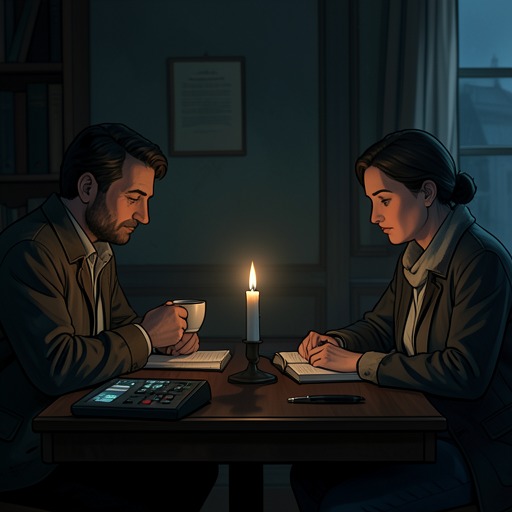
Francis and Susan McGahern’s marriage
The Greatest Beer Run Ever: A Memoir of Friendship, Loyalty, and WarFrancis (Frank) McGahern and Susan McGahern’s marriage is shaped by illness and separation, but it is not reduced to either: the memoir records continuing intimacy alongside secrecy, fear, and a growing struggle over who gets to define what Susan needs. Their last period together is marked by a sharp contrast between her brief reports of pain and his elaborate, often controlling attempts to direct her care.
Marriage Under Medical Uncertainty
Early in Susan’s illness, Francis wrote to a doctor in Dublin to ask whether she should give up teaching and what her chances of recovery were. He framed the inquiry as necessary for the family’s interests and said he had hoped not to cause the doctor further annoyance. The narrator adds that Francis had already written at the beginning of the illness and received a detailed report; that history may explain the later letter’s defensive, slightly bullying tone, which the narrator also regards as characteristic of him. The marriage is thus presented from the outset through uneven access to medical knowledge: Francis privately sought a prognosis, while Susan’s later letters show her still trying to understand what was happening to her body.
For a time, their relationship retained ordinary rhythms and physical closeness despite the seriousness of the illness. Francis continued to visit regularly, and the hard, dramatic weather seemed to improve his mood: he complained less of pain and found work to do on the land. They also continued to risk sexual intercourse despite fasting, novenas, and warnings from Dr Corcoran. In a letter that February, Susan reassured Francis that he need not worry further because her period had arrived. The small, practical reassurance sits uneasily beside the larger medical danger surrounding them, showing how the couple’s intimacy remained bound up with uncertainty and religious discipline.
Susan’s Symptoms and Competing Accounts
As time passed, Susan’s letters acquired a note of despair. After returning to school following several days in bed, she wrote that she was improved but still suffering and feared that she might simply have to continue suffering. She wondered whether better weather and sunshine might help. The narrator says that she suspected the cancer had returned, but those around her encouraged her to treat the stomach pain and recurring constipation and diarrhoea as an unrelated illness from which she could recover if she made the effort. She asked Francis to write to Dr Corcoran; he was reluctant, having already contacted him secretly.
Susan’s own letters remain brief and attentive to other people even as her symptoms worsen. She reported staying in bed to see Dr Dolan, said she was no worse, and wished that something could be done before matters went too far. She asked after Francis’s health and his work in the barracks, garden, and bog, and passed on details of the farm: the oatfield had been rolled, and Pat had moulded the potatoes. She had been in bed when fertilizer was applied and could only hope the work had been done properly. These practical details convey the marriage as a continuing exchange about home and work, while also recording how illness was taking Susan away from the activities she had once overseen.
Visits, Distance, and the Proposed Move
Francis came to Corramahon by bicycle one last time. The narrator remembers that he hardly noticed the children and spent the visit in grave conversation with Susan. She was able to walk him to the small iron gate at the road; they remained there talking for a long time, and they never saw one another again. The gate marks the end of face-to-face contact, not a reconciliation: what passed between them is left undisclosed, while the fact of their final conversation is made unmistakable.
After that visit, Francis communicated with Susan only by letter. He also began writing to Maggie. A proposal that Susan move to the Cootehall barracks for a rest was sent to Maggie rather than directly to Susan. The narrator suspects that this was meant more for public consumption than as a practical plan Francis genuinely wanted. Maggie replied that she had asked Susan, who wished to remain at Corramahon until she was stronger. The exchange makes the separation tangible: decisions about Susan’s recovery were discussed through relatives, even as she remained the person whose health and home were at stake.
The May Letter and the Marriage’s Unresolved Conflict
In a letter dated 23 May 1944, Francis addressed Susan as his motherly beloved and described hearing that she had had a good night and was much improved. He had visited the convent of the Poor Clares, enrolled her in perpetual adoration, and resumed fasting for her. He suggested that she might come to Cootehall when she was able, but warned her to move only gradually, first as far as the road and then a little farther, for fear of relapse. He also prescribed changes to her diet, including cutting out meat, rice, and rhubarb, using oat porridge sparingly, reducing potatoes, and taking greens and milk foods. His religious observances and detailed instructions show the force of his concern, but they also place him in the role of directing her treatment from a distance.
The same letter turns that care into reproach. Francis relayed that the nuns thought Susan should give up teaching, said he believed she had lost confidence in God, and accused her of opposing him quietly over the children. He described the responsibility as too much for her and said that he too was suffering. Although he wrote that he had contacted Dr Corcoran, he added that there had been no need. Against the earlier evidence that he already possessed medical information, this insistence on reassurance and self-direction sits uneasily with the knowledge he had kept from her. The letter moves between solicitude, religious counsel, blame, and an admission of strain; it does not settle the disagreement over teaching, the children, or the seriousness of her condition.
Narrative Significance and Ending
The memoir places these letters beside the narrator’s account of Susan’s dying, revealing the distance between the language used to manage illness and the life being lost. People outside the dying person’s world continue their ordinary work, while the person facing death becomes separated from the future everyone else assumes. Susan’s faith may have sustained her, the narrator reflects, yet Francis’s accusation that she had lost faith also made religion part of the pressure placed upon her. No letter could remove the human pain of leaving the people she loved and who depended on her.
The marriage ends in separation without a final meeting: after the bicycle visit, its remaining contact is written, mediated by relatives, and threaded with advice and guarded reports of improvement. The letters preserve care, but not uncomplicated tenderness; they expose a relationship in which concern could coexist with secrecy, authority, and unresolved conflict. By setting Francis’s confident instructions against Susan’s restrained accounts of pain, the memoir makes the correspondence itself a record of how illness altered their marriage and narrowed the space in which they could speak to one another.