Francis's arrangements and bequest in case of imminent death
The Greatest Beer Run Ever: A Memoir of Friendship, Loyalty, and WarFrancis (Frank) McGahern’s preparations for a possible death turn his authority over the family into a final, startling instruction: John McGahern, aged fifteen, is to manage the estate and raise his siblings. The scene is at once an act of planning and an expression of Francis’s determination to shape events beyond his control. Its force comes from the distance between the confidence of his commands and the boy’s knowledge that he cannot realistically carry them out.
From recurring illness to a reckoning
Francis had often taken to his bed with illnesses, sometimes announcing them and sometimes leaving them unnamed. His hypochondria drew him to medical books and to a curtained medicine press stocked with thermometers, senna leaves, sulphur, cascara, powders, scales, and glasses. He mixed purgative prescriptions for himself and the children, who hated their bitter taste. When he wanted attention from his bedroom, he pounded the floorboards with a walking stick or boot and grew angry if the household did not respond at once. His familiar illnesses brought a recurring pattern: visits from the police doctor, Vesey; papers for the barrack orderly to deliver; then a sudden recovery, shaving, dressing, issuing instructions, and returning to the morning inspection.
This illness initially seemed to belong to that pattern, but it lasted longer. Francis’s voice weakened, his movements slowed, and he limped when he rose. John had to help him on the stairs. Vesey came to the barracks every day, and the three guards looked grave. Each night, after the Rosary, the family prayed with Francis for his recovery. The household was told he would be sent to the Depot Hospital in Dublin. Before he left, John was asked to find documents and a small metal box, army surplus bought at auction, its green-and-mud colouring recalling grass and earth. A solicitor from Boyle—possibly Forbes or Wynn—also spent a long time with Francis in his bedroom.
The instructions by the turf fire
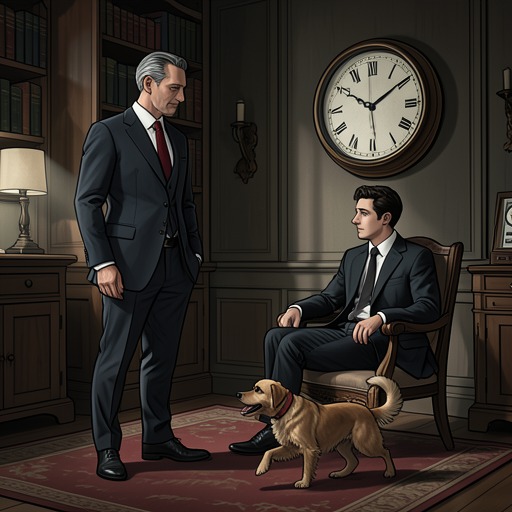
On the evening before the journey, Francis dressed slowly in uniform and descended the stairs, stopping to rest on the banister. He told the girls what to pack and gave the barrack orderly the evening off. Then he called John into the dayroom, asked him to shut the door, and sat beside the turf fire. The open metal box stood on the trestle table among ledgers and inkstands. The physical arrangement made the conversation feel less like a passing reassurance than a transfer of responsibility.
Francis told John that he might not return alive from hospital and that he had made provision for what would follow. A roll of money held by a rubber band was to cover immediate funeral expenses. A large envelope contained his instructions and financial papers: bank and post-office accounts, government bonds, and insurance policies. He was to be buried with Susan McGahern in the family plot at Aughawillan. After the funeral, John was to open the envelope, read the instructions, and take it to the solicitor in Boyle, who would help him.
A separate, larger package held objects Francis described as mementoes for the children to value as they grew older: Susan’s rings and jewellery, medals, certificates, old photographs, and old letters. Another envelope held a copy of his will. The distinction between the packages gave his plan both an administrative and a family dimension: money and documents were assigned tasks, while the keepsakes carried a record of the parents and the household into the children’s future.
A farm, a family, and an impossible charge
The barracks could not remain the children’s home. Francis said a new sergeant would replace him and warned that, if they stayed, they would all be taken to an orphanage. He instructed John to buy a house and small farm, insisting there was more than enough money and that John should bring up the others there in his place. He had a particular property in mind: Paddy Mullaney’s farm and its slated herdsman’s house, which was for sale cheaply. Francis had nearly bought it himself and told John not to waste time inspecting alternatives.
John knew the place from hare hunts in the stonewalled fields on the edge of Oakport, when he went with Nellie, a fawn greyhound, and Tom Gleeson. The remembered landscape made the proposed future concrete: he imagined gathering the family in the small house and having to raise them there. What had first seemed unreal became immediate, and he broke down, begging Francis not to die. Francis answered gently that no one could control the day or hour. He spoke of joining Susan and of the two of them watching over and praying for the children together. He gave John the key and told him to open the box when news came. John carried it upstairs, still sobbing, and put it beneath the wardrobe. Francis tousled his hair and said he had great confidence in him and that the family would manage.
The plan undone, the key left behind
The arrangement depended on John accepting a role he was neither old enough nor legally equipped to fill. Looking back, he recognizes that, at fifteen, he could not have been permitted to control such money, buy a farm, and bring up a large family by himself. The nearest adult relatives—Uncle Pat, Jimmy, Maggie, and Katie McManus—could have taken charge, but Francis did not mention any of them. He remained in contact with Uncle Pat over engines, advised Katie about her family while seeking her advice about his own, and continued to quarrel with Maggie; Jimmy alone wanted nothing to do with him. John, unaware of how the practical arrangements might have worked, believed his father completely. Francis knew the law, yet the narrator sees him as indulging a fantasy in which he could assign the children’s future by sheer command. When John told his siblings, they began to cry; Frankie and Dympna then laughed, and the others shouted at them in a manner John recognized as their father’s own.
Francis left for the Depot Hospital the next day. Within a week he was back, having been found in perfect health. The family’s relief ended the silent anxiety of waiting for news of his death, but the return also exposed how abruptly his confident preparations had been made. After a day shut away upstairs, Francis rose in his familiar bustle: he called for hot water, shaved, polished his silver stripes, buttons, and boots, ate little, and went to the morning inspection at nine. The ceremony of command resumed almost as before.
John kept the key for several days, unsure what to do with it and instinctively unwilling to hand it back. Eventually he left it on a small table beside Francis’s side of the bed. The key disappeared. Neither of them spoke about it. That silence leaves the scene’s central tension unresolved: the metal box held instructions for a future in which Francis would be absent, while his recovery restored the household to his presence without explaining what had passed between father and son beside the turf fire.