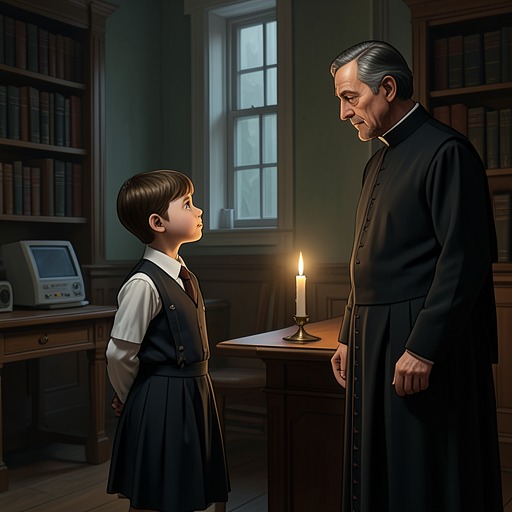
Frank confronts Canon Reilly over catechism class
The Greatest Beer Run Ever: A Memoir of Friendship, Loyalty, and WarFrank confronts Canon Reilly over catechism class when he refuses to let a parish priest detain his son on the way to the Ulster Final. The encounter turns a Sunday-morning errand into a public contest over who can command a child: the priest enforcing diocesan practice, or a father insisting that his family may continue on its way. Its lasting image is physical and absurd—the boy held by one ear, the priest by the other—but John McGahern recalls that the episode also crossed a boundary his family afterward would not name.
Background and Stakes
The confrontation begins with a promise. Francis (Frank) McGahern had promised to take John to the Ulster Final, a match he attended every year as a ritual. He arrived early on the Sunday morning in a borrowed car and proposed that they attend Second Mass in Ballinamore before setting off for Clones and finding something to eat along the way. For John, that plan carried an unexpected risk: Ballinamore’s parish priest, Canon Reilly, enforced the catechism class held after Mass.
The practice was required in some dioceses, including Kilmore and Armagh, but its enforcement depended on the priest. In Aughawillan, John knew of no such classes. Ballinamore was different. Canon Reilly stood at the church gates after Mass and sent children back to catechism, sometimes by taking them by the ear. He did not distinguish between children of his own parish and visitors, accept excuses, or leave easy gaps through which they could slip away. John therefore explained to his father why it would be better to leave early and attend Mass elsewhere on the route to Clones.
Frank initially argued that his son was not from Canon Reilly’s parish. When John explained that this made no difference to the priest, his father laughed and said they would try to get past him. The exchange sets the terms of the scene: John wants to avoid trouble and reach the match; Frank, already interested in the prospect of a confrontation, chooses not to avoid the priest’s authority.
At the Church Gates
They attended Mass at the small church at the end of Chapel Lane, among yew trees. As the congregation came out, Canon Reilly stood between the gates. Frank told John to go ahead while the crowd was still there. John tried to pass concealed among a group of men, but when he was nearly through, the priest caught him by the ear and held him while he waited to see whether other boys would follow. None did.
By the time Frank came up, the Mass-goers had gone, except for people gossiping outside the gates. He politely explained that they were on their way to the Ulster Final and had stopped to attend Mass. Canon Reilly replied that every child who came to Mass there had to attend catechism, with no exceptions, and that the journey to the match did not concern him. Frank said they would be late; the priest treated that as irrelevant. His words established an absolute rule, while his hand on the boy’s ear made the rule immediate and physical.
Frank told Canon Reilly to let go. The priest, unused to opposition, said John was going back into the catechism class and began moving him towards the church. Frank then threatened to take the priest’s ear in a citizen’s arrest, saying that the priest was preventing them from going about their lawful business. When Canon Reilly did not comply, Frank took hold of his ear. The struggle did not end at the gates: the two men proceeded through the porch and up the centre aisle, each holding the other by the ear, with John between them.
The Test and the Release
The procession stopped beneath the sanctuary lamp in front of the high altar. The church was otherwise empty apart from the catechism classes: a nun was teaching girls in one side chapel, and Master Gannon stood before the boys’ class in the other. Under the red lamp, Frank and Canon Reilly negotiated. John would join Master Gannon’s class and answer a question. If he answered correctly, father and son could leave; if he failed, the matter would have to be considered further.
The arrangement shifted the dispute from physical custody to a test of the boy’s knowledge. John was anxious because his religious knowledge was uncertain, while his father insisted on a condition of his own: the priest must never make another exception at that church, and should declare this from the altar the following Sunday. Master Gannon, visibly amused but unable to show it openly, asked John who had made the world. The question was easier than John expected. He answered that God had made the world.
Canon Reilly told them both to go before he lost control of himself. The immediate outcome was clear: John was released, and the pair could leave for the match. The scene does not establish whether Canon Reilly later made the declaration Frank demanded. What it does show is the priest’s authority meeting a limit in public. Frank does not persuade him that the rule is unjust or secure a general exemption for his son; instead, he forces a negotiation and makes his resistance visible before the remaining onlookers and the catechism classes.
Memory and Significance
John’s recollection of the day is uneven. He has a vague memory of hawthorn in blossom on the way to Clones and of waiting in town after the match while his father talked with people from Cavan, but he acknowledges that these details may belong to other years and other Finals. His pride in his father’s action, by contrast, is emphatic. As a child, he felt no sacrilege or outrage when Frank took Canon Reilly by the ear; he was proud of him.
The adult narrator also remembers what happened after the confrontation. He tried several times to raise the incident with his mother, Pat, and Maggie, but each attempt was ignored. He cannot say what they said among themselves. They would all have known about the strange procession down the aisle, and he believes they must have felt that a dangerous boundary had been crossed. The family’s silence leaves the episode unresolved beyond its immediate comic victory: the boy gets away, but the adults do not openly interpret what his father’s defiance means.
The reversal depends on the scene’s exact geography and gestures. At the gates, Canon Reilly controls passage and holds the child; inside the church, Frank answers that grip by taking the priest’s ear, and the pair move together through the sacred space. The father’s challenge does not abolish the catechism rule; it makes the priest submit the boy’s release to a question whose answer John knows. In retrospect, the episode stands out not simply as a successful escape from class, but as a rare, public instance of Frank opposing an authority accustomed to being obeyed—and of a son witnessing that opposition with delight.