Ireland in the 1950s
The Greatest Beer Run Ever: A Memoir of Friendship, Loyalty, and WarIreland in the 1950s appears in John McGahern’s memoir as a country of departures and tight boundaries: hundreds of thousands left for work, while the Church and State shaped education, public life, and private choices. The decade’s national rules did not erase the force of local loyalties, but they made the institutions through which people sought work and education powerful arbiters of what lives could be lived at home.
Emigration and the silent generation
In the 1950s, half a million people emigrated from Ireland, more than in any other decade of the twentieth century; nearly all went to Britain. McGahern describes many as young, poorly educated, and unprepared for what awaited them. The boat trains filled, and the vessels that carried emigrants to Liverpool were scarcely better than cattle boats—one even carried cattle in its hold. The scale of departure became part of the national consciousness, but the people who left were, in his account, a silent generation, disappearing without much public notice.
Work abroad was divided along gendered lines: men sold their physical strength, while women were expected to endure long hours. Some returned for the summer. Men spoke in pubs about abundant overtime; some women came back with English husbands. Jokes about ticketless men hiding in train lavatories, or an emigrant travelling as far as his body could stand, gave comic form to a departure that was often economically compelled. The humor does not undo the hardship; it shows how ordinary the prospect of leaving had become.
Emigrants were also judged by a successful class closely linked to the Church, as if seeking work in Britain were a moral failing rather than a consequence of conditions at home. McGahern places his own entrance to St Patrick’s Training College in 1953 against that contrast. Teachers in Ireland were paid better than teachers in Britain, and the college attracted some of the country’s strongest students. Training offered him a rare route to a secure livelihood at home, away from the trains and boats carrying other young people abroad.
Church, State, and social constraint
By 1950, McGahern says, Ireland had become a theocracy in all but name. The Church controlled nearly all education, hospitals, orphanages, juvenile prisons, and parish halls; Church and State worked together. This influence reached beyond formal religious observance into employment and family life. In public service, women and single men occupied a lower pay scale than married men. Divorce was unavailable, and artificial contraception was outlawed. McGahern also records the use of pelvic-bone breaking in difficult births, believed by its practitioners to accord better with Catholic teaching than Caesarean section because it seemed more natural.
The period’s public language encouraged caution. Familiar sayings advised people to keep their mouths shut, think without saying what they thought, and listen more than they spoke. Irish-language learning could be promoted as protection against foreign influence, while catechism was taught in English. The contrast exposed the uneven purposes of official culture: language policy could serve national distinction, while religious instruction remained central to everyday education.
The effects of this order could be seen later in the treatment of teachers. When The Dark was banned in Ireland in 1965, McGahern returned to his school in Dublin and was barred from the classroom by the manager’s order. In the ensuing public controversy, the Minister of Education defended the Church’s course of action; former St Patrick’s trainees wrote to McGahern about having lost teaching posts after offending a bishop or priest or violating Catholic doctrine. These later episodes do not describe the decade itself, but show how the institutional authority that had shaped the 1950s could still determine whether a trained teacher was allowed to work.
College discipline and educational opportunity
St Patrick’s Training College offered opportunity within a closely supervised institution. Run by the Vincentians, it gathered students mostly between seventeen and twenty, along with a few older university graduates. Some places were reserved for Irish speakers from Gaeltacht areas, who had studied through Irish at preparatory colleges. Many entrants through open competition had won county scholarships, an exceptional achievement when most counties offered only two.
The college’s rules made its discipline concrete. Students could leave the grounds on Wednesday and Saturday afternoons and all day Sunday, but had to return for meals and Evening Devotions and be inside the walls before the ten o’clock closing. A student who arrived late had to enter through the president’s house and give a plausible explanation; repeated lateness could mean expulsion. The remembered story of a boy who climbed the wall after a dance, throwing his trousers over the curved barbed wire to avoid damaging them, ends not in leniency but in his disappearance from the college the next morning. Education opened a way into secure employment, yet the institution guarded that opportunity through surveillance and threat of exclusion.
Local worlds and national belonging
For all the reach of Church and State, McGahern stresses that people lived in small, intense communities whose character could change over only a few miles. Local attachments often mattered more than national identity. Emigration therefore meant more than relocation: the communities people had left could remain more real to them than the places where they worked and raised children with unfamiliar accents. The distance between home and destination produced a hidden bitterness, sometimes expressed openly.
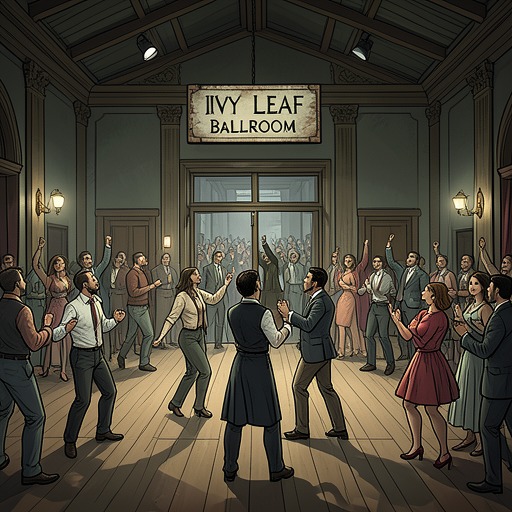
The country’s official claims could also sit lightly on local life. McGahern describes people as continuing sensible, largely pagan ways of living beneath the public conformity expected of them. The success of Patsy Conboy and his ballroom stood as an example of local culture’s strength. Church- and State-aligned institutions were among the most affected by the national order, but the force of that order did not make every community identical or every person inwardly obedient.
Authority in everyday life
The decade’s structures were visible not only in national policies and colleges, but in routine acts of authority. In a Garda notebook shortly before his retirement, Francis (Frank) McGahern recorded that in 1958 he had stopped his car on the Cootehall bridge and sounded the horn until Pat Moore, standing with his bicycle and talking to a couple, moved to the correct side of the road. John McGahern judged the intervention unnecessary: another guard would likely have waved or stopped to talk, and there was no danger to anyone. Pat Moore moved because it was easier and kept the peace.
The small incident makes authority legible at street level. The sergeant’s uniform and command could turn a trivial road encounter into an instruction that had to be obeyed; after retirement, he could no longer rely on the uniform’s protection and stood as another man among men. Set beside the college’s curfews and the Church’s influence over employment, the notebook entry shows how institutional power could be carried into ordinary conduct—and how its force depended on the office and uniform that backed it.