John McGahern and Susan McGahern’s mother–son relationship
The Greatest Beer Run Ever: A Memoir of Friendship, Loyalty, and WarJohn McGahern and Susan McGahern’s mother–son relationship is the emotional center of his childhood memories: a closeness built in shared walks and small acts of care, broken by illness and enforced separation, and preserved in the adult narrator’s account as a source of lasting security. The memoir presents that bond not as uninterrupted comfort but as something repeatedly tested by absence, secrecy, and the mother’s illness.
Identity and Early Companionship
When John was three, he lived with Susan and his paternal grandmother in a small rented bungalow outside Ballinamore. His father was stationed as a sergeant in Cootehall, twenty miles away, so the ordinary pattern of the boy’s life was shaped by his mother’s presence. She took him along the lane to Lisacarn School, where she taught with Master Foran. They walked when the weather allowed; in rain, they waited beneath trees for a lift. The route passed a drinking pool for horses, house gates, and banks crowded with wild flowers.
Susan named the flowers as they walked, and sometimes they gathered them for jamjars. The adult narrator remembers the lane as more than a route to school: in rare later walks through similar lanes, the present landscape and the lost childhood path briefly seemed to become one, bringing an intense sense of peace and security. He associates that feeling with a time when his mother’s company made the surrounding world habitable. His recollection also preserves childhood vulnerability rather than idealizing it: he was too young to learn much at school, and once had to be carried back to Susan after sitting on a nest of ants. The small embarrassment belongs to the same shared world as the flowers and walks.
Separation, Illness, and Longing
The closeness was disrupted when John developed whooping cough. His paternal grandmother, fearing infection among the other children, confined him in her room and locked the door when she left. Susan had to continue teaching, and for weeks mother and son could not be together. John called to her through the locked door; even the Rosary was said with the door between them. Susan urged him to be patient and pray until he recovered and could walk to school with her again. The episode makes separation concrete: it is not a chosen withdrawal but a confinement the child cannot understand or end.
A local folk cure brought a brief, strange interruption to that confinement. Late one cold night, a neighbour brought a donkey or similar animal to the back door, and John was passed beneath it three times. He remembers the frost on the ground and the stars overhead, but the most consequential part of the episode was being restored to his mother and walking with her again. The memory closes not on the ritual but on reunion, showing how completely his sense of relief depended on her return.
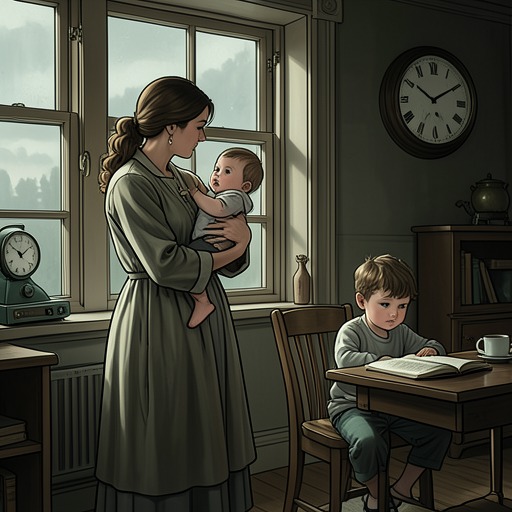
A more serious separation followed Susan’s breast-cancer diagnosis. During the family’s first long stay in the barracks, John was seven; he and the other children did not know where their mother was or what had happened to her. Their father told them not to ask and to pray. Susan, writing from the Mater Hospital in Dublin, recognized that John was beginning to understand more than the others and could not be put off as easily about her whereabouts. Her letter also looked toward recovery and a return home. The contrast between the children’s enforced uncertainty and the mother’s direct communication reveals the cost of the secrecy surrounding her illness.
Susan came back briefly after treatment, then left again while the children still did not know where she had gone. John retains little memory of that short stay, apart from a vague, almost delirious happiness. What remains sharp is the journey in his father’s car to bring her and the new baby home from a nursing home in Boyle: Susan carried the baby in a white shawl, while the adults laughed about the baby and the driver having red hair. Soon afterward, she was gone again, and the baby was left with Bridgie McGovern. The memoir’s unevenness of recollection matters here: intense attachment does not guarantee a complete record, and the child’s confusion is registered in what he cannot remember as well as in what he does.
Reunion and a Shared Future
When Susan was gradually returning to teaching and the family home at Corramahon was made habitable, she asked that John come to live with her for the first week. Uncle Pat drove him from the barracks to Aughawillan. The boy could scarcely take in his surroundings; when he saw Susan, he first drew back, overcome by self-consciousness, and then ran into her arms. Maggie teased him for losing his words, and he felt ashamed of weeping. The sequence gives the reunion its full measure: longing first makes him hesitate, then breaks through restraint. A fire burned in the open hearth, tea was made, and a cake had been brought from town. Domestic welcome follows the embrace, restoring the household in ordinary, tangible forms.
The period alone with his mother also gave their closeness a shared imagined future. Susan spoke of the hospital and of two trained singers who had been patients in her ward. She had befriended Mrs Flanagan, whose son Paddy was a priest, and from that friendship took shape a hope that John might become a priest. He adopted the idea and elaborated it: after ordination he would bless his mother, live with her in the priest’s house, and say Masses for her after her death until they were reunited in heaven. The imagined future centered on continued care, even beyond death. It excluded his father and sisters, a limitation the adult narrator recognizes, and he cannot finally separate his mother’s hope from the child’s own desire. When Susan asked whom he loved most, John answered that he loved her most; she was pleased but corrected him, insisting that this was not right.
Their bond was also expressed without grand declarations. On a walk to collect milk, Susan gave him her free hand, and he swung it as they walked beneath a pale moon. The night, the road, the lake, and her restored presence combined in his memory with the certainty that they would never die. When his chattering grew wild, she placed her fingers on his lips in affectionate reproof. At home they fed the fire, drank tea, ate bread and jam, and said the Rosary. These repeated gestures—walking, holding hands, correcting, praying—make the relationship legible through shared rhythms rather than through explanation alone.
Memory, Loss, and Lasting Significance
The memoir also distinguishes between childhood experience and the evidence later available to its narrator. John’s sisters Rosaleen, Margaret, Monica, and Dympna helped read and correct the manuscript, assisted with letters, and brought two important scenes back into the light after they had slipped his memory. His account of Susan is therefore shaped both by remembered sensations and by family members’ later contributions. The admissions of gaps do not diminish the relationship; they show how its history had to be recovered from scattered memories and surviving correspondence.
The final meaning of the bond becomes clearest against Susan’s absence. On the day she died, Margaret and Monica were kept at school and intercepted before reaching home; they were taken to Brady’s house and did not understand what had happened. Years later, John describes the love Susan gave as a hidden strength that helped the children withstand the worst years. That retrospective judgment connects the early lane walks, the locked-room separation, the reunion at Corramahon, and the unfinished dream of a shared religious future. Her protection could not prevent illness or later hardship, but the security he experienced with her remained part of the family’s inner resources after she was gone.