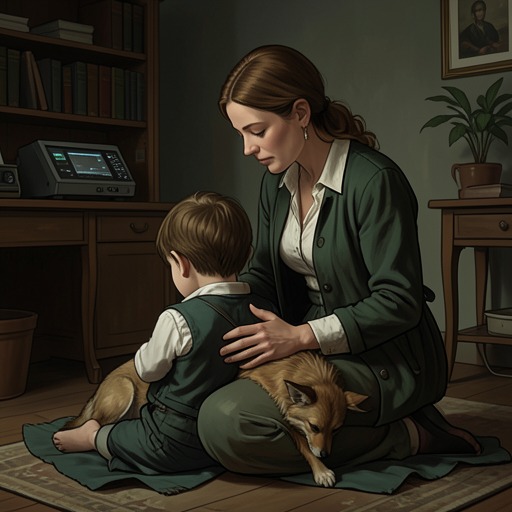
Katie
The Greatest Beer Run Ever: A Memoir of Friendship, Loyalty, and WarKatie is a domestic worker whose care sustains the McGahern children through Susan’s illness and the upheaval of life in Cootehall. She keeps the household going and tries, cautiously, to shield the children from their father’s rages. Her story turns on the difference between caring for a family and having the power to protect it: she can offer comfort and practical help, but she cannot displace the authority that governs the house.
Care during Susan’s illness
When a nurse came to the house, she was shocked by the condition of the bedroom and spent the morning cleaning and rearranging it. After consultation with Dr Dolan, the arrangements for the children changed: the baby would sleep with Katie at night, while Rosaleen and Sean slept in Susan’s room. The work of caring for their mother also became part of the children’s daily routine. At six in the morning, Susan woke Rosaleen, who woke Sean; he lit the fire, boiled the kettle, and carried hot water upstairs to help mix a white powder. Rosaleen later thought it was probably morphine. Once the nurse imposed stricter limits on visits, Sean could no longer go straight to his mother’s room after school or stay long when permitted upstairs. Katie’s care of the baby took place within this increasingly regulated household, where illness altered both the children’s tasks and their access to Susan.
A household divided between care and authority
After the family came to Cootehall, Katie remained among the few familiar parts of the life left behind at Aughawillan, along with the jennet, the white bullock, and the brown hens. She was hardworking and pleasant, and had grown especially fond of the baby. Mrs Cannon, who spent long hours visiting and gossiping over tea while Katie continued her housework, decided without consulting her to propose that Katie marry the children’s father. Mrs Cannon assumed Katie could be won over because she liked the children; the proposal ignored both Katie’s loyalty to Susan and the mutual dislike between her and their father. He was incensed, in part because he regarded Katie as a maid and looked down on her.
The narrator describes Katie as having partly taken over Susan’s role of protecting the children from their father’s anger. Her methods were indirect: she moved them out of his way, scolded them herself to divert his attention, comforted them, and let her disapproval show. Her position, however, was weaker than Susan’s. Katie’s growing social life in Cootehall also fed the father’s resentment. In Aughawillan, when Susan was ill and harassed, Katie had seldom left the house except for Mass and an occasional dance or concert. In Cootehall, she went out most nights, leaving the baby with the girls. Her connection with Peter McLoughlin sharpened the tension. Peter and his brother were independent small farmers, too proud to work as day labourers for Katie’s father, and therefore outside the influence he preferred to exert over those around him. The narrator also suggests that the father resented Katie because he associated her with Susan and Susan’s relatives, and believed she knew too much about him.
Departure and return
During one of his rages, the father threatened Katie physically. She warned him that striking her would have consequences and said she would not stay if things continued. He answered that no one would dictate what he could do in his own house and told her she could leave whenever she wanted. Although Katie did not want to go, she eventually had no choice; Pat McManus (uncle) came to take her home in a hackney car.
Her departure did not end the household’s need for her. The father placed advertisements that combined his search for a domestic worker with a search for a wife, but the women who came proved unsuitable. Katie remained willing to return: she was fond of the baby, attached to Susan’s memory, and interested in Peter. The father stubbornly refused to have her back until the house became so chaotic that he had to turn to Maggie. Maggie made face-saving arrangements that allowed Katie to return without requiring him to admit defeat.
The limits of her second stay
The children were overjoyed when Katie came back, and some practical conditions improved. The large living room became cleaner and more orderly; the small range was kept alight; meals became more regular; and the children had clean changes of clothes. But a more orderly home did not mean a safer one. The account indicates that Katie’s return was conditional: she had complete charge of Dympna and Frankie, but was not to interfere with their father’s authority over the others. When the older children were beaten, Katie comforted them privately, yet no longer tried to protect them during his rages. She bent over her work, turned away, or went outside.
Her social life continued under this arrangement. On most nights she changed into her good clothes and went out to the village, often to Gilligan’s, where there was music and dancing and Peter was with her. He no longer came near the barracks. Sean sometimes asked whether Katie and Peter would take him out on the river in the Tarred Boat again; Katie smiled and turned aside the invitation, and he eventually learned not to press. Later Peter went to England, and Katie left soon afterward. By then she had spent nearly two years in the household during her second stay. The children remained fond of her, but her presence also helped make Dympna and Frankie into a younger, different family from the older children, a division that became more pronounced over time.
Narrative significance
Katie’s care is practical, sustained, and sharply limited by her place in the household. She performs the work of feeding, cleaning, and caring for a baby, and she tries to interrupt the father’s violence without directly challenging his command of the house. The contrast between the improvements after her return and the older children’s continued exposure to beatings prevents domestic order from being mistaken for protection. Her departures mark the cost of a system in which she can be useful to the family but is denied the authority to act on the children’s behalf; even her return depends on a compromise arranged by Maggie and enforced by the father’s terms.