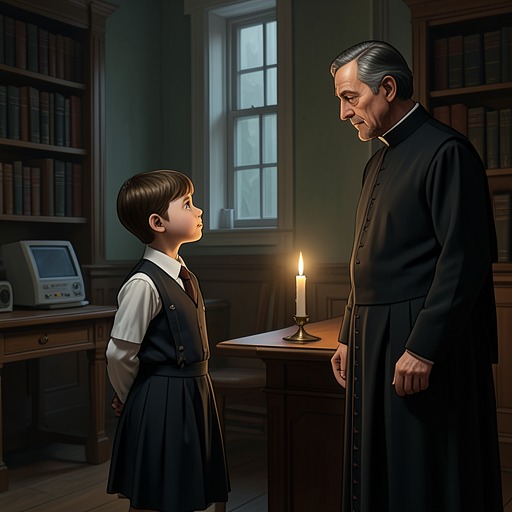
Kilmore Diocese's requirement for catechism classes after Mass
The Greatest Beer Run Ever: A Memoir of Friendship, Loyalty, and WarKilmore Diocese's requirement for catechism classes after Mass made Sunday religious instruction a duty for teachers in some dioceses, but its practical reach depended on the priest enforcing it. In Ballinamore, Canon Reilly’s uncompromising efforts to return children to class transformed a parish rule into a contest at the church gate—and, when John McGahern tried to avoid the lesson, brought his father into direct confrontation with the priest.
Scope and Local Enforcement
In certain dioceses, including Kilmore and Armagh, teachers were required to conduct catechism classes after Second Mass on Sundays. The requirement was not applied uniformly: its rigidity varied with the priest. In Aughawillan there were no classes, but children in the surrounding area knew that attending Second Mass in Ballinamore meant being expected to stay for instruction.
Canon Reilly enforced the rule personally. He waited at the church gates and, if a child tried to leave, would take the child by the ear and deliver them to the catechism class. He accepted neither excuses nor arguments, and the rule applied even to children from outside his parish. By closing the gaps around the church, he made it difficult to slip past him. The gate thus became more than the entrance to a building: it was the point at which an obligation backed by church authority was made bodily unavoidable.
The Attempt to Avoid Class
John McGahern explained the problem to his father and proposed leaving early to attend Mass at another church on the way to Clones. His father initially observed that they were not from Canon Reilly’s parish, but agreed to try their luck. After Mass in a small church at the end of Chapel Lane, he told John to move ahead while there was still a crowd.
John tried to pass unnoticed among the departing men. When he was nearly through, Canon Reilly caught him by the ear and held him while he checked whether any other boys were attempting to leave. The tactic failed: the crowd dispersed, leaving John detained at the gate. His father joined him after the other worshippers had gone, turning a child’s attempt to evade Sunday instruction into a confrontation between two adults accustomed to asserting their authority.
Confrontation at the Church Gate
John’s father ordered Canon Reilly to let go of his ear. The priest insisted that the boy was going back to catechism, and began moving him toward the church. His father answered that he would make a citizen’s arrest if the priest continued to hold John and prevent them from going about their lawful business. When Canon Reilly did not comply, John’s father took hold of the priest’s ear.
The two men proceeded through the porch and up the church aisle in an extraordinary physical standoff: Canon Reilly held John by the ear, while John’s father held the Canon by his. They arrived beneath the sanctuary lamp, in front of the high altar. The church was otherwise empty apart from the catechism classes: a nun taught the girls in one side chapel, and Master Gannon stood before the boys in the other. The rule had pulled a dispute over one child’s attendance into the church itself, before the classes it was meant to secure.
Negotiation and Significance
Under the sanctuary lamp, the two men agreed on a test. John would join Master Gannon’s class and answer a question; if he succeeded, he and his father could leave, while failure would require further consideration. The arrangement made John’s uncertain religious knowledge the immediate condition of his release. The account records the terms of the negotiation, but does not establish here how he answered.
The scene sits within a life ordered by religious practice as well as clerical authority. Prayers marked the day, from the Angelus at noon to the Rosary at night, and church ceremonies introduced John to beauty, sacrament, and mystery. He understood the Church as an authority beyond his father’s violence and control. Yet at Ballinamore the obligation of catechism was enforced through capture and physical pressure. That contrast gives the rule its significance in the memoir: religious life could provide a source of meaning and a counter-authority to domestic power, while local enforcement could also make doctrine an instrument of coercion.