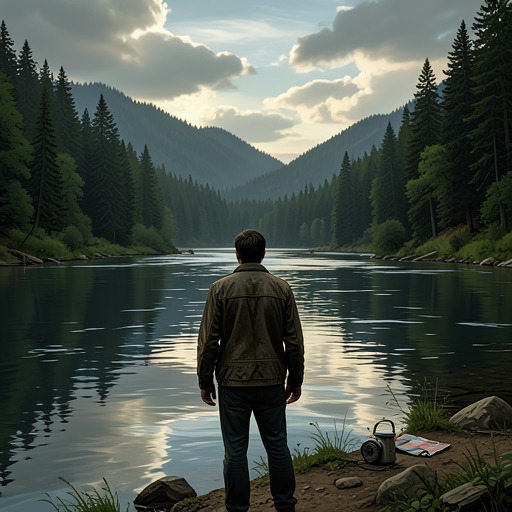
Oakport
The Greatest Beer Run Ever: A Memoir of Friendship, Loyalty, and WarOakport is more than a rural backdrop: its lake shore, woods, and river passages give shape to the narrator’s encounters with his father, his growing independence, and the first stirrings of his writing life. Its ruined estate features carry traces of an older order, while its water and reeds become a place of work, recreation, and, finally, solitude. The landscape connects family decisions to the narrator’s private ambitions without resolving the tensions between them.
Estate and Setting
The route into Oakport passes along a broken stone avenue once used by carriages travelling to Oakport House. Its great iron gates have fallen onto the damaged stones. Beyond the wall are tall trees and broad fields of short grass; nearby, Nutley’s boathouse stands over the lake. The scene holds together signs of former grandeur and present disrepair, while the lake, gulls, and dark woods remain vividly active around them. Oakport’s physical character is therefore not simply that of an abandoned estate: it is a working landscape and a place the narrator continues to encounter from the water.
The lake shore also gives the landscape its changing light and sound. During the evening hunt, a red sun sinks toward the woods and streaks the lake with red and orange. On another day, the wide water glistens in the brightness as a boat crosses it. From the village, the hounds at Oakport House can be heard as they are about to be fed; from the narrator’s solitary journeys, the same evening howling becomes part of the landscape’s familiar pattern. Oakport is made from such contrasts between distance and nearness, quiet and noise, and the estate’s remembered past and its continuing life.
The Hunt and a Family Decision
The evening before he is due to return to Aughawillan, the narrator accompanies Francis (Frank) McGahern to Oakport to shoot rabbits. His father has almost run out of ammunition and gives the narrator the three shells he has left to carry. They move silently beside a high wall until they reach a break in it, where the father signals that they should wait. As the light weakens, rabbits emerge to graze in the fields. The father tries to line up two for one shot; after the rifle fires, he calls for the narrator to run and retrieve the wounded rabbit, then kills it with a single stroke of his hand.
The walk back, with the rabbit carried between them, brings the outing to its real consequence. Near the stone piers and fallen gates, Francis asks whether the narrator would consider coming to live with him in the barracks. The narrator’s first concern is what will happen to the others. His father says they will remain in Aughawillan and that everything there will stay as it is. Later, crossing the bridge into the village, they hear the hounds at Oakport House across the lake. Francis becomes less pressing and asks the narrator to think before deciding, but also tells him not to reveal their conversation because women might misread it. The landscape thus marks the setting of a private proposal, not its resolution: the narrator is left to weigh a possible change in home and family life.
Water, Work, and Companionship
Oakport’s lake and river routes give the narrator a freedom that is negotiated against the demands of home. When he takes Katie McManus and Peter McLoughlin out in the boat, he is pleased to have their company and sees their presence as helping secure permission for the Sunday trip. Peter rows while the narrator fishes and Katie holds a line. They pass the black and red navigation pans at the Gut and enter the shade of Oakport Woods. The boat is moving too quickly and too far into the current for a likely catch, so the narrator asks Peter to slow and draw closer to the reeds and drowning leaves. They examine the timber platform above the Gut, where boats on the River Shannon were loaded and trolleys carried timber from the sawmill deep in the woods. They reach Tohran’s Island without catching fish.
In later summers, the river journey becomes more solitary. After drawing saved turf to the road by jennet and cart, the narrator has earned a measure of bargaining power: he can go out alone so long as the freedom is not made too visible. He sets nightlines for eels and rows as far as Knockvicar; sometimes one of the girls comes to help hold the lines. When they have coins, they buy biscuits and fizzy lemonade there, stretching out the small treat before rowing home. His father approves of the fish, which cost nothing and, in his view, are good for his health. But the narrator’s attachment to the river exceeds its practical value. He comes to love its navigation signs, reeds, lilies, wildfowl, islands, and changing light, as well as the clear, cold spring well and the wild mushrooms gathered in the woods. Above all, the river lets him be completely alone.
A Place of Reading and Vocation
That solitude becomes the setting for an inward change. After the family loses the convent-laundry turf contract, the narrator is the only one using the barrack boat. On days when he does not fish, he rows into an inlet among the reeds and drowning leaves and reads. Coming out of a book, he notices the drone of flies, a fish’s sudden splash, the saws working deep in Oakport, and distant sounds from the farms. These details do not interrupt his reading so much as surround it: the river offers a sustained interval in which a new idea can gather force.
Over many days and months, the narrator begins to imagine that a writer might live many lives by creating them, rather than choosing only one profession. The thought first forms in the boat beneath the dark Oakport woods, although he has no clear knowledge of how books are made. It competes with his long-held hope of becoming a priest and with his promise to say Mass for his mother. When he later accepts a call to teachers’ training college, he recognizes that its short teaching hours, long holidays, and financial security will leave room for writing. He tells no one that this is his real reason for going. The dream that took shape among the reeds has not yet become a practical plan, but he describes it as having set him free.
Oakport also remains part of the narrator’s imaginative geography beyond the river journeys. In London in 1954, an orange moon above Whitechapel recalls the moons of Gloria Bog and Oakport. The remembered landscape briefly accompanies him away from home, linking the distant city to places formed by childhood experience. Across these episodes, Oakport’s importance lies not in a single revelation but in its recurring roles: estate ground for a father-and-son encounter, shared water for fishing and companionship, and a private landscape in which reading opens a way toward a life of writing.