Susan’s cancer hospitalization and the children’s separation from her
The Greatest Beer Run Ever: A Memoir of Friendship, Loyalty, and WarSusan McGahern’s cancer hospitalization and the children’s separation from her turned an unexplained absence into a prolonged childhood encounter with illness concealed and only partly understood. Diagnosed with breast cancer, she spent weeks in the Mater Hospital in Dublin for tests and treatment; she returned briefly for the birth of Dympna, then left again, leaving the children in Cootehall without knowing where she had gone. The memoir presents the separation not as a single departure but as a recurring rupture, shadowed by Francis (Frank) McGahern’s private inquiries and Susan’s later fear that the cancer had returned.
Removal and Uncertainty
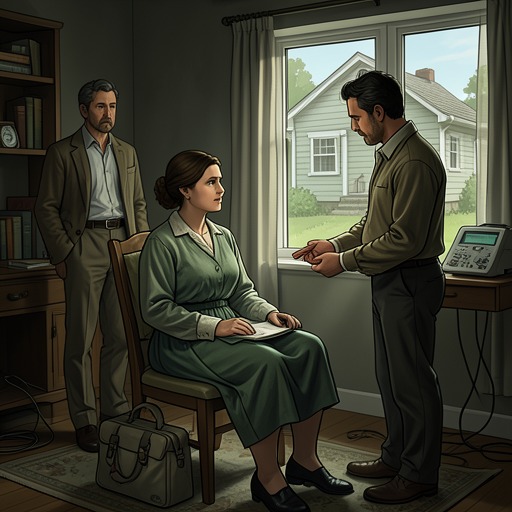
A few weeks after the family’s visit to Beaghmore, Susan had to go away. The children were not told why. She asked them to behave, cause no trouble, and pray for her; the grave, closed faces of the adults offered no explanation. The house above the bog was shut, and the five children and Bridgie McGovern were moved to Cootehall barracks, where they joined Francis (Frank) McGahern and the maid.
The children’s new rooms had been uninhabited for so long that their voices echoed when they shouted. The noise soon irritated Francis (Frank) McGahern, who roared up from the dayroom for them to be quiet and remember they no longer lived in a field. The move thus brought the children physically under their father’s direct rule at the same time that their mother’s whereabouts became a forbidden subject. When they asked about her, they were told not to ask and instead to pray to God.
The narrator was seven during this first long stay at the barracks. In retrospect, he describes the household’s secrecy as characteristic of his father, while noting that Susan herself was unhappy with it. From the Mater Hospital in Dublin, she wrote that Sean was beginning to understand more than the others and would not be put off as easily about where she was. Her letter also expressed hope that she would soon be home, and that looking forward to returning was helping her get better.
Diagnosis and a Brief Return
Susan had been diagnosed with breast cancer and remained in hospital for several weeks of tests and treatment. She came back to the barracks briefly for the birth of Dympna. The narrator recalls the return as a vague, delirious happiness, with one sharply preserved journey: he and Francis (Frank) McGahern went in Packie McCabe’s car to a nursing home in Boyle to bring Susan and the baby home.
Private cars had been taken off the roads because of the war, and Francis (Frank) McGahern’s small Ford was resting on blocks in a barracks shed. The journey therefore depended on Packie McCabe’s car. Susan carried Dympna wrapped in a white shawl; the baby and Packie McCabe both had red hair, a resemblance that prompted laughter the child did not understand. The narrator remembers the return through these precise details rather than through an explanation of Susan’s illness: the car, the shawl, the laughter, and his mother home again.
Susan stayed at the barracks for about a week. Then she left once more, leaving the infant with Bridgie McGovern. The children still did not know where she had gone. Her brief return had not resolved the uncertainty; it had made the next departure another separation, now with a new baby remaining in their care.
Medical Knowledge and Family Silence
Francis (Frank) McGahern sought medical information beyond what the children were told. In a letter to a doctor in Dublin, he asked about the medical outlook for his wife’s case, including whether she should give up teaching and what her chances of recovery were. He had already written at the very beginning of her illness and received a detailed report. The memoir connects that prior, secret inquiry with the defensive, slightly bullying tone of his later correspondence, presenting his effort to obtain information alongside his reluctance to make the illness openly discussable at home.
The secrecy continued as Susan’s condition became harder to ignore. Around the time her letters first registered despair, she wrote that she had been back at school after several days in bed, was improved but still suffering, and feared she might have to go on suffering. She suspected the cancer had returned. Those around her instead treated her stomach pain and recurring constipation and diarrhoea as an unrelated illness from which she could recover if she made an effort. Susan asked Francis (Frank) McGahern to write to Dr Corcoran in Dublin; he was reluctant because he had already communicated with the doctor secretly.
This disparity between Susan’s suspicion, her bodily symptoms, the family’s explanations, and the medical information held by her husband gives the separation a second form: alongside physical distance, access to knowledge was uneven. Her earlier hospital stay had been presented to the children without a clear account of its cause; later, when she feared a return of the cancer, reassurance and concealment again stood between her and an open reckoning with illness.
Prayer, Care, and the Child’s Witness
Prayer was part of the framework through which the children were told to understand their mother’s absence. In the household, prayers marked the day: the Angelus stopped work and conversation at noon, and the Rosary closed each evening. During Susan’s later illness, the Rosary was said in her bedroom, with Katie bringing the narrator’s brother upstairs so that they could kneel around the bed. Religious practice offered a shared form for being with Susan even as the family’s account of her condition remained incomplete.
The narrator’s memory of religion also includes its sensory and communal forms: the small church’s ceremonies, the Stations of the Cross in Lent, and Corpus Christi processions. He later described the Church as his first book, a source of ceremony, mystery, and meaning. That history helps explain why prayer became both a response to his mother’s illness and a way of sustaining an inward connection to her. Yet faith did not remove the human pain of losing someone on whom the children depended. The memoir notes that Susan’s faith was even turned against her when Francis (Frank) McGahern accused her of losing faith in God.
The recollection also sets this separation against an earlier childhood illness. When the narrator had whooping cough, his grandmother shut him in her room and kept him apart from Susan for weeks; after a nighttime ritual in which he was passed beneath a donkey three times, he was restored to his mother and to their walk to Lisacarn. That episode ended in reunion. The cancer hospitalization returns the child to separation from Susan, but this time her departures are bound to a serious disease and to an uncertainty the household does not resolve for him.
Significance in the Memoir
The hospital episode marks the beginning of a recurring pattern in which Susan’s presence is briefly restored and then withdrawn, while the children receive instructions to pray rather than an explanation of what is happening. The boy’s sharply remembered trip from Boyle with his mother and baby sister contrasts with the indistinct memory of Susan’s short stay at the barracks; intimate details survive where the medical account was withheld.
The separation also anticipates the memoir’s later account of the world of the dying as distinct from the world of those who continue with ordinary work. As Susan’s illness worsens, the narrator seeks time alone with her after school, tells her the day’s news, and returns to her room after chores. Her illness makes everyday life newly precious to him, while the family’s silence leaves her with little space to communicate the full burden of what she is losing. The event therefore joins childhood dependence, medical uncertainty, religious consolation, and the painful limits of what a family can say to one another.